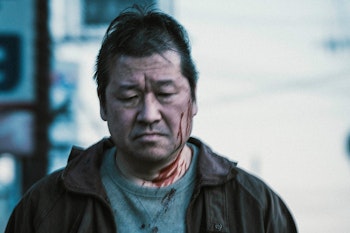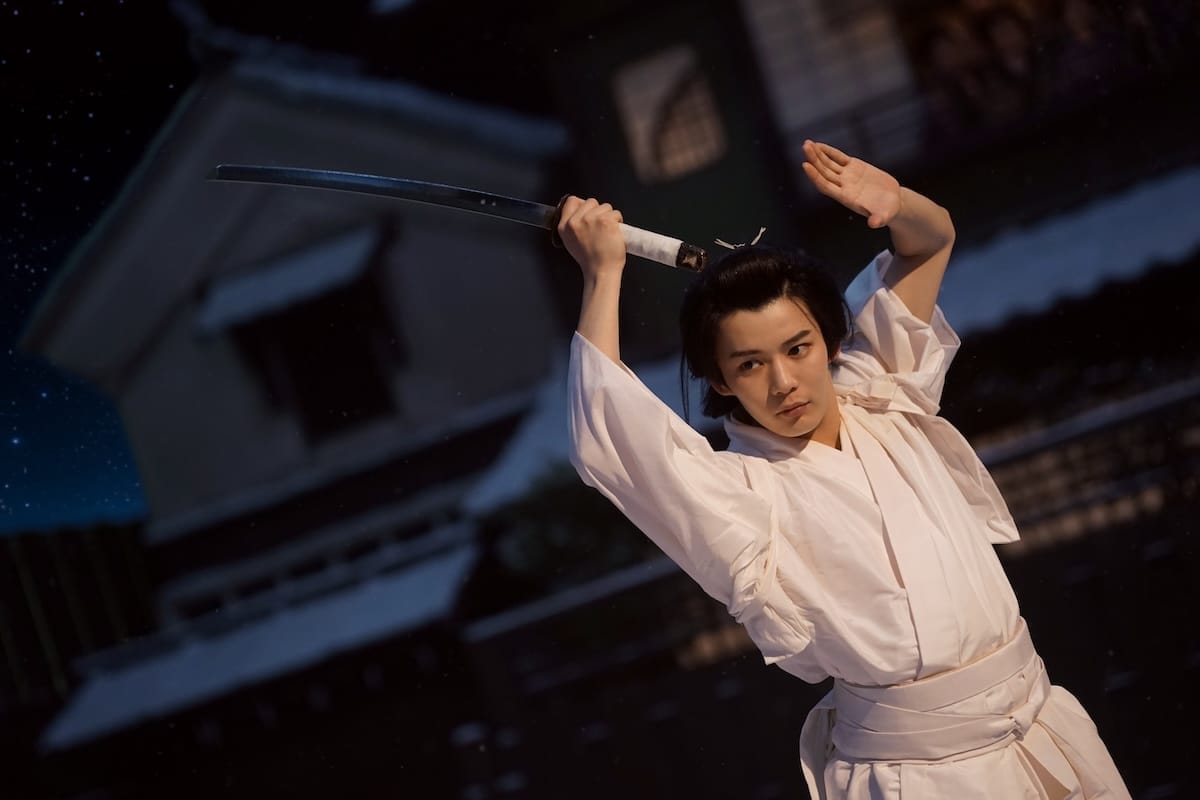
Samurai Vengeance (Kobikicho no Adauchi) certainly makes a strong and very literal first impression. In the titular district of old Edo, a rather suspicious yakuza figure steps out after a performance in an old kabuki theater, when he spots a young geisha wandering by. Taking an interest, he follows them to this empty space beside the theater, where the geisha reveals their true identity: they are no ordinary woman, but instead a seemingly familiar man in disguise. At least, the disguised figure recognizes them. The yakuza figure is a murderer, and one night they killed the man’s father in cold blood. This was a chance for revenge.
They fight, blade on blade, to the view of shocked onlookers from both inside and outside the theater. It’s brutal, blood splattering, and they fall inside of a shack in the courtyard from the force of their conflict. A few moments later, the man seeking revenge steps out. In their hand, the severed head of the former yakuza. That's what I call samurai vengeance.
Or is it? Because this opening sets the premise if not the tone for the rest of the movie, and it’s hard not to wish the film could maintain the intrigue of its opening moments throughout the rest of the feature.
The film is not a revenge, you see, but a detective story, of sorts. After this cold open the film suddenly jolts 18 months into the future where we meet the more aloof Soichiro Kase (Tasuku Emoto). He knows the man who sought revenge for his father’s death, a man named Kikunosuke (Kento Nagao), and can’t believe such a man would enact such a brutal and sudden, violent revenge in plain sight like he did, and suspects there’s more to the story. Especially considering he knows about what his father had been doing before his death.
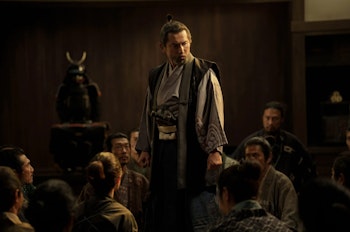
So, he’s made the trip to Edo, to the theater beside which this attack took place, to learn the truth. The core staff for the theater is small, consisting of Ippachi, a swordsman teacher named Sagara, a costume maker named Hotaru, Kyuzo, as well as the playwright Kinji, the most prominent of these characters played by the veteran Ken Watanabe. Each know more about the true events that took place that night, and with enough prodding slowly reveal their secrets as Soichiro himself reveals the true purpose of his visit and desire to learn the truth.
This turns the film away from a revenge tale centered on Kikunosuke as one would expect from the film’s opening, but instead a story about uncovering the truth of the events that took place that night from the perspective of a man who was never there. It immediately causes a major problem, that being without a connection to the night itself it’s hard to connect with Soichiro’s desire to learn the truth, especially since, once we learn his ulterior motive, his desire to learn of the case has only partial relevance to the events witnessed in the film’s opening.
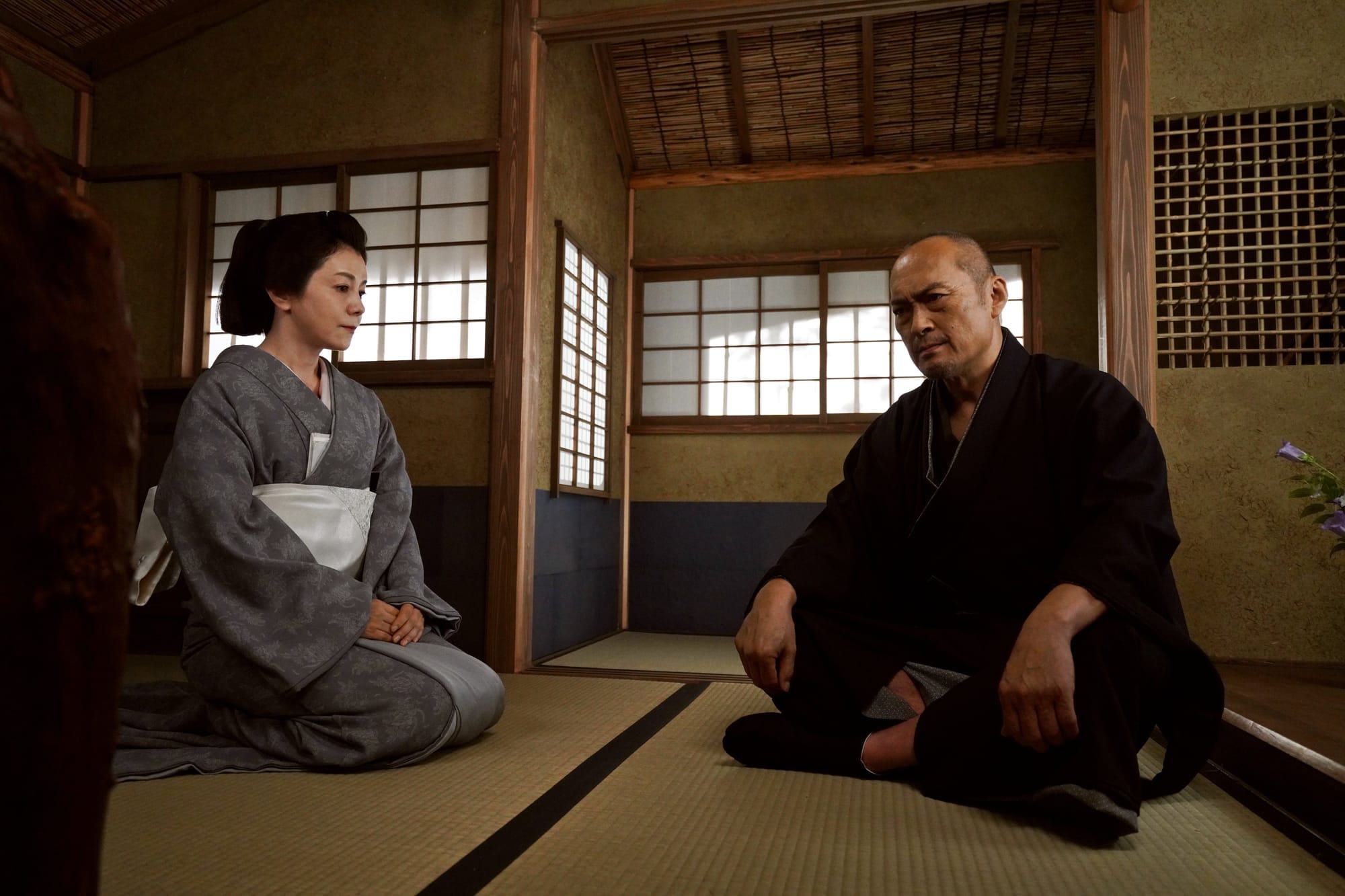
Still, the case has enough twists and turns to make the act of learning the truth not an entirely a useless endeavor, had it been handled with more care. Samurai Vengeance’s biggest issue is that, as we learn about Kikunosuke’s time working at the theater and befriending its oddball staff, it appears torn between whether it wishes to be a suspenseful drama about trust and betrayal, or a comedy of hijinks about a revenge that in a million different ways nearly wasn’t.
The concept of unearthed corruption, a man bearing the burden of a death that wasn’t their fault, and the tragic circumstances that brought the group together and must undoubtedly cause them to part, has the potential to be a fascinating and emotional character piece. Over the months where Kikunosuke was housed at the theater we see him work with the craftsmen bringing the theater’s kabuki show to life on their hidden second quest to prepare all the materials for a fake revenge, a pretend murder of a decoy that allows the man framed for the case to be liberated from the weight on their shoulders, we see new depths to everyone as the group genuinely become close friends.
Each are somewhat outcast in various ways that make the theater and the people around them a family. They’re willing to welcome this similarly-outcast figure into their world for that familiarity, as much as it makes the night of undertaking their plan where they must never meet again a painful one.
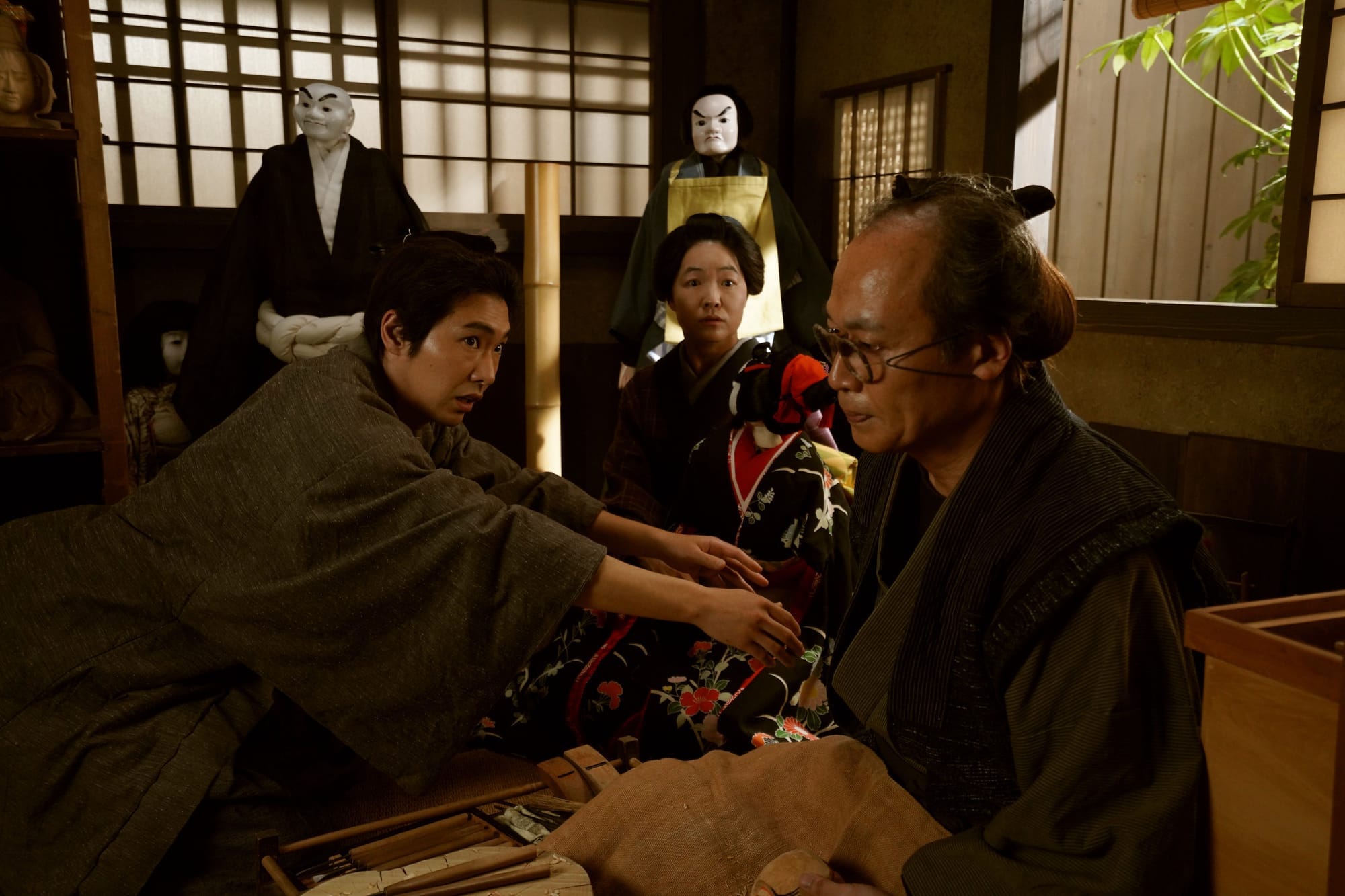
In these scenes, Hotaru and Kinji are given the most time to explore their own skeletons that make them so willing to help, revealing undercurrents to samurai society and this era that are often overlooked. Yet for every scene where these people are portrayed with depth and complexity, the film’s numerous attempts at comedy heavily undermine it.
For example, as part of conducting their plan, it’s necessary to craft a fake head that can be held aloft to show the man has been slain. Their skills make this something they can achieve with ease - they need fake heads that can be held aloft in the theater often, for the play they perform - but that doesn’t make the crafting and transporting of the head any less complicated by a series of coincidences and comedic gags. From carving the face with a funny face to transporting it while accidentally dropping it there’s tons to go wrong, all designed to get a laugh. Towards the end and while they execute the plan, it even succeeds at this. The issue is that to feels at odds with the drama and often neuters the tension and dramatic impact that could have been built when every scene includes an attempted elbow to the rib like this.
This is a constant throughout Samurai Vengeance. Whenever the intrigue on the dual truths of the murder and attempted fake revenge build, a joke will be inserted to create a farce and dampen the moment. It leaves the film stuck in an awkward inbetween. Often these jokes aren’t funny enough to classify the film as an entertaining comedy, with only one or two ever bringing even a chuckle throughout the two-hour runtime, while the actual core of this period film is undermined to the point that its ending tug at the heartstrings runs cold.
The result is a surprisingly timid and boring film despite the fact that the story never holds back throughout its runtime. A few strong performances from Kazuya Takahashi as Hotaru and Ken Watanabe can’t save the film either when its lead is unfortunately left anonymous both in terms of performance and a script that holds them back from deducing any of the truth behind what took place, the purpose of their visit in the first place. For what could have been an entertaining thriller ends up as a film uncertain what it wants to be, and thus ends up being forgotten the moment you leave the cinema.
While far from the film’s fault, it also doesn’t help the story is set amidst the world of kabuki, and for all it intersperses the craftsmanship behind these shows into the story, unfavorable comparisons to the reverence that Kokuho holds for the theater further dampen the experience. For a story set in a theater I can only hope that the audiences attending the in-movie kabuki performances were more entertained by comparison.
Discuss this article and more on the scrmbl Discord server