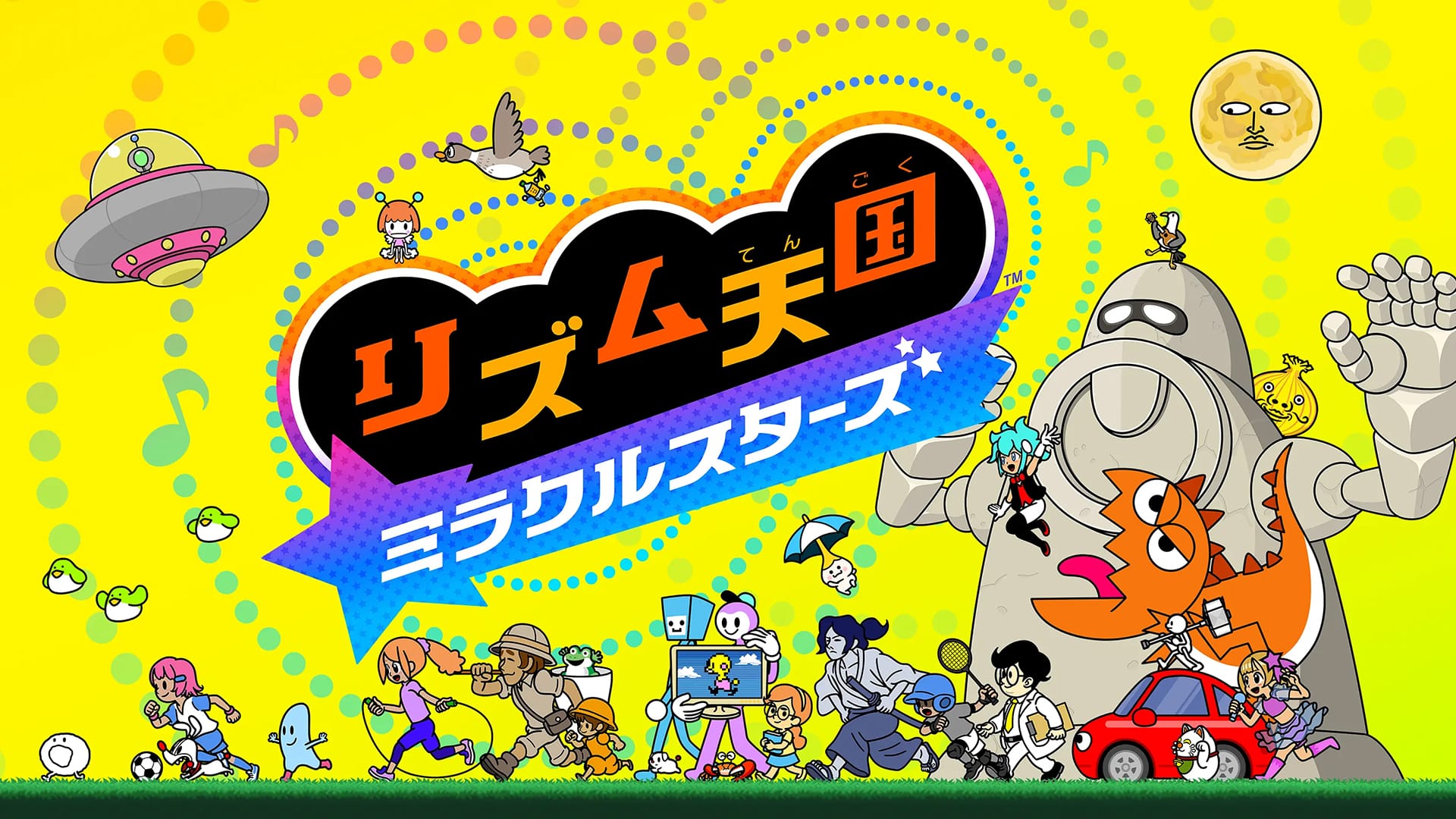
When the first Rhythm Heaven (Rhythm Tengoku) game was released by Nintendo for the Game Boy Advance exclusively in Japan in 2006, the international franchise and imitators it would spawn two decades later could hardly have been predicted. The game was merely a fun idea from the mind of music producer Tsunku♂, who worked as the game’s producer as it was fleshed out and developed by Nintendo’s E.P.D. 1, the same team who made Warioware, Inc.: Mega Microgame$ previously. He went on to work with the company and composer Masami Yone on the sound and identity of a franchise that hit arcades and numerous consoles over the coming years, and it’s this sound, more than anything, that defines the franchise as a singular property that resonates more today in a nostalgia-fueled world than it even did upon its buzzworthy original release.
So singular is its sound and identity that even those unfamiliar with the franchise will recognize and ape the title in their own projects. Beyond a slew of indie games inspired by the classic, much buzz was raised when PinkPantheress paid tribute to their love for the series and music by including audio samples and creating a music video for their song “Girl Like Me” that heavily aped the pace and tone of the franchise. Yet despite being the person who initially approached Nintendo with the idea in the 2000s, the person most often overlooked in the story of the audiovisual identity of this now-beloved Nintendo franchise is Tsunku♂, a pioneer in the sound of 1990s and early 2000s J-Pop and idol music that paints the blueprint for the identity the series still pulls from today.
Tsunku♂ first rose to prominence as the lead singer and songwriter for Sharam Q, a rock band with influences of jazz and electronica that would be carried throughout the composer’s career even after his priorities shifted from the band to broader music production. The group’s most famous song, “Zurui Onna”, is where this sound is most apparent, playing into themes of love (albeit at their end) with a bouncy drum-driven undercurrent and prominent saxaphones.
Evolving from the group’s slow rise from underground pioneers to mainstream success, the foundation of modern-day female idol agency powerhouse Hello! Project was almost a happy accident. Initially, in partnership with reality TV show Asayan, the hope was to find a new female vocalist for the group to diversify their sound. So many talents were discovered that the competition ended up serving as the instigator for the formation of Morning Musume, featuring five runners-up from the competition. Their initial demo single sold over 50,000 units in the first four days on sale, with their official debut single selling over 200,000 units.
Almost every single in the group’s early days was produced by Tsunku♂, and their sound, intense dance performances and inspirations from eurobeat and disco led to a revival and transformation of the Japanese idol industry through the lens of their performance. Numerous of their early singles, including “Ren'ai Revolution 21”, are still regarded as some of the most iconic J-pop and idol songs ever produced, shifting the industry into a more dance-infused and electronic/rock sound from the more jazz-infused undercurrents present in the 1980s.
This secondary group eclipsed the original project and Sharam Q, becoming the catalyst for the formation of Hello! Project and initiating a boom in idol groups that, through a continuous rise and fall in subsequent decades, persists today. Meanwhile, a vast majority of songs for Morning Musume, and the later groups, sub-groups, and solo projects started under Hello! Project, were written by Tsunku♂. To date, he remains one of the best-selling Japanese music producers of all-time. All while continuing to occasionally produce music with his group and create solo releases, often leading to stints in the early years of Hello! Project where numerous releases every month had some involvement by him.
He was near-inescapable - releases would often include his name on the front of the album alongside the artist - and his sound fundamentally shifted the landscape of Japanese music, particularly during his peak in the 2000s.
Rhythm Heaven was a change of pace in many ways. The first game released in the dying days of the original GBA long after the Nintendo DS’ release, and was designed more as a fun experiment with this idea from Tsunku♂ and the assistance of Ko Takeuchi who produced much of the art. The game was very unusual in the landscape of rhythm games in 2006, mostly for discarding the typical beatmaps of notes progressing along a track to play in time to music for a series of wacky scenarios that brought character to every song and setting. Devoid of a specific plot, each level presented a different scenario, such as a man performing karate or a wrestler being interviewed, who must act in time to the music and the events around them in order to proceed through the scene and clear the level.
In place of typical musical notation, the game infused motifs to clue the player into what action to perform, allowing the focus to remain on the art and scene. It was unlike anything else, but that’s what made it so compelling. Such design required precise musical tuning to make it work, which is where Tsunku♂’s experience thrives most when looking back on early titles.
While not an active member of the development team - he was simply too busy for that - his role involved more than providing a few songs. He ensured the development team got dance lessons to understand not just the music but the beat behind them, since this new direction of rhythm games required such comprehension to work. He would also, according to a prior Iwata Asks interview, offer his own guidance on core issues the team faced as well as moral support.
Of course, the music was a major factor, and when listening to the music of these games, you can hear the history of Tsunku♂’s disco-infused musical evolution come with it. If J-pop of the 90s and 2000s, particularly the hits he produced and the many derivatives he inspired, was driven by the bubbly idol persona that can shine, dance, and sing on stage as one with their fans, the game retains the infectious simplicity that these songs ensure. What makes these early levels of the Rhythm Heaven franchise, many of which have returned in future entries, so memorable is how easy they are to pick up and play not because they lack challenge, but because the underlying song is so catchy, easy to memorize and hum along to, that the performance between you and the game comes naturally. So natural, that frustration at a mistake is not the fault of any glitch, but a personal regret of losing that synchronization.
It’s impossible to split the sound of these games from the J-Pop industry he overhauled, and even with other composers in support, this underlying sound has endured. The newest entry, Rhythm Heaven Groove (the first in over 10 years), comes amidst a Y2K revival in Japan and internationally that is primed for the time capsule of energy and sound this franchise provides. Gyaru fashion, Y2K, the music of the era, and even the GBA and DS, are all part of a return to the 2000s that evokes the very era Tsunku♂ dominated and this series was born. Perhaps there’s no better time for a new Rhythm Heaven, though the game’s return is more than welcome no matter the circumstances.