Imagine you’re playing an old-school, first person dungeon crawler, like Wizardry or Dungeon Master. When you look left or right, the orientation of the world changes, to mirror how our point of view reflects our perspective. Intuitive, right? Now imagine that you are playing a top-down, third-person action game like The Legend of Zelda, but the camera still follows first person orientation. Whenever the player character turns left or right, the entire world abruptly revolves around them. That’s Brandish, Falcom’s infamous 1991 dungeon crawler.
Brandish was made at a time when game developers hadn’t figured out how to do a 3D camera yet. You could say that the game’s perspective trick was a compromise, meant to give the player control over their character’s viewpoint within the framework of a top-down action game. These days, though, the camera shift is so abrupt that it can feel nauseating. What was once a step towards realism is now a reminder that the world the player inhabits is not real, and cannot be perceived in a “natural” way.
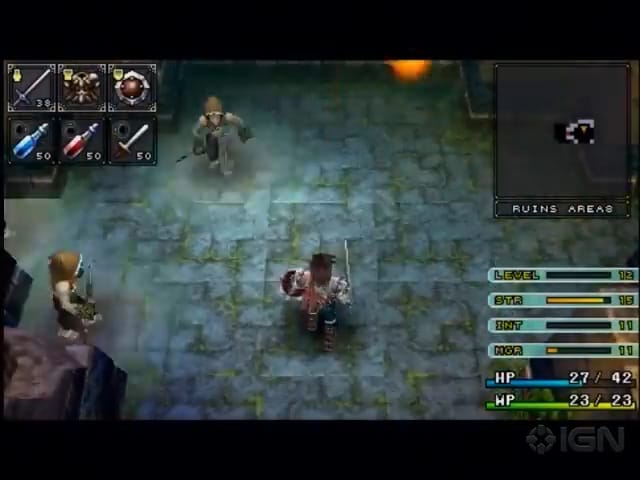
Falcom remade Brandish for PSP in 2009 as The Dark Revenant. (It was released abroad in 2015.) The greatest change that Brandish: The Dark Revenant made to the original was smoothing out its infamous perspective shift. Now when the player character Ares turns, the world rotates rather than cutting from one angle to another. Still, the player can only face in four directions, and the game retains its player-centric perspective. Brandish remains an antique.
Which raises the question: why play Brandish at all? After all, you might say, the top-down action game was “solved” in 1986 with Zelda. Nearly every game in this genre follows its example, including recent indie hits like Mina the Hollower. Only a handful of games, like the experimental RPG Maker title Pangea’s Error, mimic the abrupt perspective shifts of the original Brandish.
Unlike what some independent developers would lead you to believe, though, game mechanics are not a “solved” problem. They are choices that the developer makes. Tools in their box (or, depending on the game, torture instruments.) Brandish’s rotation mechanic is just that, a tool. So what is its purpose?
The star of Brandish is not any one character, enemy or set-piece. It is the dungeon itself: forty floors of locked doors, traps and treasure. Winning the game requires studying the environment for clues, acting on your hunches, and taking whatever you learn on one floor to solve the next. The action by comparison is just a means to an end, with weapons breaking after a set number of uses, and enemies reviving on timers. Battles are distractions to manage while you devote most of your brainpower to solving the dungeon puzzle.
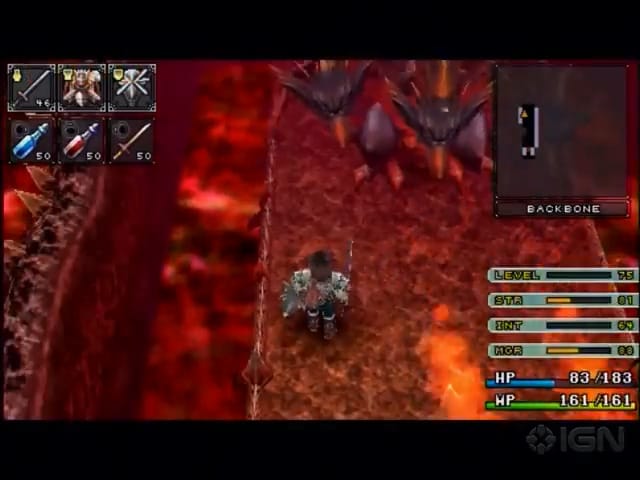
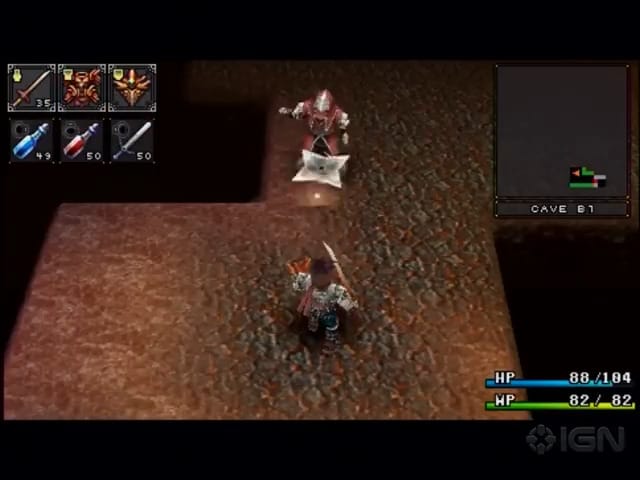
Brandish’s dungeon design is surprisingly mutable and physical from the very start. Sledgehammers break crumbling walls. Steel balls crack open pitfalls. While modern games like Dark Souls might hide optional levels behind secret passages, you cannot complete Brandish without shaping the dungeon with tools. The very first level of Brandish requires that you excavate secret passages to progress. Later levels have you taking leaps of faith across pitfall-ridden rooms while rationing your steel balls.
Brandish’s player-focused perspective might imply that the player is at the center of its universe. But I think it’s actually the other way around. The dungeon is at the center of Brandish. While it is portrayed from a 2D perspective, it is really a 3D object, like a Rubik’s Cube in your hand. You strategically shape the dungeon to achieve the best possible result. In this respect Brandish is for all intents and purposes a toy.
Other games have sought to emulate this approach through graphics. Grezzo’s 2019 remake for the Nintendo Switch of The Legend of Zelda: Link’s Awakening, for instance, rendered the pixel graphics of the original as toy-like figures. Dragon Quest VII Reimagined modeled its main characters as dolls, and its environments as top-down dioramas (just as Fantasian did a few years earlier in 2021.) These aesthetic choices though had little to do with the mechanics. Better is the famous Eagle's Tower dungeon from the original 1993 Link's Awakening, which requires that the player combine dungeon floors by smashing pillars supporting them. That is certainly closer to the heart of Brandish.
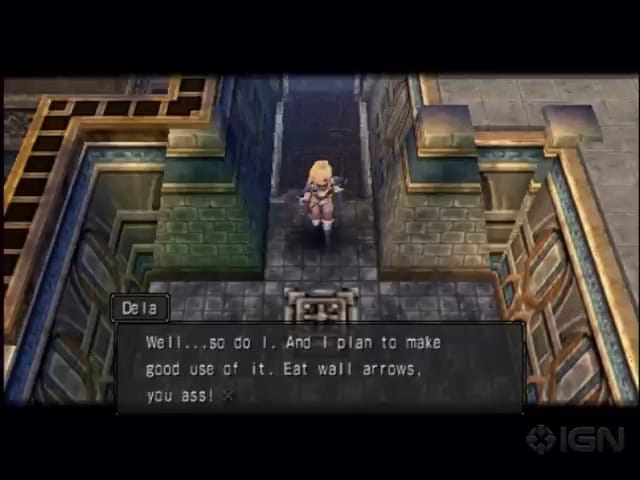
There’s still something about Brandish, though, that sets it apart. Perhaps it’s that the game is so unabashedly dungeon-centric, with little else to distract the player’s attention. The story exists to build atmosphere and not much else. The one genuinely memorable character, your adventurer rival Dela, exists for mechanical gags where she falls into holes or teleportation traps. Weapons and armor are differentiated mostly by how much damage they do or resist, while magic is limited and/or expensive. Even the signage that the player encounters along the way addresses them directly, rather than dungeon inhabitants running shops or haunting doorways.
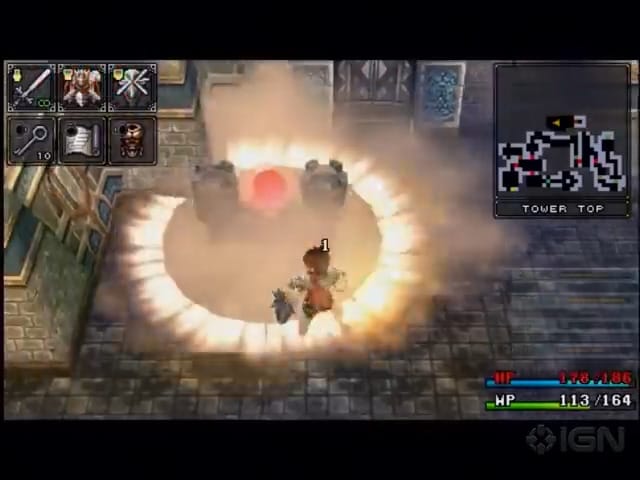
The oldest, most foundational RPGs in the genre, like Wizardry, required that the player map out their dungeons with graph paper. Knowledge was power in those games, more so than equipment or levels. Rather than carry that knowledge in your head, though, you inscribed it into reality, recreating dungeon floors on paper. In this way the virtual landscape is remade as a physical object.
The original Brandish was nicer to the player than Wizardry, in that it included an automap. Players never had to worry about where they were in the dungeon even if the game’s revolving camera angle could be confusing. Even so, the physicality of Brandish’s dungeon links it in my mind to those past mapping games. Brandish was a world that you took in your hands, turned, and reshaped, like clay. The developers want you to get your hands dirty, so long as you operate within its limited set of verbs. Verbs which benefit from choices that, from our modern perspective, might be called “dated,” “confusing” or “time-wasting.”
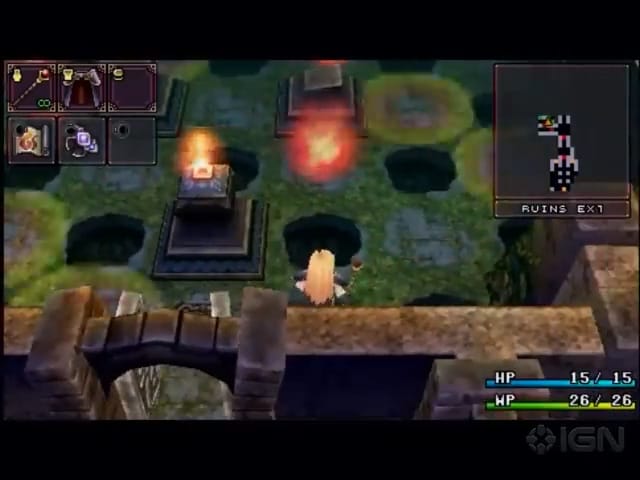
It’s a matter of taste of course. You may love or hate Brandish. What I’m asking is that you take a moment to understand Brandish. If you do, think to yourself: what other “dated” games have you set aside out of the fear that the world has passed them by? Perhaps all they need to reveal their secrets is a different angle.