Your journey used to begin with a video game cartridge and a choice for your starter Pokémon. It started with route 1 and gym badges. It started with trading cards. It started with Ash Ketchum. It came to end when you became a champion. But that’s not really true anymore. It doesn’t start or end, it exists everywhere. When you create an institution to the scale of Pokémon in 2026, something has to give, and for all that Game Freak had no idea what what was to come when the first game released in 1996, the scale it is today was surely not on the cards.
Pokémon is a lifestyle, one consisting of not just video games, an anime, and a TCG, but merchandising stores around the world, a presence at themed installations like Poképark Kanto and parks in Universal Studios in Japan and America, something that will soon grow. It’s a teaching tool, a sleep application, it has live-action Japanese TV dramas about the lessons of Pokémon in the workplace for adults and an American detective movie for kids. It’s also an investment portfolio, and a pillar of Cool Japan and soft power.
It feels a little strange to say Pokémon is 30 years old , because Pokémon today is unrecognizable not just from its conception, let alone even what it was five years ago. For better and for worse, while some fans will look back on the series with nostalgia, Pokémon is one of the few monocultures of the modern world, something it has only achieved by shedding the shackles of the past to embrace its modernity and its malleability. To become not just a trendsetter, but the ever-present. You can’t lose your status of cool when you’re simply the default.
The origins of Pokémon are a known story by this point. The idea came from Game Freak co-founder and series creator Satoshi Tajiri as a way to translate the experience he had catching bugs and creatures in the nature near his Machida home with friends through video games, eventually expanding to become what we know as the series today. It was just the latest project from a small studio who started as a doujin magazine about video games and was making modest titles for Nintendo platforms, except this one became a phenomenon.
Since then it’s only grown. More impressively, just as it’s always seemed like it was sure to reach a plateau in how many new fans it could attract, something would propel it to new heights. The widespread adoption of the Nintendo DS helped the Diamond and Pearl generation to become the highest selling until that point. In 2016, Pokémon GO became the highest-grossing mobile game in the world as its outdoor GPS-driven game to “catch ‘em all” created in-person spectacles of people coming together to catch Pokémon. Somehow, it’s declined 2024 revenue of $557million was still slightly above its launch year.
COVID propelled the card game in particular to new heights - over 10 billion of the 75 billion plus cards in circulation were printed between 2024-25. Numbers only go some way to speaking to just how all-encompassing and massive the franchise has become, far beyond any possibilities expected by a guy who merely wanted to recreate aspects of his childhood while working for a company of barely a dozen people. Amidst all this is the unmistakable presence of merchandising - retail sales for Pokémon were at $2 billion in 2014, and $12 billion in 2025. A massive growth considering that even in 2019, it was just $4 billion.
What once reflected one person’s life is now a lifestyle. This is most prominent in Japan, where baby-centered sub-brands like Monpoké exist. Where Pokémon has entered all aspects of life through mascots for rural regions of Japan and sponsored manhole covers that encourage tourism. But it’s anime and plush toys are still available globally to audiences of all ages, and new animated online shorts and apps from Pokémon Kids TV to toothbrushing aids like Pokémon Smile are intended to introduce Pokémon as a concept to kids from the youngest of ages.
Even if you don’t directly interact with it, it’s visible everywhere. It’s all-but impossible for a kid’s first experience with Pokémon to be with the games. It’s not just that you’ll have encountered Pokémon before you play a game today (if you play the video games at all - impressive games sales in 2025 of over 14 million are only a small portion of the broader financial revenue for the franchise), the omnipresence of many on-ramps to becoming a fan mean you’ll be familiar with what Pokémon means before you pick that first starter.
That’s by design. Pokémon Concierge on Netflix won’t appeal to the same audience watching the revived Pokémon TV anime. Pokémon Voltage embodies this idea. As we’ve mentioned before, the project is the embodiment of embracing Vocaloid’s cool factor to bring a new sound to Pokémon, but it’s also an example of how the franchise is willing to no longer be confined by the constraints of what it once was in order to appeal to new audiences.
Vocaloid’s style has slowly become synonymous with the mainstream of Japanese music as producers of Vocaloid music enter the mainstream. Beyond mobile games like Project Sekai even the recent Cosmic Princess Kaguya movie uses Vocaloid music and culture, resonant with audiences familiar to it and broader VTuber and online culture to become the biggest movie of 2026 in Japan so far.
The project’s been so successful that it’s received not just a second wave of music, but a live concert and even targeted merchandise specific to this particular project and the original characters spawned from it. While the project seems unusual for the series, it’s exactly emblematic of the new strategy of Pokémon. To maintain its status, it needs to reach out to audiences and evolve, not the reverse. Vocaloid’s primary audience is young, predominantly teenagers, and the exact younger generation for which gaming and franchises like Pokémon are being forced to increasingly compete with apps like TikTok for attention. For all Pokémon has always had some outlandish collaborations and spin-offs, examples like Pokémon Conquest or pinball events have typically confined themselves to gaming or remained small. This is far more ambitious.
Which speaks to why I personally find it difficult to discuss the 30th anniversary of Pokémon under the veil of nostalgia. The series hasn’t abandoned its core ideas of catching ‘em all or training and trading with friends, but it’s no longer defined by its past or nostalgia. If it was, Voltage or many other ideas wouldn’t exist.
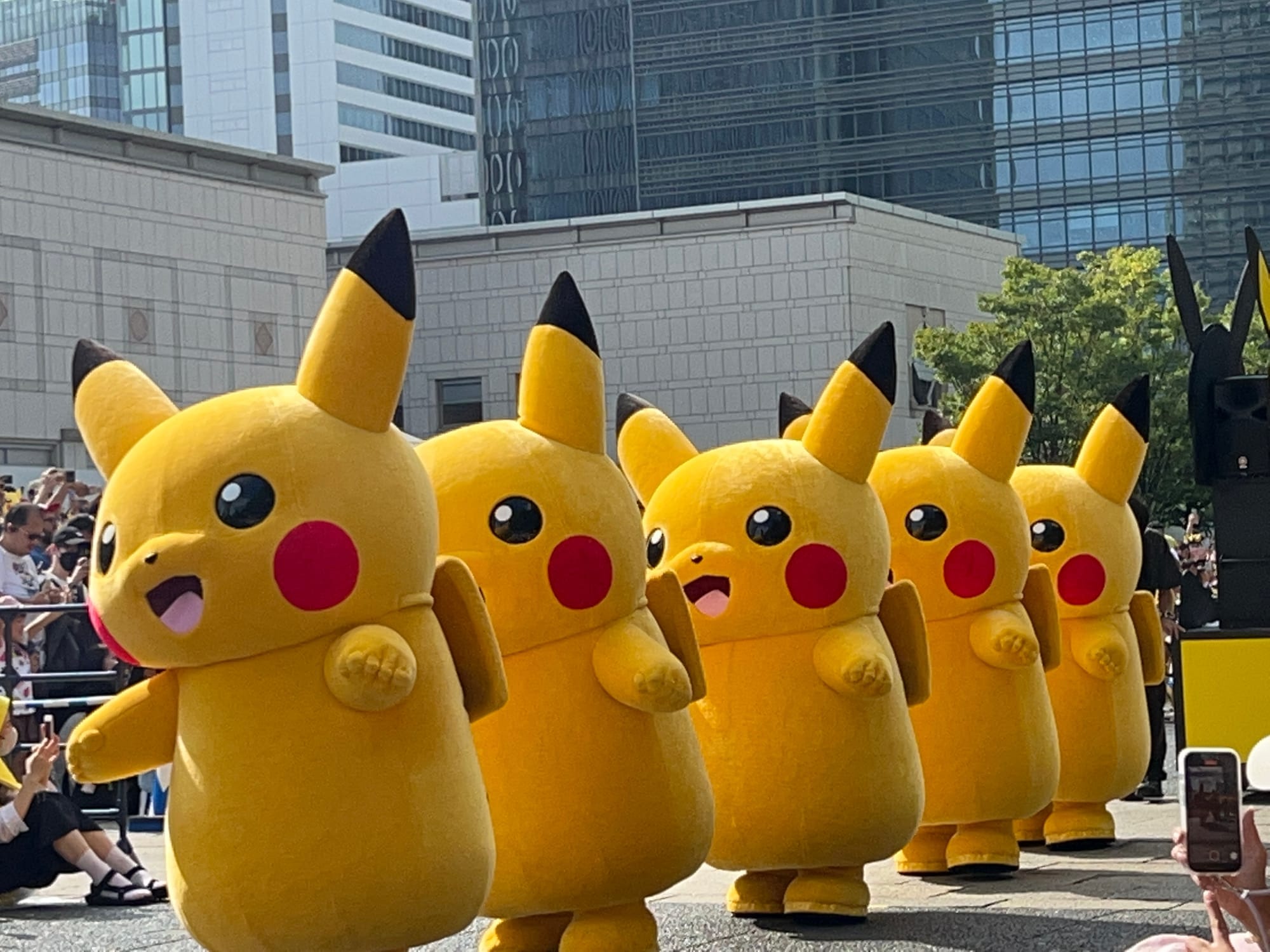
I think prominently to my experience attending the Pokémon World Championships in Japan in 2023, and just how the city of Yokohama was transformed for the event. You had the championships themselves in the major convention hall, but you also had cruise ships commandeered to Pokémon theming, decals and figures across the city, Pikachu parades. Free Pikachu hats being handed out at many stations meant not only did you see thousands of people from young kids to old women in wheelchairs wearing Pikachu ears as they walked, many stores commandeered them to put on their mannequins or for employees to wear.
You had one or two events with a nostalgic bend to them, such as the cruise ship named after the S.S. Anne from the original Pokémon games. A first-ever Japanese World Championship could easily lean heavily on nostalgia and the journey it took for these games to come home. Instead, evergreen icons blended with new icons to make the event a statement on the future. Pikachu was everywhere as the franchise mascot in parades or the free ears, but so were many other new Pokémon. Drone shows took the series to the skies with technicolor music shows. It melded the series to the fabric of life in statues, rather than subsuming, seen best with the Japanese summer festival it hosted with a Pokémon-themed twist.
You had less savory aspects too. TCG product or exclusive goods being resold for inflated prices just outside the venue, or even for brief moments on the second floor of the Pacifico Yokohama before being moved by venue staff. Two sides of a coin reflective of Pokémon’s growth, and how that growth influences what this series things mean to people.
Cards are a commodity traded like stocks with value, and that trickles down to younger audiences who will see videos online about the cards and how to react when engaging with the TCG. The joy for a favorite card is replaced or influenced instead by the monetary value of a gamble, especially with parental influence. Yet that doesn’t mean strangers and multiple generations won’t explore Poképark Kanto and take joy in this themed space, a shift from Pokémon being solely the interest of kids who never played the old games, but will have their own favorite Pokémon from even newer titles regardless.
Nostalgia is employed, but only as a niche of something larger. The recently-announced LEGO Pokémon sets are inspired by the original games explicitly, while notably being priced for an older collector market compared to Nintendo’s child-friendly Mario sets. Even just this week, a re-release of Pokémon FireRed and LeafGreen, GameBoy Advance remakes of the original titles, were announced to hit the Nintendo eShop to commemorate Pokémon’s 30th anniversary. Yet while these will both still be successful for the series, sales will inevitably be a minor note compared to Pokémon Legends Z-A, which sold 12 million units in just a few months while very notably abandoning historical stonewalls in Pokémon game design. A quick visit to a Japanese Pokémon Center shows classic imagery almost non-existent.
Pokémon is looking forwards, and that means deviating from what brought it to this point. It’s why being reflective on the creation of the series feels like an irrelevant point that obscures just how much Pokémon has changed. With mobile games and merchandising a bigger core, the appeal of Pokémon is more akin to a Disney theme park. The original media is important, but for the purpose of funneling the most beloved aspects of those experiences into a broader experience you can live and be a part of far beyond it.
By shedding the harness of nostalgia while transforming its most resonant aspects from nostalgic memories to a timeless franchise symbol, you can focus on what will bring in the next audience and keep things fresh. Over the last five years Charizard is less “the final evolution of your Generation 1 starter” and more “the cool fire dragon everyone associates with Pokémon,” and that’s deliberate. The last decade following the release of Pokémon GO, a game which showcased the potential of the series beyond its core fans, have seen the franchise go on an osmosis that has led to some of the biggest innovations and missteps of its 30-year history. It’s had mistakes on that journey. But it’s a bonafide success story.
Thus, celebrating Pokémon at 30 feels like the closing of a book, rather than a continuation. Because Pokémon at 60, or even Pokémon at 35, will likely be even more unrecognizable than it is now. You can decide if that’s a good or a bad thing.