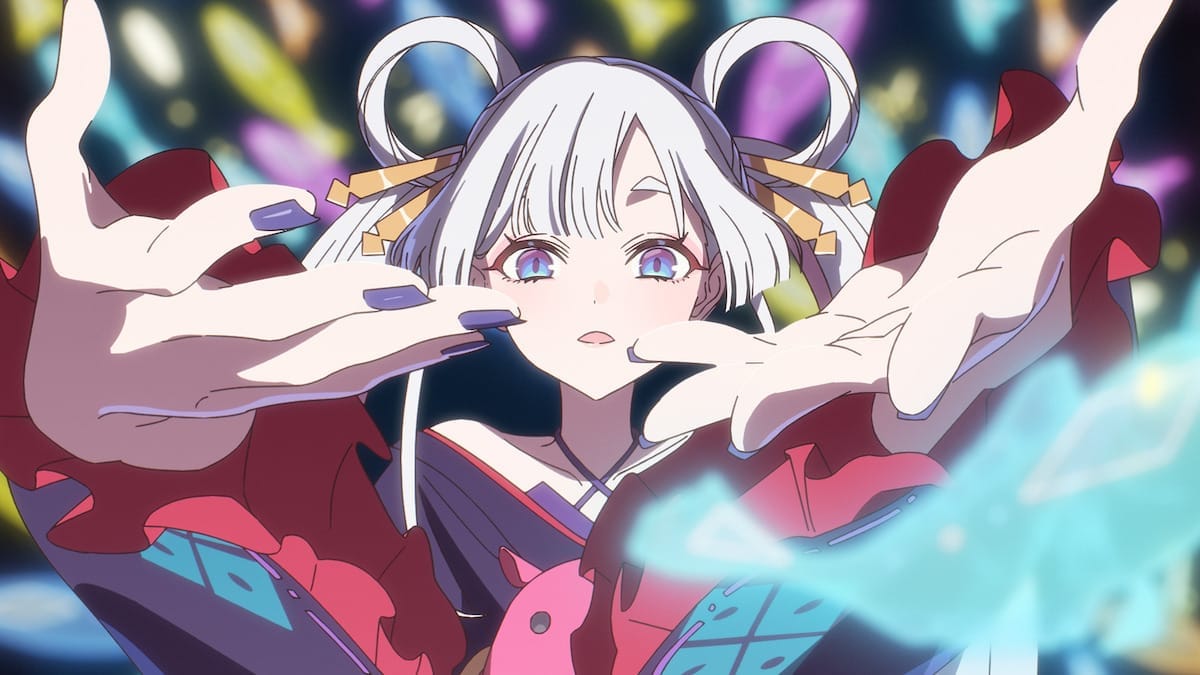
Netflix’s multi-year ambitions to become an anime production powerhouse have increasingly borne fruit for the company, much to the delight and chagrin of clashing factions of anime fandom and creatives alike. They have a broad reach to general audiences thanks to the popularity of their streaming service, and it can provide a platform for films that would not be produced without the pockets or global reach of the platform, if a path to virality can be summarized in a brief tagline. In that sense, a “Vocaloid-infused VTuber-inspired yuri retelling of a Japanese folk tale” certainly fits that bill, with Cosmic Princess Kaguya existing as a fascinating original release, and a film that unfortunately struggles to live up such an exciting concept.
The movie is the latest in Netflix’s long-running production partnership of original movies with Studio Colorido, providing a futuristic take on the traditional Tale of the Bamboo Cutter. It centers on Iroha Sakayori (voiced by Anna Nagase), a young schoolgirl whose father has passed with a difficult relationship to her mother. That difficulty led her to move from home to attend school in Tokyo alone, even supporting herself alongside her studies with part-time jobs while saving for university alone, a schedule that pushes her sleep and body to the limits. All that keeps her going is her love for Yachiyo Runami (Saori Hayami), the virtual idol star beloved nationwide and the unofficial ruler of the virtual metaverse Tsukuyomi. Without fail, Iroha will attend Yachiyo’s nightly concerts and support her.
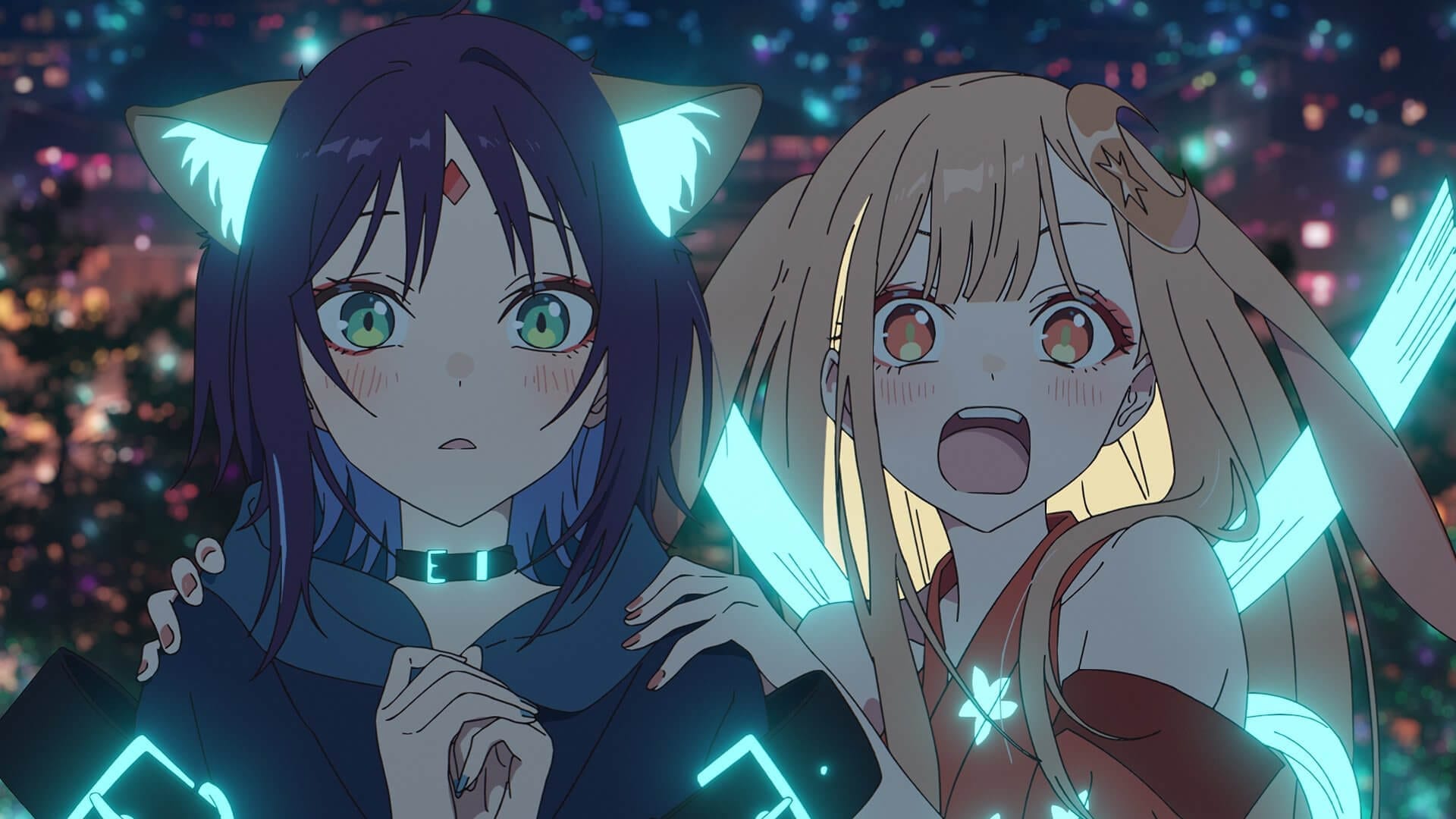
One day, a baby crashes from the sky into the telephone pole outside of her rickety apartment, and reluctantly takes her in. The young baby is given the name Kaguya, just like the tale, and quickly grows to join her and become infatuated with the virtual world. When Yachiyo announces an event to allow the most popular streamer to join her for her first ever collaboration concert, Kaguya becomes obsessed and recruits Iroha onto a joint mission to start a streaming career and make it to that stage.
It’s a setting and reimagining that immediately speaks to the modern moment. VTubing, ever since Kizuna AI burst onto the scene but especially since COVID with the rise of Hololive, have come to dominate online otaku spaces. The fandoms are passionate and spill into live concerts and online spaces. While the metaverse idea may be far from a reality beyond the faint breaths of the concept in massive free-to-play monoliths like Fortnite and Roblox, the conceit links them all. Though a more apt comparison point for Tsukuyomi’s all-encompassing nature would be more in line with Summer Wars, without the ties to government infrastructure and the ability to weaponize it to risk the end of the world.
Indeed, the film’s biggest strength and weakness can be tied to the core conceit of Kaguya’s impulsive dream to perform with Iroha and Yachiyo and the world of Tsukuyomi. The virtual world, for all it’s been established as embedded into the framework of this near-future society and a core part of the lives of almost everyone, the actual purpose or meaning behind this world is never given any moment. That’s because for all the events of this story almost-entirely take place within the virtual popularity rankings, games and cultural landscape of Tsukuyomi, there’s no purpose to this world’s existence in the context of the story. It has no identity beyond the meta-identity it’s given by the film’s conceit.
Tsukuyomi exists as an omnipresent excuse for any pop-culture reference or story conceit that’s necessary at any given time. The big headline following the film’s announcement was the fact this anime movie was a tribute to the transformative effect of Vocaloid and utaite culture, and that can be seen everywhere. Almost every song performed by our characters is a cover of a popular Vocaloid song, and one of the biggest surprises came when it was revealed that legendary early Vocaloid producer Supercell had returned to record a new version of their iconic Hatsune Miku hit song Melt for the film. The influence of Vocaloid, from throwaway references to the songs themselves, is everywhere, and as a fan of the culture and the songs across the years there’s undeniable joy to seeing some of these songs animated and brought to life in this form.
But it’s fanservice, and fanservice that won’t resonate with a majority of the audience who don’t share this history at that. While the songs have an entertainment factor in their own right, they don’t drive the story, and yet it feels like this world and this story is constructed around finding an excuse to slot as many songs as possible into the runtime of the film, rather than telling a story that feels natural to such a tribute. It’s a similar issue to the one which plagued the recent Project Sekai movie adapting the Hatsune Miku free-to-play mobile game, except in reverse. While that movie fell apart under conflicting desires to bring Miku to the big screen, respect the game and its characters, and create a story that made sense, this feels like a film made in reverse, imagining how cool it would be to create an anime with these songs and struggling to build a movie around it.
It’s not to say that the film is beyond salvation. There’s a lot of charm to the animation, and these musical moments do deliver. I even appreciate the characters, particularly the core relationship between Kaguya and Iroha. From a reluctant parent to companionship that allows both to embrace their true selves, it’s sold by the sheer commitment and how genuinely funny some of their interactions can be. It’s believable to see these unlikely roommates clash over streaming props and tight living spaces when one is immature and the other is mature beyond their years, and they both influence the other to grow. There's even genuine romantic affection hinted in their reactions, a love that transcends. It single-handedly elevates the film, even if it can't prevent the film's pacing issues.
These tiny character moments, the songs, the animation. There’s the underbelly and seeds of something great, and it’s a film whose intensity and energy is greater than the sum of its parts. But this ultimately is a film of moments, not of engaging storytelling - good moments, sure, but it falls short of telling a complete story. For something that’s already surprisingly long for an animated film at 140 minutes, that’s a problem. Cosmic Princess Kaguya feels unmotivated, and drags before it reaches its emotional climax.
More cynically, it feels split between its commitment to creating a fun movie and the corporate desires of Netflix. Moments of this film feel created less for the purpose of story or entertainment, but for being clipped for use elsewhere. Songs animated with flair for YouTube uploads or streaming playlists, comedic skits made exclusively to be scrolled past on TikTok or X with the hope that you’ll click through to watch the full movie. This film pays service to VTuber culture and Vocaloid and I truly believe it’s creators love it and want to respect it, but the overall package feels like something wrapping itself in that imagery for the purpose of living on in snippets. For a culture that endures, there’s an irony to that.
Cosmic Princess Kaguya could be great, but it’s a film ultimately torn between telling a story, paying tribute to a decades-old fandom, and corporate overreach that sees anime as an expansion of Netflix’s image rather than a medium for creativity. You can create something at least passable and entertaining amidst such conflict. But not something great.