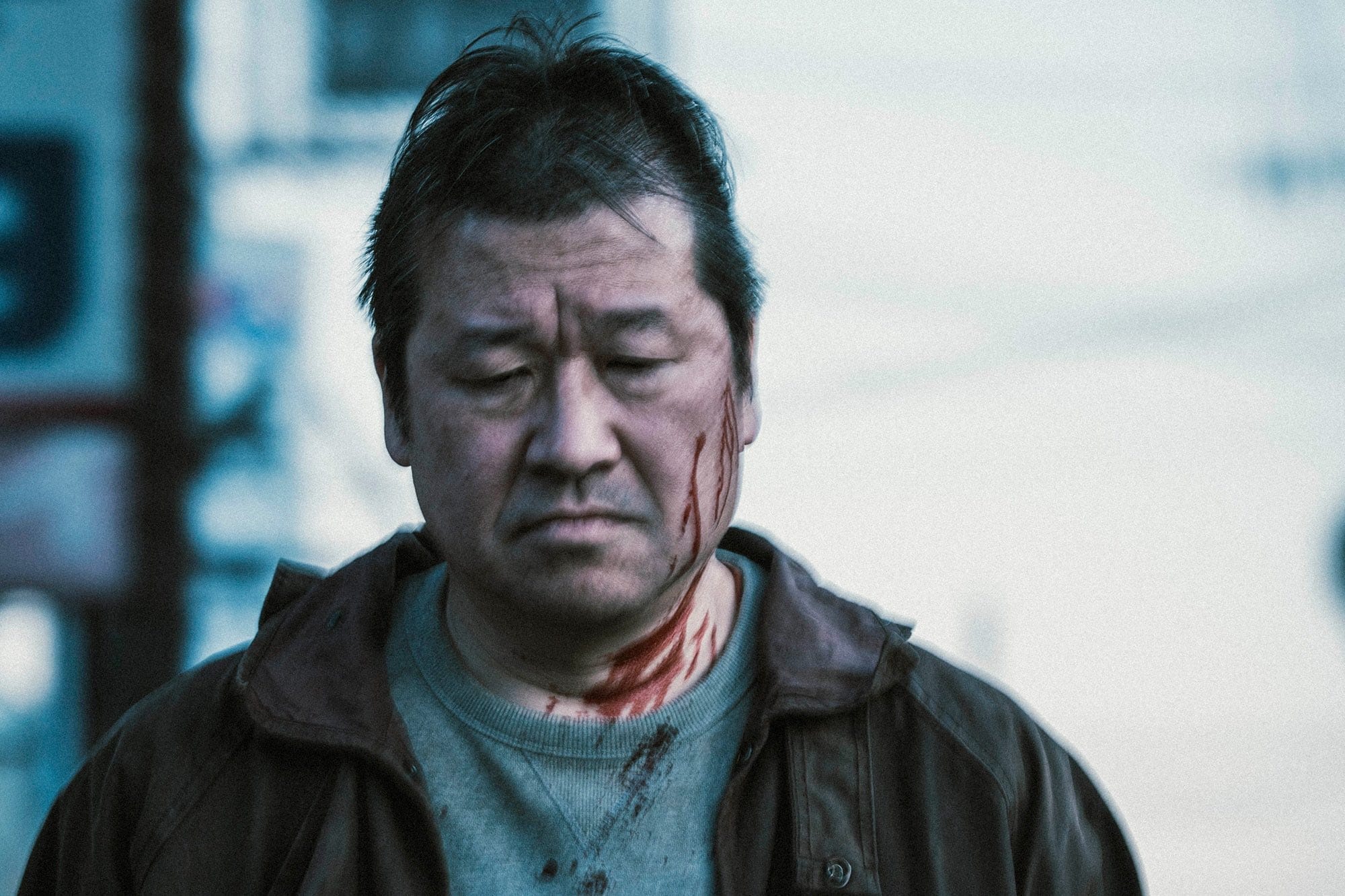
A murderer with no murder weapon, and no clear motive for why he is going on a rampage of murder through the streets. To CCTV cameras on the scene, all we see is a strange man waving an empty arm frantically around, causing civilians to fall in pools of blood. What’s the cause of all this?
Ever since Hideo Jojo made the shift to more mainstream filmmaking with On The Edge of Your Seats after a career producing adult and pink films, the director has been prolific and, generally, consistent. From dramas to thrillers such as this, often unique premises for stories are executed with competency and intoxication, and Nameless (Nanashi), this latest film, is no different. What makes this more fascinating, however, is that Jiro Sato, the veteran Japanese actor playing the murderous protagonist, is also the writer of the manga from which this film was adapted, with art by Ryo Nagata, making this a rare case of the mangaka playing a front-of-camera role in their own work’s jump to the big screen.
The man’s story begins as a young boy, found on the streets unable to speak and with his left arm taped to his body with wire. It’s not explicitly stated - indeed, much of the origin of what caused these powers to manifest is left deliberately unexplored - but the sense is that the boy survived after being abandoned young from an abusive home, in part due to these powers. The person who discovers him is a police officer, who takes him to get IDed and hopefully reunited. When he won’t answer questions, they instead ask the boy to take them to what he knows. In a sewer, a young homeless girl is also found, and stolen food they found becomes a scrounged meal.
Thanks to the police they get inducted into a kindergarten and orphanage with the hope of being given a normal life, being given the deliberately-anonymous names of Taro and Hanako Yamada, two names often used on unidentified, nameless suspects or bodies. They remain on the outskirts of the social groups of this group, however, and it’s here we see the truth to Taro’s powers. Anything his left hand touches will drain of life and die. He tries to pet a dog and it dies, and plants suffer a similar fate. Alternatively, anything he holds disappears.
As adults, the two are the only people who will stay together, though they lack comfortable living and are far from happy. Still, handling scrap metal, there’s a semblance of a normal life. Only for a betrayal towards Taro to sow the seeds of distrust in a world that always turned its back on him, festering until it overflows. The invisible wormhole that is his left arm becomes useful, a hidden weapon only visible in reflections he can use to enter crowds and lash out at a world that ignored him. Thus, the murdering begins.
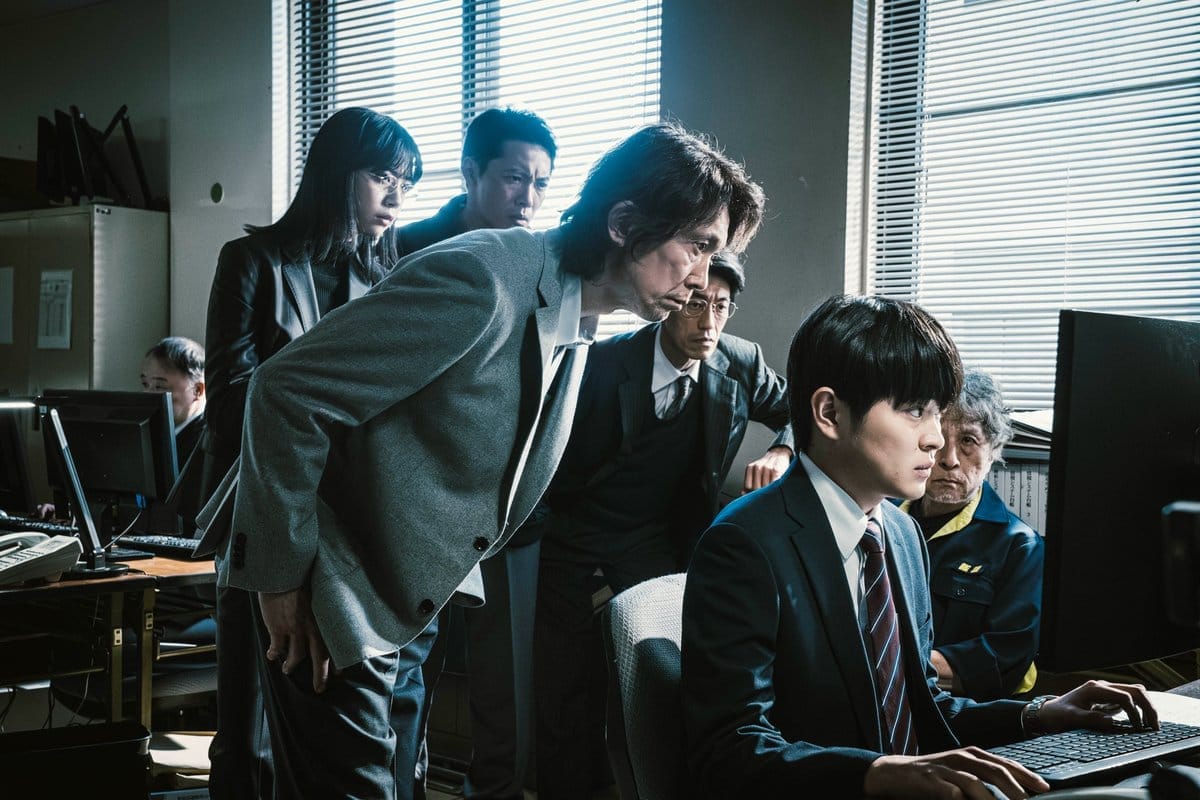
It’s a sense of the supernatural and the unexplained that makes the thriller aspects of Nameless so intriguing. At its core, while I wouldn’t go as far as to say it is generic, there is a sense of familiarity to the dynamic of the police investigation that encompasses much of the modern-day segments of this film. While we open with the shock of the weaponless murder in a coffee shop in the film’s opening moments, the investigation is the typical routine of crowded rooms of questioning officers, the sudden realization of new evidence, and the rapid sense of urgency to deal with an evolving emergency.

What makes it interesting is the personal investment into the case for Kunieda (Kuranosuke Sasaki), the police officer who first found Taro all those years ago. Seeing his vulnerable state then, but also how he has gone on this rampage now, leaves him feeling a sense of responsibility for the fact this crime is evolving, as well as an edge in knowledge that proves vital, that brings a personal agency to proceedings.
It’s through the interweaving of past and present and the parallel stories of this young vulnerable kid becoming this relentless killer that ties what could be a disconnected story together. While it is disappointing we don’t learn the truth behind the powers Taro possesses, it’s less important when the ability itself serves as a metaphor for the overlooked and disregarded lashing out at a world that ignores them. When the child is found, initial attempts to help them feel more like an obligation (and a nuisance one at that when it turns out the child’s mute status makes it a more difficult case).
No one seems to understand him. The kindergarten teacher sees a painting of darkness and doesn’t seek to understand it, merely asking for a new one. The one person who does care for him, genuinely, is the one person who makes him think he can live a normal life. When even that can’t last, it almost breaks him.
The adult relationship he forms with his childhood comrade in homelessness is just a nail in the coffin. This is the one person that understands him, and not even she can bear the thought of it. The power aids this violence, but the cause is not linked to its existence. The cause is the result of decades of neglect and the fact so few people attempt to see the truth underneath a broken shell, until the isolation gets too much to bear. Suddenly, when seen like this, we see where Kunieda begins to understand the situation and becomes so determined to make a difference and fix things.
Jiro Sato’s performance as Taro becomes such a fascinating glimpse into the downtrodden, and such a departure for the actor in a career that spans into the hundreds of TV and film appearances by this point yet still feels unique. Beyond a few forced, raspy lines from someone so alone he can barely speak, Sato is able to bring out such expressive performance from what is a silent role, the endless twitching of a face ready to explode but unable to express it and the monotone killing revealing a truth far more than any words could achieve. It’s in minimalism that a core to the character is revealed.
Nameless has issues. While once again, I find it unnecessary to explain the powers that Taro possesses, this is a film that wraps its story in just 80 minutes and I can’t help but feel its thematic message could be enhanced by taking an extra few minutes to touch on this further while maintaining the mystique. Yet this violent and potent thriller sticks in the memory long after the credits roll for how unrelenting it is.
Japanese Movie Spotlight is a monthly column highlighting new Japanese cinema releases. You can check out the full archive of the column over on Letterboxd.