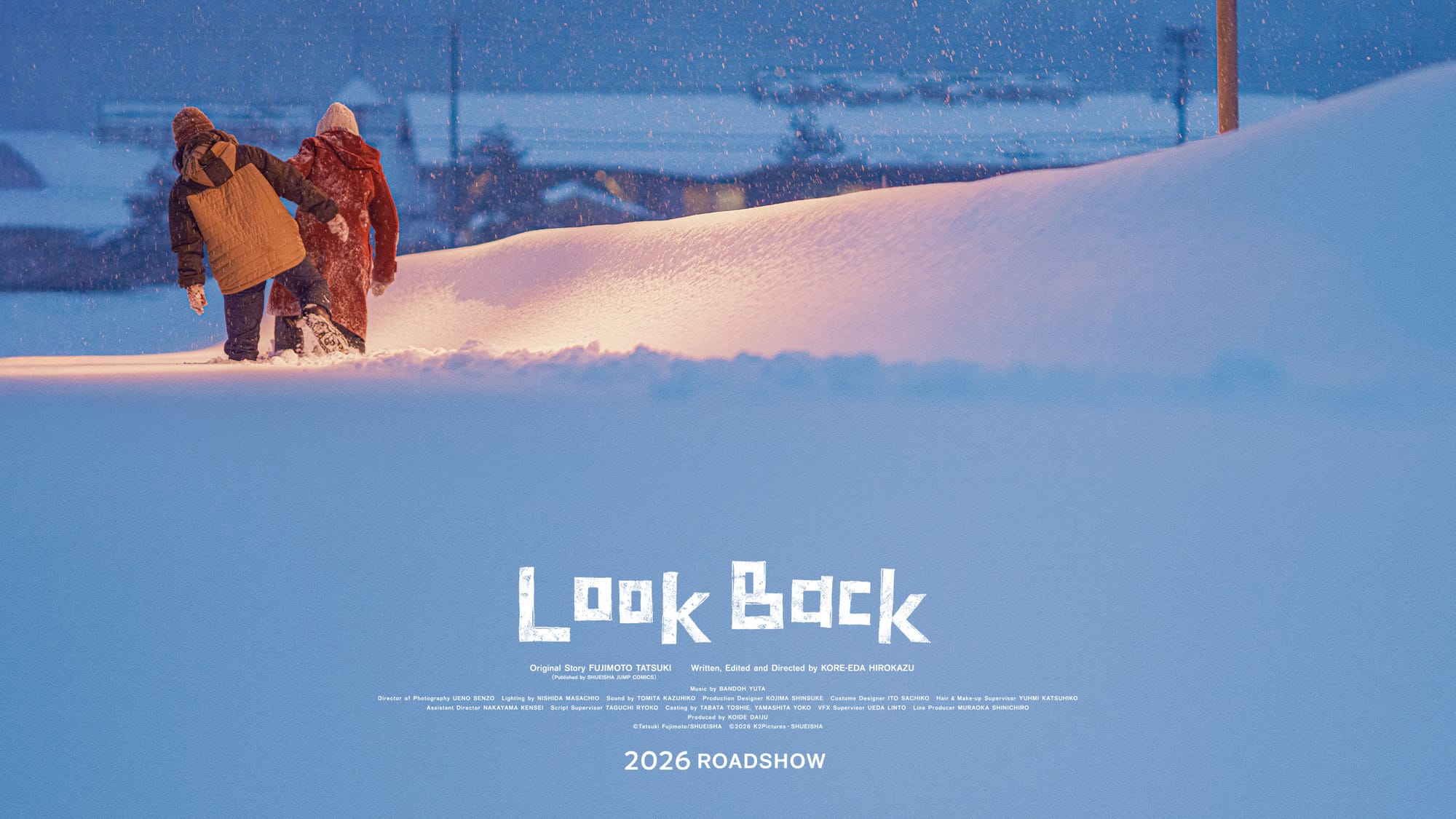
If you’re going to make yet-another film adaptation of a beloved work already adapted for the big screen, you may as well get the best. It’s hard to get much bigger than Kore-eda Hirokazu, the directly who recently attached his name to a live-action adaptation of Look Back. After the beloved one-shot manga from Tatsuki Fujimoto recently stole hearts with its animated adaptation earlier this year the film enjoyed an extended theatrical run, is set to receive an exhibition in January, and will soon at last receive a home video release after enjoying comfortable streaming success on Amazon Prime. Why try again with another new take on this story, even with such a name attached to its production, rather than simply enjoy this larger-than-expected success story?
Its existence speaks not just to the present, but a potential future for the Japanese film industry that goes far beyond this one film or even its director. The key to that potential lies in its newly-founded production company, K2 Pictures.
It should first be noted that the development of multiple adaptations of the same work in a major multimedia approach is nothing new for the Japanese entertainment industry, and is core to the strength of the sector more broadly. More recently you’ve seen a live-action adaptation of Wind Breaker hit Japanese theaters merely one year after the anime adaptation of the hit manga first graced screens, and these multi-medium adaptations cross between more than just anime and live-action films and TV series.
Almost every motion picture gets its tie-in novel, from Five Centimeters Per Second to Exit 8, video game Gnosia already received a manga adaptation prior to its anime adaptation, and that’s before talking about the ways franchises have taken a similar path to what Look Back is taking now in capitalizing on the success of one interpretation on a work with another. And we can’t forget the theater and the many adaptations made for the stage like Kakegurui or the recent Chi.
The recent buzz surrounding Look Back comes primarily from the team behind it, but the actual concept behind this adaptation is nothing new. Whether this is a strength or detriment of the industry is more difficult to determine, since at times these can be richly-unique, distinct works (a recent favorite of mine in this department is the Kaguya-sama: Love is War live-action in relation to TV), while others betray their blatant attempt to cash in on the hot trending IP. There’s an argument multiple adaptations within the same medium (be that film and TV with the distinction being live-action or animation, or otherwise) shrink the potential for original works to be produced, but you could also say that the existence and success of these works provides the capital to take a risk they may otherwise avoid.
That being said, it’s hard not to note how prevalent the growing success of manga and anime on a domestic and global stage have fundamentally shifted the landscape for Japanese entertainment and what is produced. The top two highest-grossing Japanese films of all time, both domestically and globally, are Demon Slayer, the most recent film earning over $750million worldwide on a relatively-standard budget for anime. Such a budget notably pales in comparison to the cost of a flashy Hollywood blockbuster, and that potential has made anime and related mediums a hot commodity for producers and major corporations. Sony have made significant investments into the anime industry over the past decade between purchasing Crunchyroll and investing in a number of anime studios, and they’re far from alone as streamers like Netflix make similar strides.
The result is the growing importance of not just anime, but the IP behind them. Anime films have routinely dominated the Japanese box office in recent years, a shift that begun with Your Name in 2016, while the appetite for taking this work and reinterpreting it only grows. Netflix’s One Piece only continues to grow in popularity, and the frequency that these adaptations in particular grace international streaming or are even remade in other countries (beyond English-speaking territories, also) has seen Japan become a soft-power titan for its cultural export.
When does leaning into such success become a liability to new stories, however? With the exception of this year’s surprising word-of-mouth hit Kokuho, almost every successful hit in Japanese film has come from anime and manga rather than being made-to-the-medium original stories, and even many of the exceptions come from novels or other mediums. This issue is less pronounced in the world of TV dramas with a lower barrier to entry, but even then a return to prior hits or manga with stories like Chihayafuru: Full Circle or the upcoming live-action Flowers of Evil TV drama has seen a noted increase.
K2 Pictures is a new initiative by some of the biggest artistic minds in the industry created in part to address this. Citing a lack of opportunities for new creatives and the desire to bring Japanese live-action cinema to a global audience in the same way anime has been embraced, Kore-eda Hirokazu stands as one of the company’s founding members leading this charge to improve awareness and engagement with the medium from global audiences. While the concept of an Oscar-nominated director such as him taking on such an adaptation may initially seem bizarre, it begins to make sense considering his involvement in this key company behind it. A notable aspect of K2 Pictures is their independence from major studios like Toei and Toho with the express desire to move more agile and create with audiences in multiple territories in mind, but that’s a major risk. Even in Japan where costs are lower, it’s still not cheap to create movies, nor is it risk-free just because people recognize your work.
Look Back is a perfect first work for the studio. Tatsuki Fujimoto’s work is embraced by audiences around the world thanks to Chainsaw Man, and Look Back in particular was a major hit in cinemas and on streaming for Amazon Prime. People know the name, making not only a near-sure hit, but a recognizable story with a major director that will cause even non-anime audiences to sit up and take notice. To be fair, rather than simply being a safe retread, Kore-eda Hirokazu’s stunning work on his most recent film, Monster, is a showcase that he can bring out awards-worthy performance from young child actors and create a story with nuance and grace to the sensitive subjects it explores. More than this being yet another multimedia adaptation, this is the start of K2 Pictures and a chance to create something new from familiar territory.
Yet I still feel trepidation from seeing a Look Back live-action film announced, and it comes not from my fear it could fail to live up to expectations. Indeed, it’s the creative team’s vision that excites me just as much as it leaves me nervous. While this is the perfect choice to kick-off K2 Pictures’ thesis statement and for the director in charge, it’s also a likely-necessary choice to make people take notice, at least at first, when only limited festival hits have otherwise been able to break through out of the many Japanese cinema exports despite the quality, depth and variety of the movies produced on a yearly basis.
Yet in an industry already flush with adaptations of familiar IP, the risk is in boxing live-action Japanese cinema into the space anime is increasingly being forced to conform with: an easy-viewing digest of stories first pioneered elsewhere. Both are capable of much more, yet while audiences flock for Chainsaw Man they don’t rush out for original stories like The Obsessed, and the loudest voices in anime revere the Shonen Jump anime and their action hits while ignoring just how much is possible.
Will opening Japanese cinema to a global audience bring more money to fund unique projects and encourage audiences to check out new stories, enriching the industry? Or will it box the entire country’s cinema into a factory style while the monetary potential of a global hit leaves everyone chasing over that while the depth suffers, as we have begun to see within the anime sector? I certainly have no qualms about a Look Back adaptation from this team, but questions regarding the impact of K2 Pictures’ intent and how it could influence the industry far beyond this work if it succeeds in its mission is both exciting and unnerving.
Either way, Look Back’s live-action adaptation presents a fork in the road, and an unknown future. Considering the story at the heart of this new frontier, there’s hardly a more fitting film to make that first step.