Jin-Roh: The Wolf Brigade opens with a nuclear bomb. In animated form, we witness the destructive force of the first atomic weapon dropped on a human population, bringing with it the end of World War II. A tragic event no matter the context, though it should be noted that in this film’s version of historic events there is one notable difference between the fact’s behind the use of this bomb. Namely, that it wasn’t the US forces that would drop the weapon on Japan. It would be the Germans.
In the final months of the 20th century in August 1999, the film written by Mamoru Oshii and directed by Hiroyuki Okiura would premiere to the world at Canada’s Fantasia Film Festival, bringing with it an animated prequel to the broader Kerberos Saga films such as 1986’s The Red Spectacles. The film is set in an alternate-history postwar Japan following the occupation by this universe’s Nazi Germany, the winners of World War II. In this world it was the German’s who won the war after the US chose not to intervene, and it was also them who dropped nuclear bombs on the country to force their surrender and occupation. Only, after this, Hitler was assassinated and traces of Nazism were purged from German ranks anyhow.
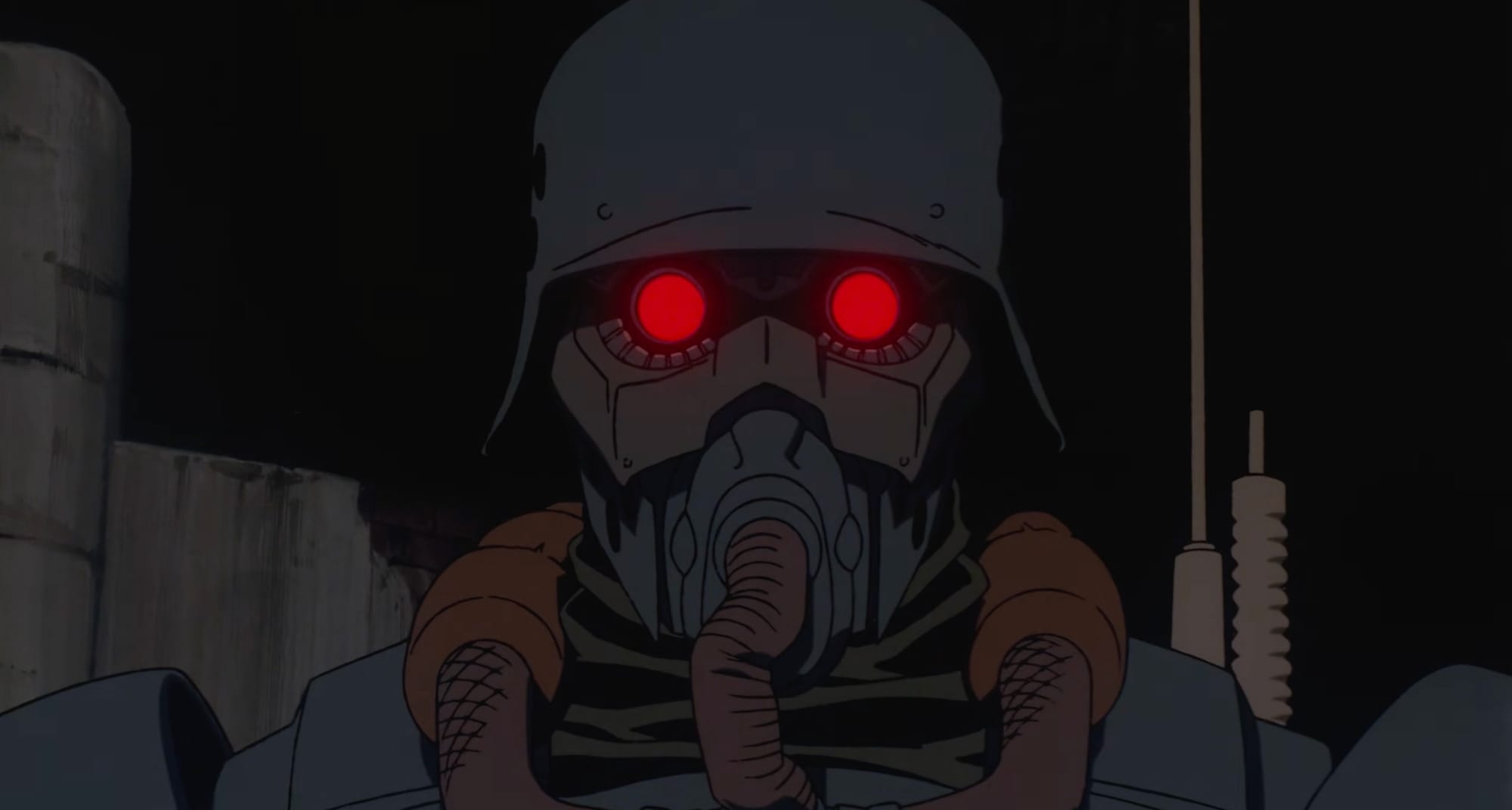
A far-right Japanese government following occupation sought to integrate itself back into the global economy, only to find its attempts at economic reform a disaster that spike citizen dissent. Facing increasingly-violent protest, the government employs a new specially-armed and genetically-modified paramilitary group to quell disorder: the Kerberos. Initially the foundation of this augmented force powered by powerful Protect Gear exoskeletons are designed to restore order, but with both the Sect and Kerberos using increasingly-violent means to achieve their goals and turning streets of Tokyo into scenes of urban warfare, support for both drops massively and the desire by all sides is for all to be regulated out of existence.
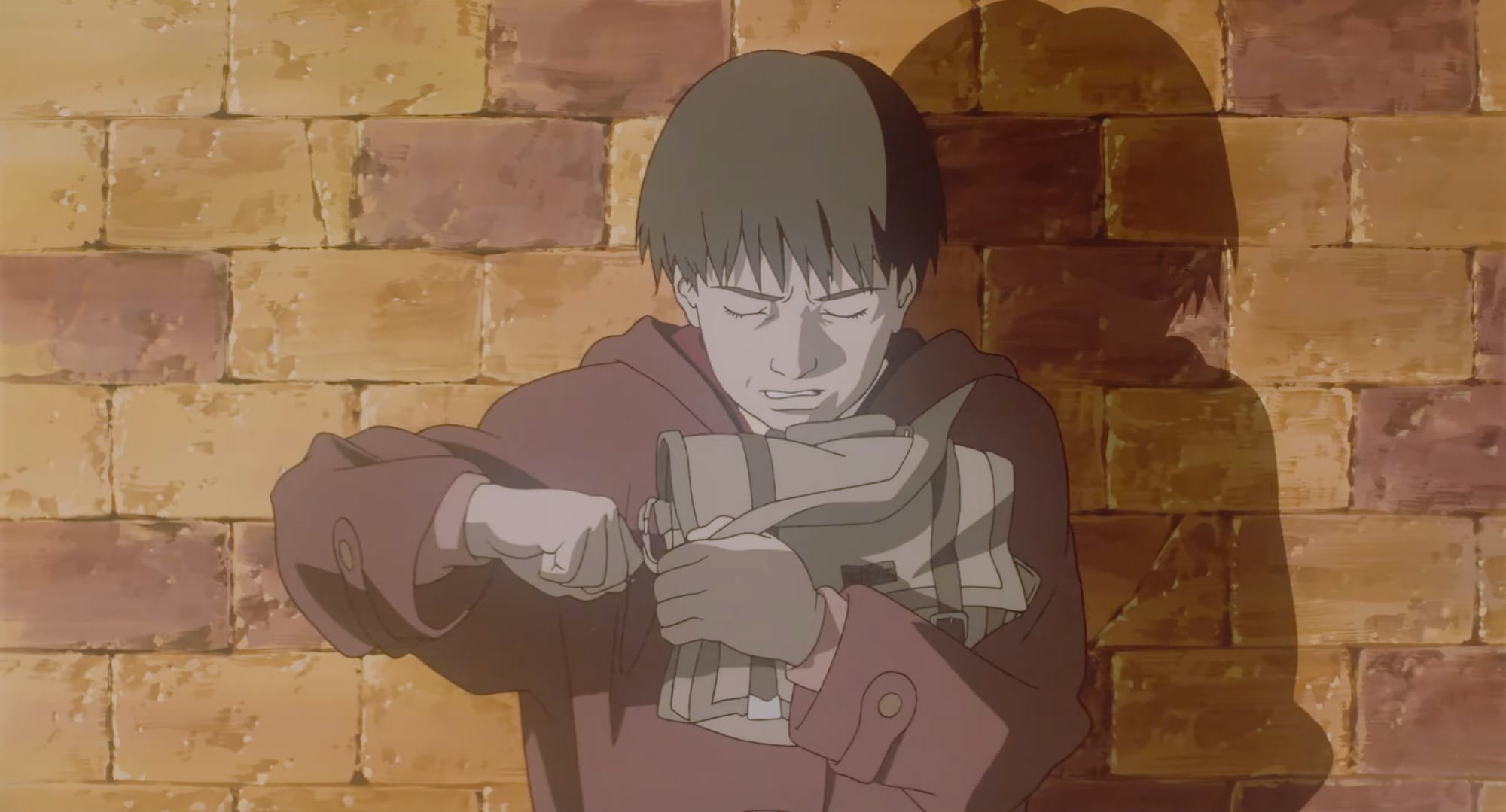
Amidst all this we meet Kerberos member Kazuki Fuse, who on one such clash witnesses a young female terrorist commit suicide with a bomb inside a backpack. Shortly after, he meets a woman claiming to be the deceased’s sister, Kei Anemiya, a meeting that place’s them both at the heart of a conspiracy by some in government to find a scandal and excuse that can allow for the Kerberos to be dissolved while equally dealing with the Sect threat.
As a precursor to The Red Spectacles written (albeit not directed) by its original creator it’s no surprise this anime film serves as a well-made companion piece to that classic film alongside standing on its own, but it’s what this film does to expand on the core thematic ideas on society and fascism that makes this such a compelling work of anime, especially today. Despite being 25 years since the film’s original release the ideas of Jin-Roh could be speaking about society as it exists today, and what it means to endorse unjust control on a population merely by sticking to the predetermined rules of the oppressor class.
While foregoing much of the slapstick that sought to make a mockery of continuing the facade of power when authority has declined, this film uses Kei as a foil to directly contrast the role of civilian with the structures of power. Having witnessed her sister blow herself up in front of his eyes and being haunted by that image as a scrap of humanity against the robotic machine-like armor he is perpetually intertwined, the question he has of why she would do such a thing lives on in this person’s existence. In place of absurdity to reveal the political underpinnings of transforming humanity into a symbol of control through the Kerberos, the silent contemplation of a man in the armor torn apart by questions serves that role.
For while the man remains a mystery even after spending time in and out of armor with him, his understated, minimal emotions reveal far more about his attempts to understand his role in the political frustrations of the world around him. The entire Kerberos saga, both in The Red Spectacles and Jin-Roh, play as a sci-fi infused exploration of Oshii’s experiences in the widespread protest movements of the 1960s. This was an era defined by a young student and working-class subset standing up against military partnerships between the US and Japan and the role of society and conflict in Japan’s future. It was a militant search for the soul of the country, one that continues today even as the violent clashes of this era have subsided.
This was an era where, to get voices heard, people would occupy college campuses and control public buildings to relay concerns, direct action that forced conversation because the violence and deterioration of social order forced those in charge to wrangle with their actions. We call these acts extreme because they break with what is typical and just in most circumstances, removing it from the bounds through which our brains can adjust to the point we have to contend with what happening. When this girl blows herself up for her cause, it, more than the other violence, is what prompts our protagonist in his time with Kei to question his blind following and endorsement to go forth with enforcing the authority he represents.
Because, if The Red Spectacles is about searching for a society beyond the acceptance of violence and fascism, Jin-Roh, at its core, is a love story. In hesitation, and the friendship that follows as the girl he faced remains in his head, there’s a peace that opens inside of a world that forgot to connect. Fuse and Kei’s relationship provides a pause in the black-and-white ultra-violence of the world to what it has forgotten, a humanity, that is what’s truly important and worth protecting. What can exist merely by understanding.
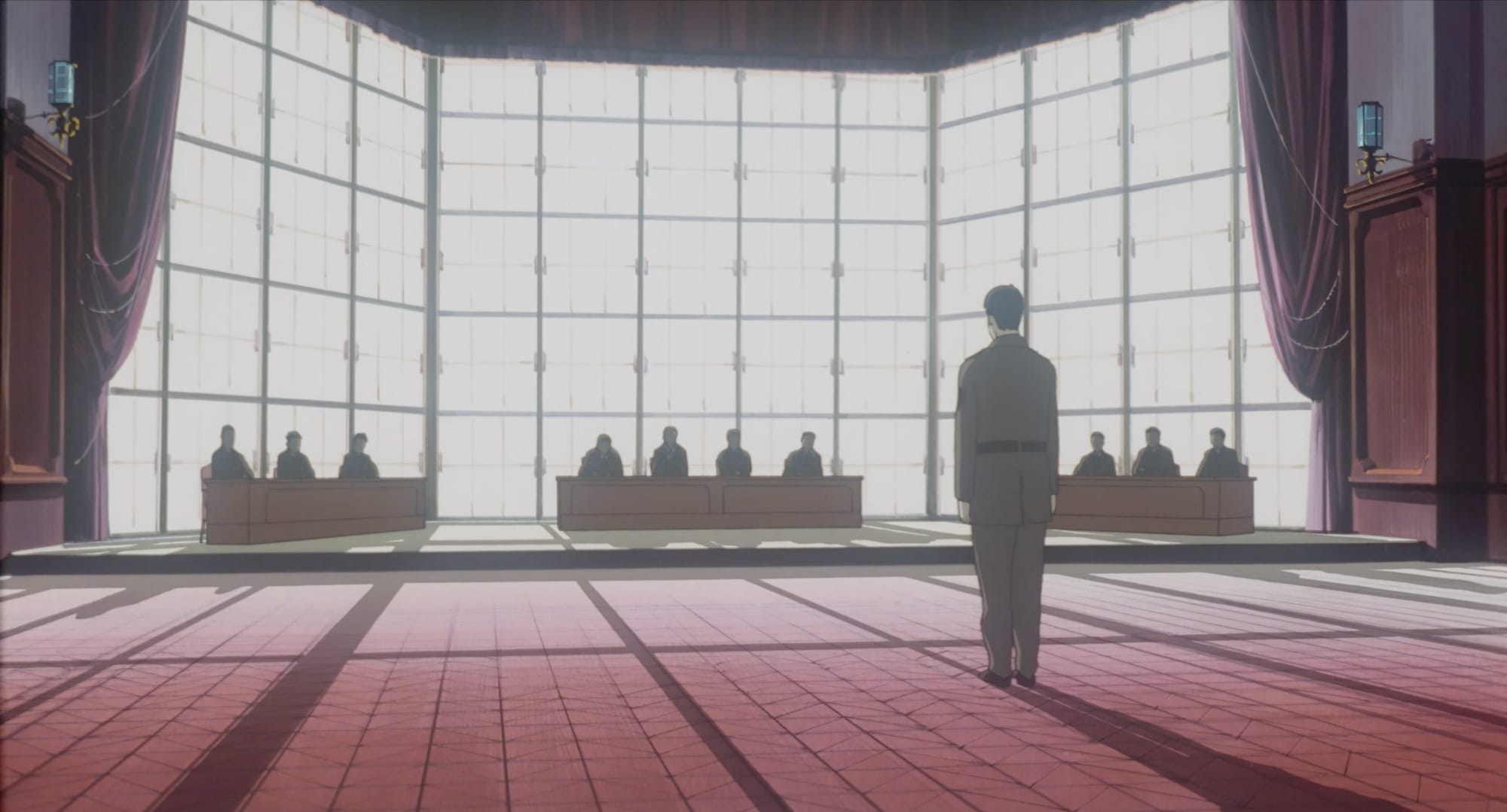
The murky color palette and striking-yet realistic animation set a tone of a world that, despite its futuristic components, is deliberately real in its ideas. When even a neon-colored dystopia is striking in color and visuals and can separate the fiction of the adventure from the real world it seeks to evoke, this ensures we remain mentally in the present while the ideas being explored. When elevated by a fluid and human-like approach to animation, it feels more like watching a memory or a premonition than an animated film. And by pairing a dark yet real world with an innocence of love, you create commentary on where violence makes us forget.
The Wolf Brigade that the title refers to speaks to the other side of this story: the intelligence group designed to protect the Kerberos. They get involved here, because in shooting before Kei’s sister could blow herself up in the opening, he is vulnerable, and it’s the threat that poses a choice for Fuse as he navigates this new relationship. This is a violent movie when it needs to be, but much of the time is spent in the quandaries of when to be violent, why, and who is being served by whom in the service of centralized power and control. Despite its more serious tone it sits alongside the rest of these films while standing alone as the best in the series and a stunning political drama.
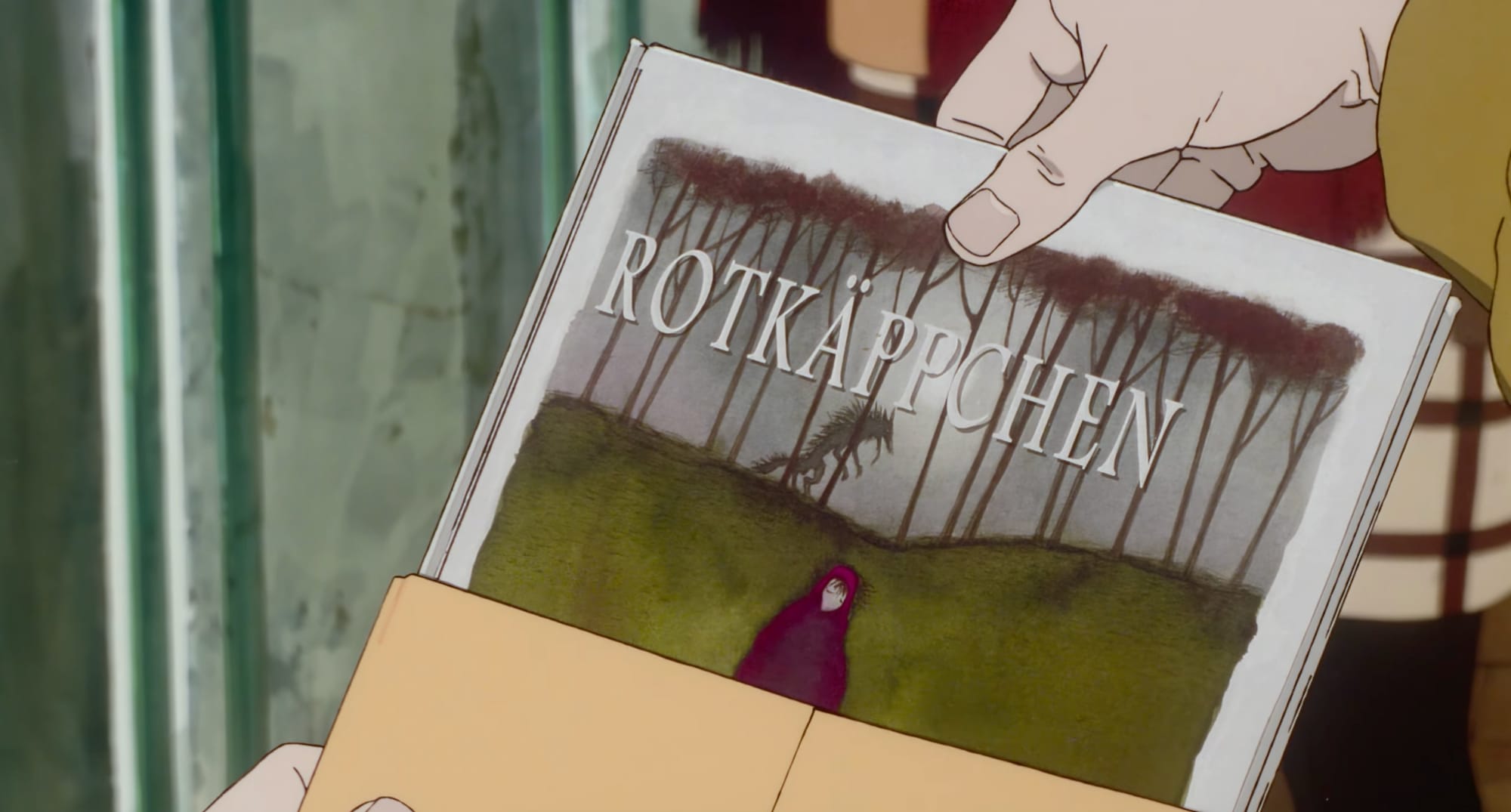
In a world of rising fascism, where protest rises in a more divided Japan than ever once again that still feels more united than what can be seen elsewhere when the streets of the United States, Jin-Roh feels like an bleak, dour echo dangerously few steps away from being a mirror of the scenes this film captures with such beauty and terror. Now, 25 years later, this is a story that endures not just because it resonates today, but because it recognizes what is truly important if we are to avoid repeating the structural errors that created the Kerberos and Wolf Brigade in the first place. The question is, can we learn from it?
No one wins in this story, but perhaps by learning from it, our world can be different.