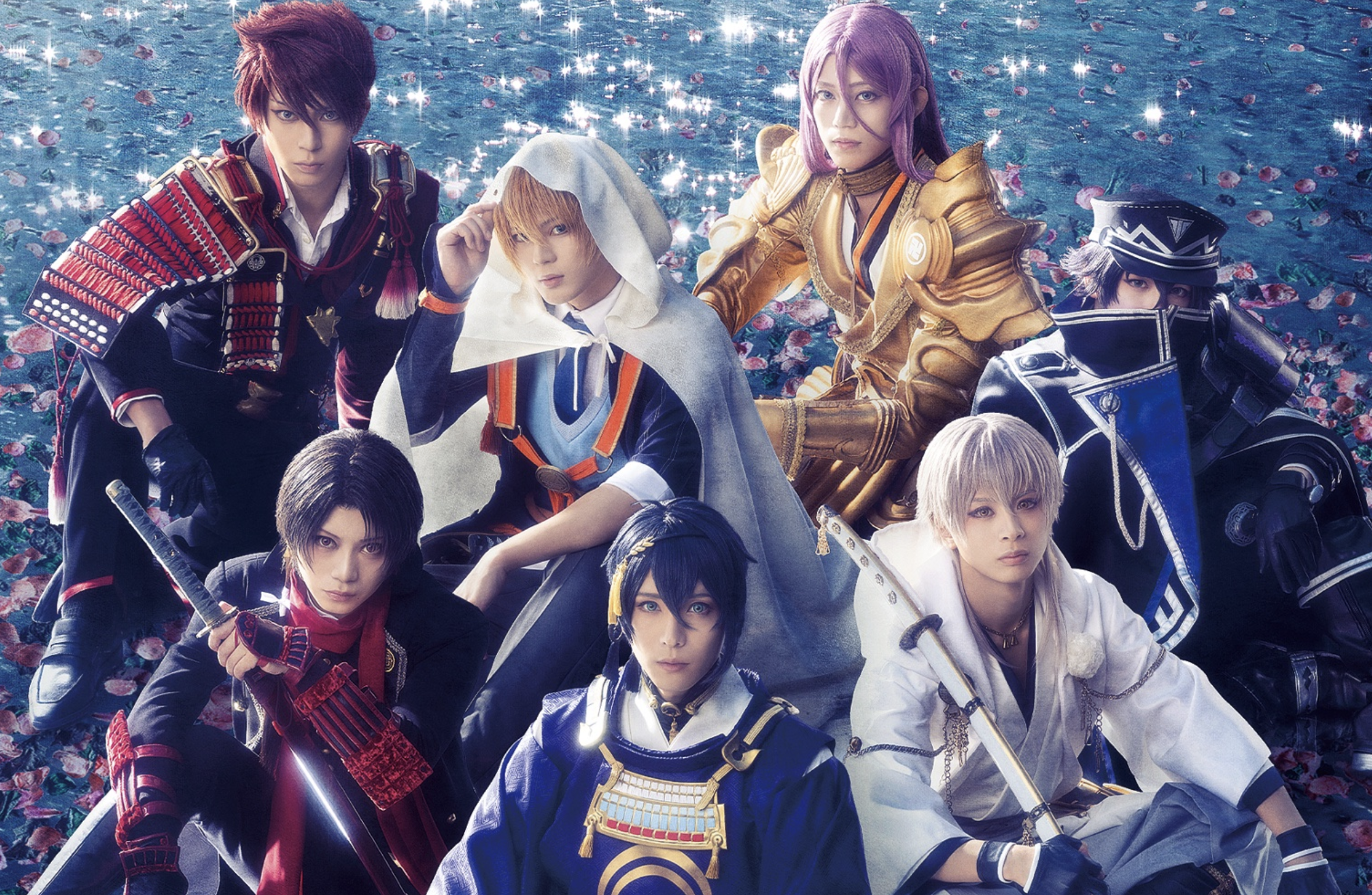
When Touken Ranbu initially launched in January 2015, it was a near-instant hit. It was a browser game aimed at women where a number of famous and legendary swords from throughout history were depicted as attractive men, a bishonen wrapper to a strategy game that can take on surprising depth the more you level up and progress with your hot blades. There’s a broader story where you, a Saniwa sage, are traveling through time animating these swords to defeat evil forces looking to alter the course of history, but the appeal of these characters and their storylines both inside and outside of battle are a key appeal.
With such success beyond Japan and even into the broader East Asia, it was inevitable that spinoffs would follow. Action-focused premium game spin-offs, anime, manga, each are natural followups on such a successful formula. Yet the most successful of these multimedia experiments begun that same year and remains popular to this day. The series has enjoyed a marvelous second life on stage, receiving not one but two separate, wildly successful, long-running series of theatrical adaptations that have been hosted at regular intervals on stage almost without pause, tapping into a hunger from fans of the game and 2.5D theater to bring the series to a new medium and audiences.
Musical: Touken Ranbu
It didn’t even take for the game to reach its first anniversary for a musical adaptation to hit theaters. Albeit as an initial ‘trial performance’ to test the concept and ensure the game would even benefit from a shift to live-action theater, as well as to test audience demand, the first trial run of a musical was held at the now-closed 800-seater AiiA Theater Tokyo in Shibuya in late-October 2015. This was a notably lower-scale production to what would follow, with a cast limited to the most prominent members of the series and limited set design befitting its test status.
The structure of the show was also unique, forgoing a two-act musical for a single act accompanied by a live music performance performing songs in-character and related to the series, a trend that would continue through later performances in many instances, as would regular livestreams, live viewings in major cinemas, and home video releases of every show. Which would only become more necessary as the scale of the production grew in subsequent performances.
The continuous main storyline of these shows follows closely to the game, with each show involving a team of swords traveling back in time to various key events in Japanese history to prevent the events of these moments in history being altered. In the show Musubi no Hibiki, Hajimari no Ne first held in 2018, for example, the show centers on events attempting to prevent other forces from tampering with the historically-significant role Hijikata Toshizo, held in 1868 Japan.
For those unfamiliar with this era of Japanese history, this year marked the end of the Tokugawa Shogunate, after the Imperial Army aiming to reassert the Emperor’s power as head of state and overthrow the Shogunate, ultimately resulting in the Meiji Restoration upon their victory. Hijikata Toshizo was a commander in the Shogunate who ultimately lost his life in one of the final battles of this war, and any attempt to shift the events of this historic battle and war would massively alter the direction of Japan as a nation. This is just the latest plot by the evil forces to alter history.
This continuous story is serialized and advanced upon each performance, but there are also additional side shows made up of smaller casts and centered on specific characters. Songs from the show and the live portions of each performance have regularly been released on CD and even topped the Oricon charts. The music is often a blend of rock and traditional stage musical affair that combined brings a unique sound, allowing the team to even perform concert-only shows at venues like Zepp Diver City.
This long-running story remains popular, though all good things must come to an end, as the saying often goes. It was recently announced at the start of December that the musicals will come to an end in 2027, ending one of the longest-running continuous 2.5D musical storylines after over a decade. In that time, the series has performed for millions across thousands of performances, a testament to the continued popularity of a musical that has arguably transcended the original.
Stage: Touken Ranbu
That being said, the non-musical theatrical shows for Touken Ranbu shouldn’t be overlooked. Though born from the same source material, these have an entirely-separate cast, and do take the series in a notably more serious direction compared to the musical (while still retaining the more extravagant concepts from the source material and retaining a light-hearted tone and character interactions where appropriate). Between these two simultaneous theatrical interpretations, it ensures that there’s almost-always a different stage show in one of the two continuities running at any one time.
The first production in this continuity is Kyoden Moyuru Honnoji, from 2016, based on the Honnoji Incident. Not only was it a success and popular enough to justify that these non-musical theatrical productions in the franchise be allowed to continue, this particular production is also the only case where one of these shows has received its own anime adaptation. An eight-episode series based on the play released in 2022, followed by a prequel film in cinemas.
Though these two stage adaptations remain distinct with their own continuities and casts, a natural fanbase overlap and shared source material make attempts to bring the worlds together inevitable. Touken Ranbu: Daienren was set to be a grand-scale multi-part event that brought the worlds of the musical and play together on the same stage for individual and shared performances. In a testament to the enduring success and popularity, this was even going to take place at the theater project's largest stage yet: Tokyo Dome. Unfortunately, this was going to take place in August 2020, and as this timing may suggest, the COVID-19 pandemic prevented that show from becoming a reality as it was eventually canceled and not rescheduled.
Yet the fact these two linked but distinct theatrical adaptations of Touken Ranbu have found enduring success spanning for over a decade is testament not just to the quality of these shows, but to the dedication of fans who have followed these shows and actors for such a long time. Even if one strand is beginning to come to an end in its current form, does that mean the end, or simply a return or reboot in a new form? At least, the continued success of both the musical and stage plays for Touken Ranbu suggest that neither will fully disappear from theaters in Japan anytime soon.