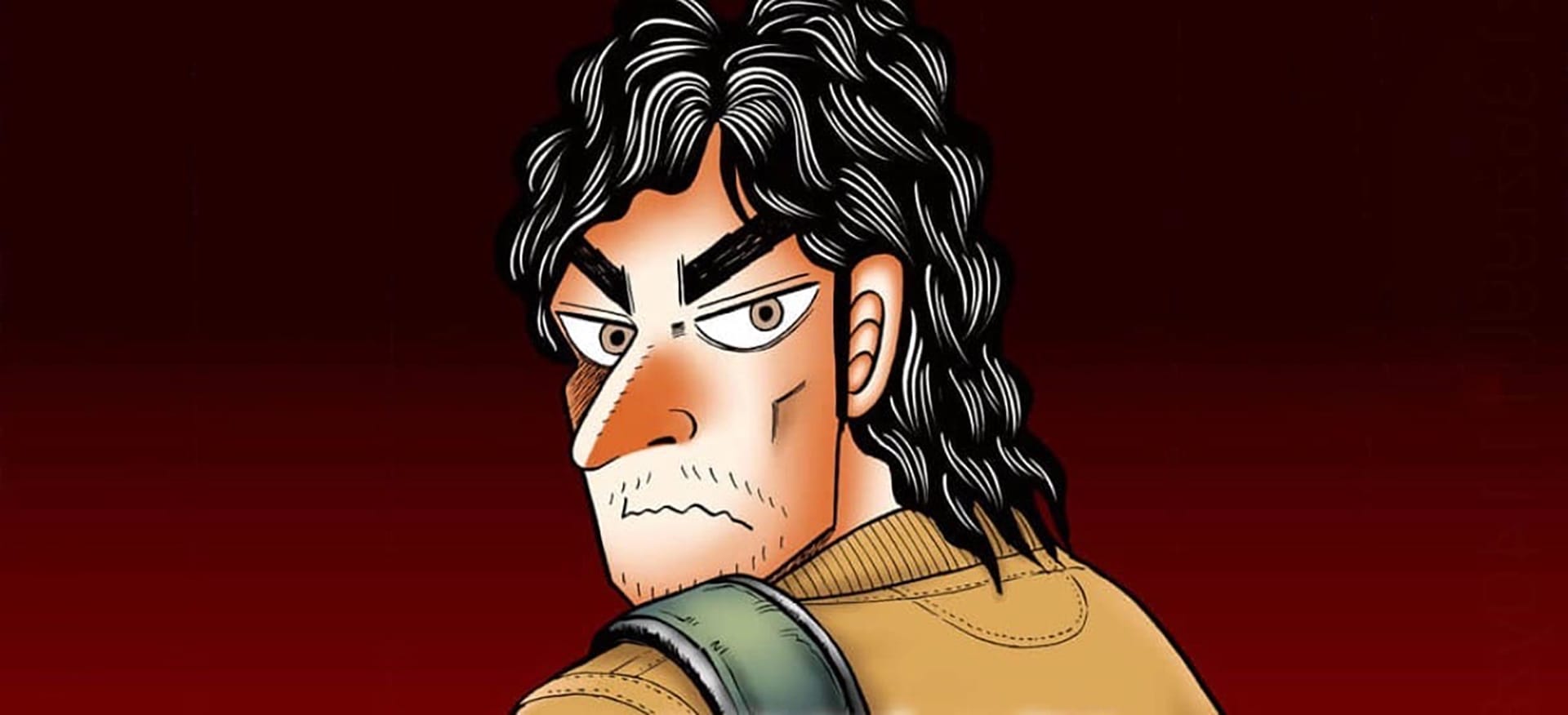
All of the great sports manga are about victory. While a scant few chart the entire journey from passionate amateur to the greatest in the world, part of their appeal comes from the sweetness of success mixed in with the bitterness of defeat. Nikaido Hell Golf, however, is a very different beast: a sports story full of nothing but pain and failure from the twisted mind of Nobuyuki Fukumoto that lives up to its title.
Even for the uninitiated, Nobuyuki Fukumoto surely needs no introduction. Not only has he created some of manga’s most iconic gamblers in the form of Kaiji Itou and Shigeru Akagi, his art style is instantly recognizable, expertly threading the line between beautiful and grotesque. Moreover, his depiction of the criminal underworld and societal malaise has turned many of his works into cultural encapsulations of Japan’s so-called “Lost Generation” following the end of the economic bubble in the 1990s.
Speaking of Fukumoto’s previous works, Nikaido Hell Golf does fit the mold to a certain extent. Just like Kaiji, it follows a male protagonist down on his luck by the name of Nikaido Susumu: a middle-aged golfer with a similar hairstyle who has failed the test to become a professional ten times at the start of the story. Similar to Akagi’s depiction of mahjong, it also makes use of extended metaphor and heightened imagery to elevate the otherwise pedestrian sport into a visual feast for the eyes.
That being said, there are two major points of difference. First of all, the activity of golf takes up surprisingly little space in the narrative: series such as Kaiji and Akagi always focused on the game first and foremost as a vehicle for storytelling, but the first time we even see Nikaido play a full round is in volume four. Secondly, while Fukumoto has always used supernatural themes and imagery for dramatic effect up until this point, Nikado Hell Golf marks the first time that he has ever given one of his characters some kind of special ability.
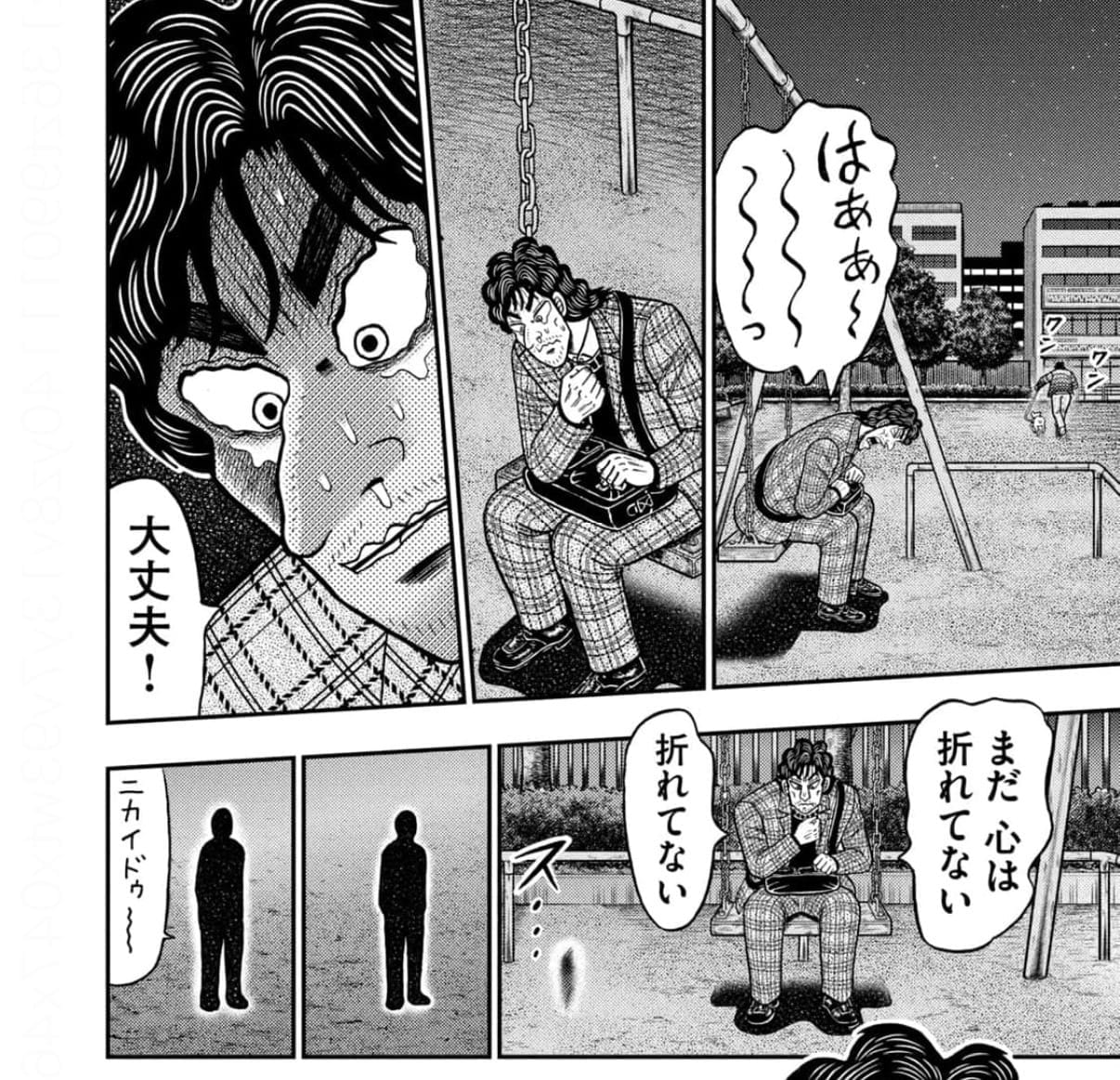
Right at the end of the very first chapter, Nikaido sees a small, shadowy man that seems to be calling his name in a tiny voice. He initially dismisses it as an illusion, remarking that everyone sees things from time to time, but a myriad of events eventually exposes this mysterious figure as a way to travel back in time. Even so, Nikaido is only able to do so by about five seconds, making this ability only really useful for golf and almost nothing else.
You might think that the ability to turn back time would remove almost all of the tension from a sports story, but this is kind of the point. Nikaido only awakens to his extraordinary potential after close to 20 years of the pro test, one failed suicide attempt, and his adoption by a group of like-minded losers who idolize his dog-eyed determination. The sheer length of time that Nikaido has devoted to the dream of becoming a professional golfer, coupled with his tendency to lift up and inspire others across the country, allows him to come to the conclusion that even a victory won through cheating is worth something.
Or is it?
Countless mornings at the driving range, all of those wasted hours fishing balls out of ponds and sand pits, as well as the cumulative frustration of failing to land a good put make it hard for Nikaido to really accept this point of view: he knows how hard golf is and how much work is needed to win a tournament. To make things worse, one of his opponents in the final round of the pro test also turns out to be cheating through collusion by moving his balls during plays to the green from the roof. Nikaido immediately recognizes that this is wrong, but is he really in the position to judge?
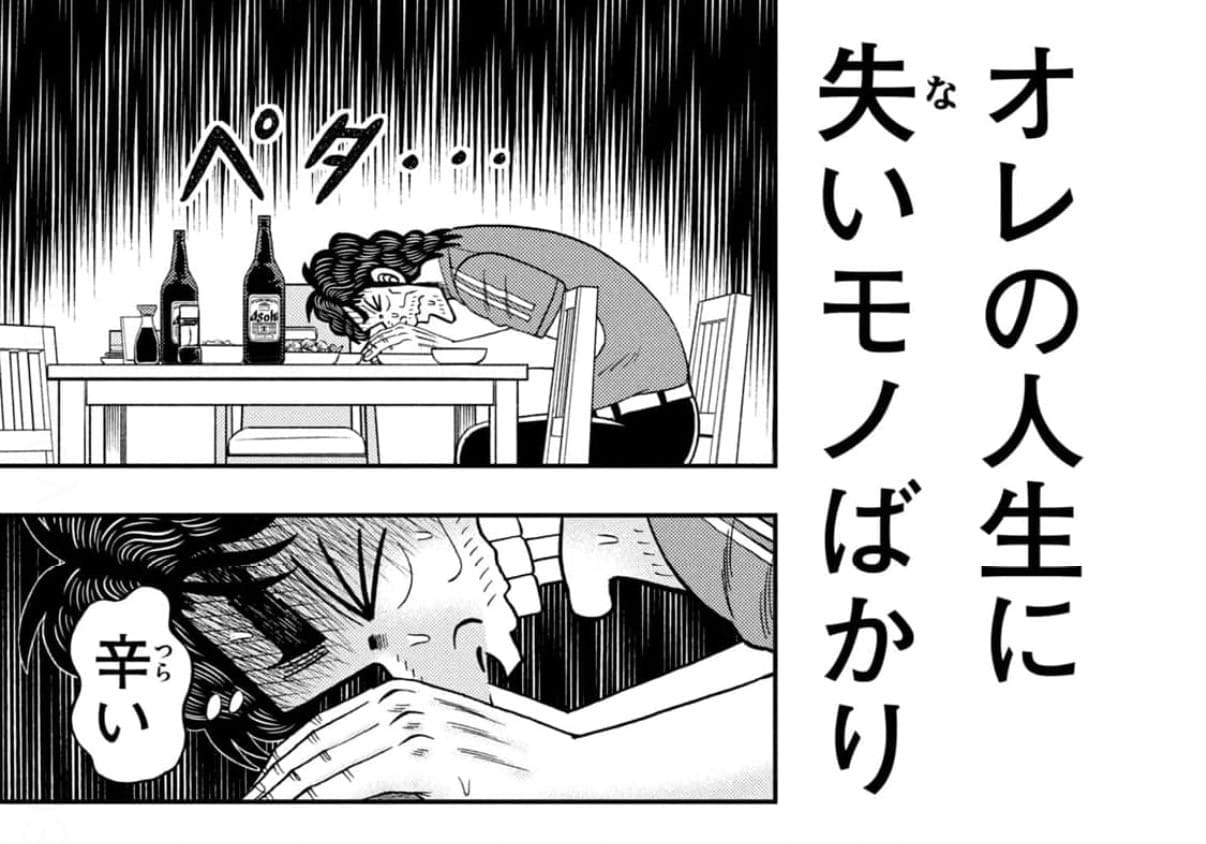
This contradiction lies at the heart of Nikaido Hell Golf, as well as the sense that each added layer of moral quandary serves as some sort of divine punishment. Just like the title, perhaps Nikaido does not just find golf to be hell, but is actually stuck in some sort of golf-themed hell: this would explain why every little thing, from his ability’s specific use case to his rivals for the pro test, serve to trap him further in self-doubt. Nobuyuki Fukumoto famously did send another character to meet Enma in Akagi, so it wouldn’t exactly be a left turn.
What really sells the feeling of endless torture is the sheer amount of time that Nikaido Hell Golf covers, going from Nikaido’s debut as a fresh faced rookie to an ancient 48 year old hopeful. Seeing failure is never pleasant, but seeing someone repeat the same mistakes over and over again is another thing entirely. Other than awakening to his time-warping ability, the narrative never outlines a grand shift in Nikaido’s approach in response to continued failure: he just continues to practice diligently, wondering why he even tries in the first place.
Throughout all of his trials and tribulations, Nikaido comes into contact with many characters, but none prove as important as Kasumi. Introduced in volume two, Kasumi is a part-time idol who works at a local snack bar to make ends meet: a kind of pub in Japan where most or all of the employees are young women. Her dream to break through to the mainstream with her group ‘Literature Girls’ mirrors that of Nikaido’s and provides him with the courage to continue taking the test, even if most other people around him view passing it as impossible.
Although romantic feelings are implied on both sides, this doesn’t come to a head until Kasumi decides to leave Tokyo and return to her hometown in Ibaraki. Completely distraught, Nikaido follows her and seriously considers giving up golf if it means that they can be together, but the time away actually gives him new insights into the game and renewed confidence that he can finally clear the bar. Their final scene is a heartbreaking one, with Kasumi finally confessing her feelings as Nikaido walks away, unable to escape the hell of his own choosing.
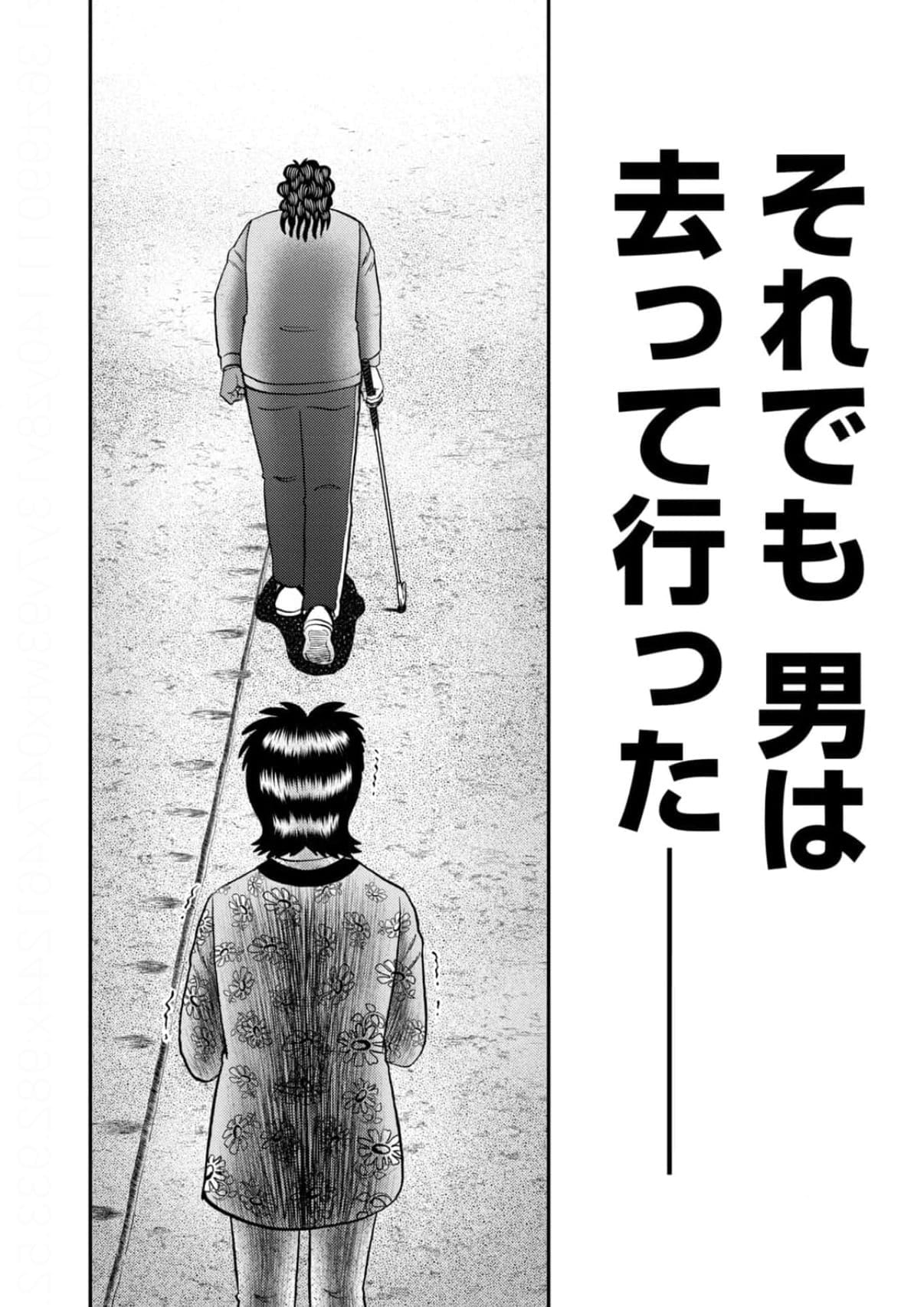
From a narrative standpoint, Kasumi provides Nikaido with the necessary character motivation to continue moving the plot forward. At the same time, just how Nobuyuki Fukumoto chooses to resolve this plot point will determine the ultimate moral of the story: shouldn’t a character like Nikaido, who has worked so hard and suffered so much, get what he wants in the end? Or should his sins against the game and selfishness be punished with eternal solitude, casting him deeper into damnation?
Indeed, both end points are logical and even probable looking at the tone of Fukumoto’s previous works. No one ever forgets the heartbreaking twist at the end of Saikyou Densetsu Kurosawa, while Akagi rounded up on a surprisingly hopeful note following the conclusion of a decades-long mahjong game. The fact that either outcome could come to pass just stands as another reason to dive into this fantastic story.
Nikaido Hell Golf is currently serialized in Kodansha’s Morning magazine. You can read it online via the official Morning website.