
Given that the manga market surpassed ¥692,500,000,000 (around $4,353,744,037 USD) in total revenue last year, you might be forgiven for thinking that all is well. Not only does the medium continue to produce staggering numbers, it also still occupies a central place in the Japanese pop culture landscape when it comes to adaptations and other joint IP ventures, despite growing competition from the likes of light novels and webtoons. Even so, a recent article by industry analyst Ichishi Iida on President has exposed some dangerous trends among young readers that should cause serious concern about the future.
First of all, the falling circulation of manga magazines is a well-known story at this point. Almost every year, some kind of report comes out to highlight the slow death of the anthology, but Iida has some interesting data to share on the subject. It turns out that high schoolers used to read as many as 10 publications every month at the highest point of literacy in 2004: the proportion of students who read none at all rose to 77.7% in 2023, constituting a tremendous decline in a very short amount of time.
Within this decline actually hides a surprising stability among male readers. According to surveys from both 1996 and 2019, the most popular magazine among elementary school students remained Shogakukan’s CoroCoro Comics, along with Weekly Shonen Jump for middle and high schoolers. The preferences of female readers, on the other hand, have shifted considerably across the board: elementary school students now read Ciao instead of Ribon, middle schoolers prefer nicola over Myojo, and high schoolers have taken up Myojo over SEVENTEEN.
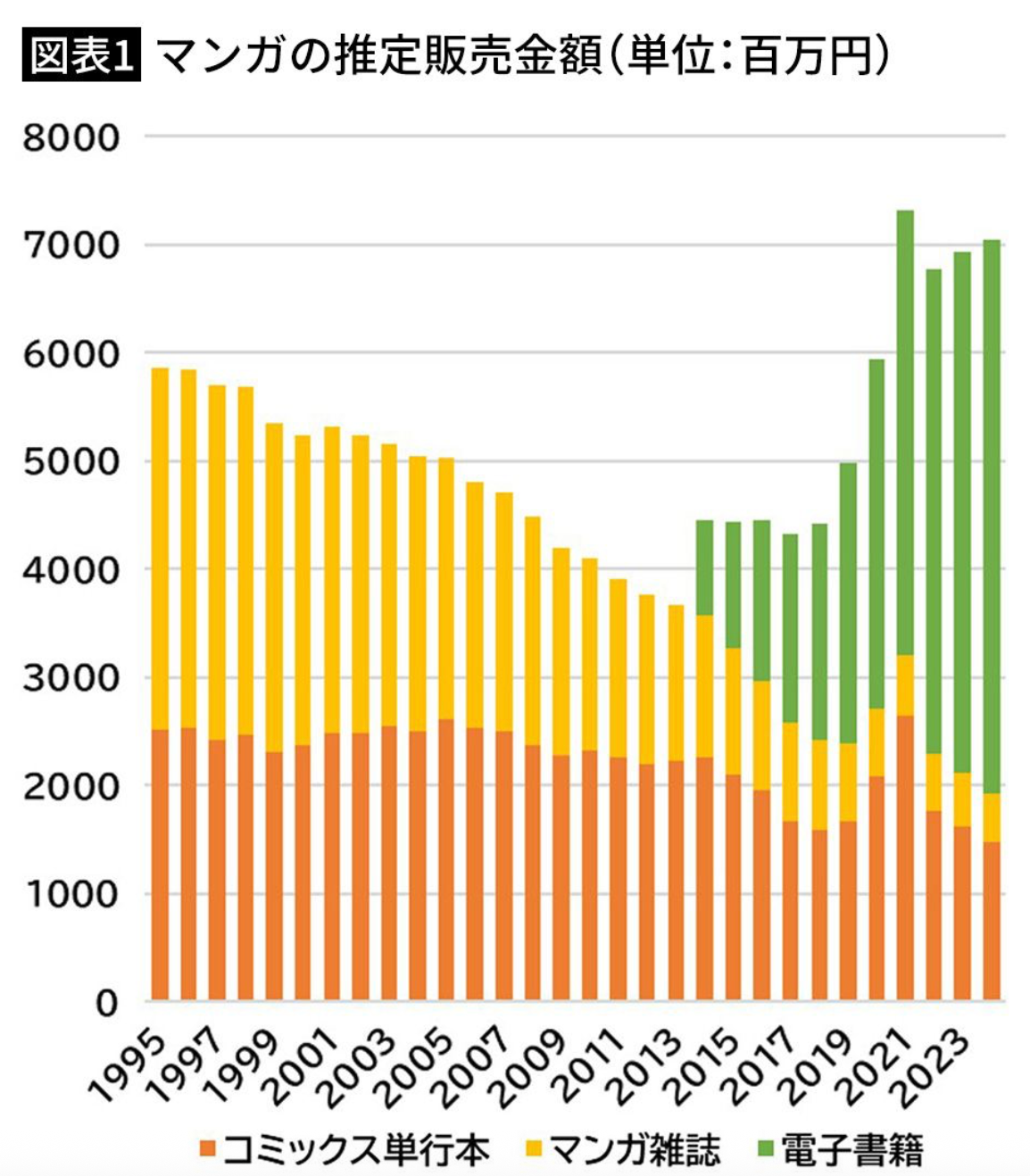
In any case, the presumption has always been that young readers have simply switched over to digital manga. Last year’s industry report put digital manga sales at 76.1% of the total revenue as opposed to magazines at 5.7% and physical volumes at 18.2%, but Iida’s research claims that only 49% of high schoolers were reading digital manga in 2023. That number drops to 35% among middle schoolers and further still to 15% among elementary school students, suggesting that the majority of the market’s growth is being driven by older demographics.
One major point of comparison here is the Korean comics industry. In stark contrast to their Japanese counterparts, the number of Korean high schoolers who read digital comics stands at an overwhelming 70%, followed by 69% and 45% for middle schoolers and elementary school students respectively. Aside from the recent proliferation of popular titles, part of the reason why is that Korean webtoons are usually completely free to read online or via an app, with the majority of revenue coming from advertising.
Digital manga in Japan, on the other hand, is usually only available in ebook format for a similar price to what it would cost to purchase the physical book. Jujutsu Kaisen is a good example here given that Weekly Shonen Jump is the most popular magazine among middle school and high school students: although certain batches of chapters occasionally go free as part of a special campaign or as a tie-in to an airing anime, the only way to read the series online consistently is to buy individual volumes from a digital manga services such as Comic Cmoa or Book Walker.

The problem here is that middle school students and high schoolers don’t necessarily always have a payment method that they can use on online platforms such as a credit or debit card. Even PayPay, perhaps Japan’s favorite way to pay outside of the traditional chip and pin, requires a bank account to configure automatic top up or a trip to the nearest ATM to replenish your balance. In short, the barriers to entry for minors are much higher than adults, resulting in a downward trend in interest from the younger generation.
Furthermore, Iida makes the argument that precisely because the number of children and adolescents engaging with the medium has fallen, less and less series are made with those audiences in mind. Shonen manga has arguably never been more popular and pervasive than it is right now, but the amount of series aimed at elementary schoolers outside of CoroCoro certainly seems much more limited than it was in the past. The fear is that without this entry point, the next generation of manga lovers cannot be born.
Does this mean that manga is doomed? Probably not, given that plenty of consumers above the age of 18 still engage with the medium and drive record-breaking amounts of revenue. Nevertheless, the way that the industry’s current preferred method of distribution locks out certain customers should give some food for thought… history is littered with the corpses of dead artforms.