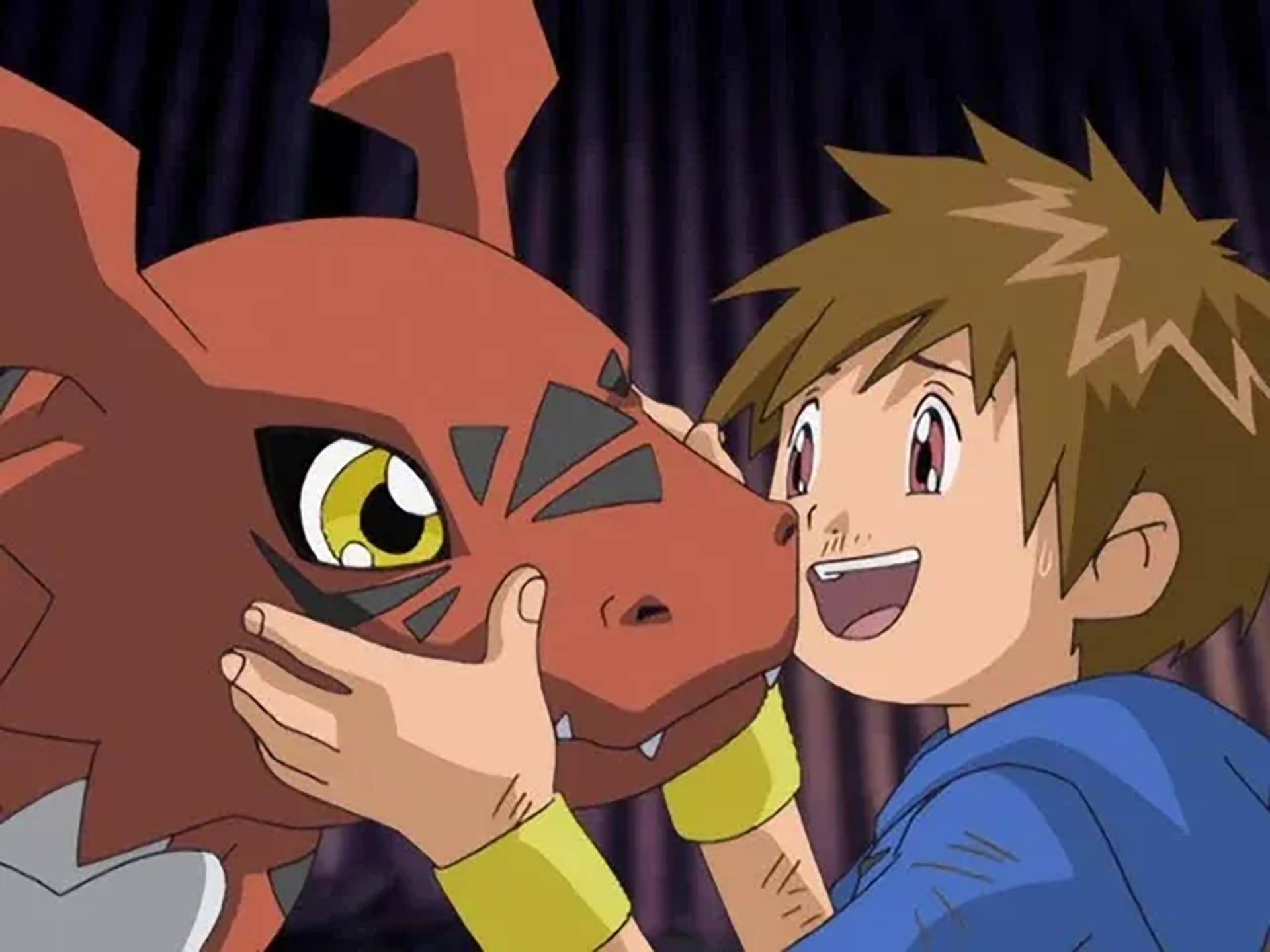
Digimon Tamers was one of my favorite anime series growing up because of how scary it was. While other series like Pokémon promised happy-go-lucky adventures in a static world, Tamers ended with a Lovecraftian entity kidnapping the protagonist’s best friend and plunging Shinjuku into darkness. Characters in this series didn’t just grow or change for the better–sometimes they became worse. In that sense Tamers felt like permission. I didn’t have to be satisfied with cute and cuddly stories for kids. Weird stories could be cool too.
Since the series is approaching its 25th anniversary, I decided that now would be a great time to revisit it. The first episode was just as eerie and atmospheric as I remembered. As I continued watching, though, I came to appreciate something that I missed the first time around. Digimon Tamers isn’t just special because of the “digital monstrous” angle. It’s the “Tamers” aspect that is the heart and soul of the series.
Before it was an anime cultural touchstone for millennials, Digimon was a Tamagotchi variant for boys. A Tamagotchi toy was a simple virtual creature you were expected to feed and care for. A Digimon by comparison was like a hyper-buff Tamagotchi bred to fight. As Daniel Dockery wrote in his book Monster Kids, “their purpose was singular: to train, to fight, to evolve into something stronger, and then, one day, to die.”
It’s no surprise then that the early seasons of Digimon, titled Digimon Adventure, leaned into the battles. The first two seasons were staged as portal fantasies in which children traveled with their monster partners to save another world. Every episode promised a new evolution and special power, just like the gradual introduction of weapons and toys in Japan’s live action tokusatsu shows. The journey aspect on the other hand brought not just Pokémon but also Dragon Ball to mind.
That’s not to say that the Digimon anime excised the “raising” aspect entirely. Some of the most memorable episodes of the series, like the one in which Tai pressured his Agumon to evolve into a terrifying monster, leaned into this dynamic. But they were the exception rather than the rule. Digimon Adventure was first and foremost (you guessed it) an “adventure.”
Digimon Tamers brought the “raising” aspect to the forefront. Its protagonist Takato is a young boy living in the real world who longs for a Digimon of his very own. His dream comes true when the Digimon he created, Guilmon, emerges from cyberspace. This new creature is very different from the monster partners of the past. Agumon had a fully fledged personality when he first met Tai in Adventure. Guilmon by comparison is a baby. A large, dangerous baby.
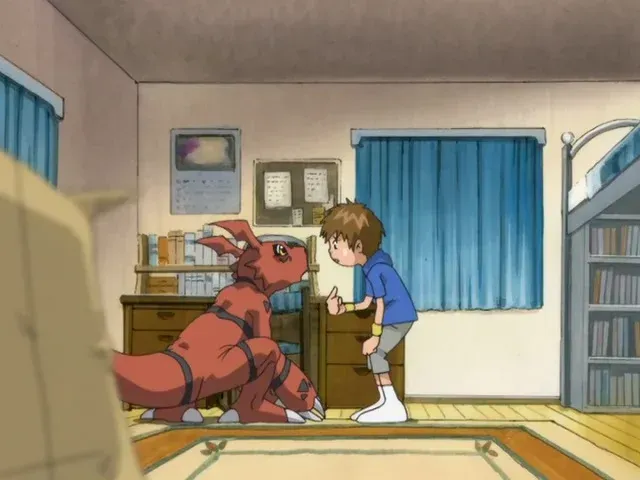
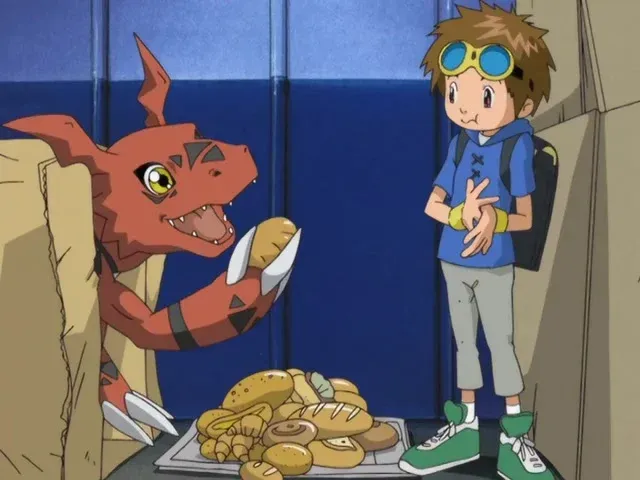
Caring for Guilmon proves to be much more challenging than Takato expected. He’s too big to pass as a house pet, so Takato has no choice but to find a place for him to live away from home. Guilmon has an appetite, so Takato steals from his family’s bakery and the school cafeteria to feed him. Also, while Guilmon is friendly, he becomes frightening and unpredictable when other Digimon appear. Takato must manage his animalistic streak in ways that Tai never had to worry about with Agumon.
That’s one reason why the stakes in Tamers are so much higher than in the earlier seasons. Guilmon isn’t just a new friend for Takato. He’s a child that Takato must raise. Being responsible for another life is a heavier responsibility than just “saving the world.” Also, Takato’s just a regular kid, and regular kids routinely kill their Tamagotchis by mistake. It’s not easy to feed and care for a talking, fire-breathing saurian.
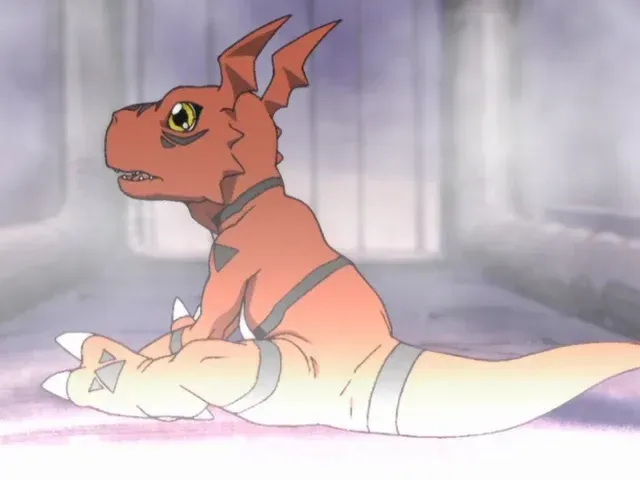
There’s a great early episode where Guilmon evolves into his “Adult” form, Growlmon, for the first time. At first it’s a moment of celebration, something that Takato and Guilmon have been working towards since the start of the series. But Growlmon can’t change back to his “Child” self on command. He’s too big to fit in its former home or to hide from other people. Eventually he becomes so forlorn that Takato breaks down crying. It isn’t until a rainbow appears, and Growlmon calms down, that he is able to become Guilmon again.
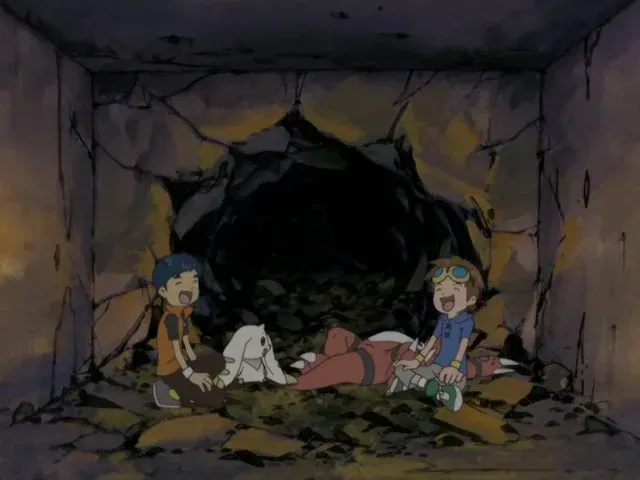
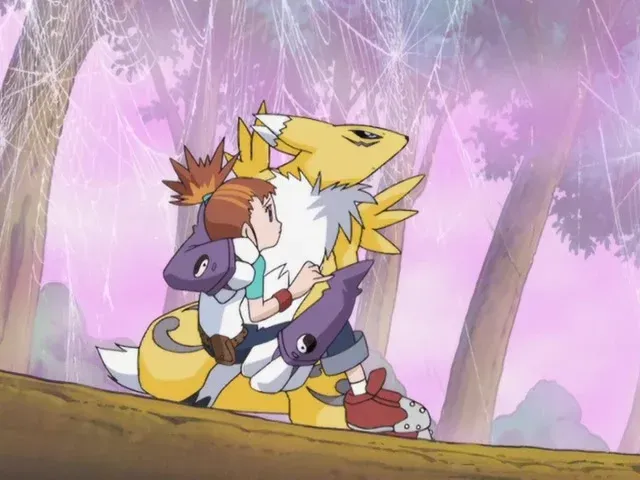
Takato’s tamer peers (and their partner monsters) mix up the status quo in other ways too. Jianliang feels guilty for making his partner Terriermon fight and kill other Digimon before he knew it was a living (rather than virtual) creature. He’s reluctant to send him off to battle even though Terriermon badly wants to protect his friends. Meanwhile, Ruki treats her partner Renamon like a servant who must obey her every whim. In reality, though, Renamon is more like her concerned aunt. The two can’t function as partners until they learn to respect one another as equals.
Then there’s Impmon, a wandering creature who doesn’t see why Digimon should obey humans in the first place. What gives them the right? Impmon can be a nuisance, but his concerns are in fact justified. There are people in the world of Digimon Tamers, like the secret organization Hypnos, that work to control and even destroy Digimon without the consent of Digimon themselves. While some Digimon are in fact very dangerous, Hypnos is positioned by the narrative as an organization of out-of-touch adults who misunderstand what Takato and his friends have learned through first-hand experience.
Tamers wasn’t the only show for children that asked its audience to consider what it was like for another creature to depend on them. Ojamajo Doremi #, the 2000 sequel to the 1999 magical girl masterpiece Ojamajo Doremi, introduced a magical baby for its cast of young witches to supervise. In a particularly memorable episode of the series, when the heroine Doremi confesses to her mother just how difficult it is to care for a child, her mother slaps her. Why are you worried about yourself, she says, when this baby is depending on you?
It’s a scene that I think is too harsh in retrospect. No child should be in the position of having to take care of another. Yet it is true that children must learn how to treat others that are smaller and weaker than them–hamsters, rabbits, and yes, other kids. Whenever Ojamajo Doremi approached emotionally fraught material, it was always in service of letting kids see their experiences represented on screen, including the difficult and scary ones.
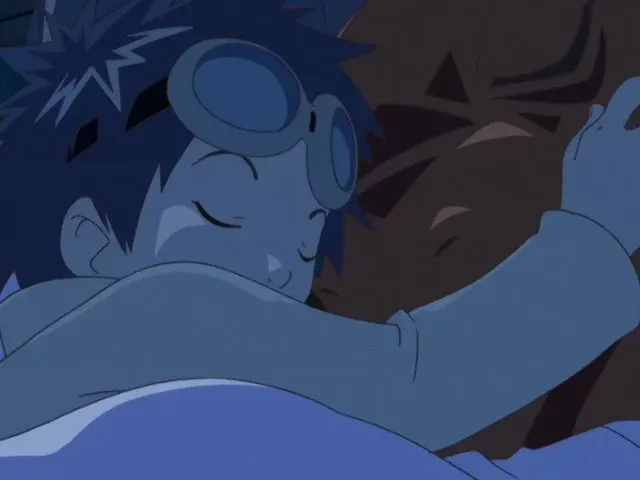
Digimon Tamers was targeted at young boys rather than girls. So its protagonist, Takato, raises a fire-breathing dragon instead of a baby. Still, as a children’s series, I think that the staff took these lessons very seriously, just as the Doremi staff did. Series director Yukio Kaizawa (in an interview archived by Ravel Monte on the Digital World Archive) discussed how he wanted “a story very focused on realism,” and thought through questions like “if an average child were to see a Digimon on the street, what would they think?” Scriptwriter Chiaki J. Konaka on the other hand took lessons from his own childhood experiences watching Ultraman. Just like that series (which he contributed to as a writer through the late 90s) he and his fellow writers interspersed child-friendly material with more complicated scenes he hoped would stick with the audience until they became adults.
For this reason, I think that Digimon Tamers deserves to be remembered as something more than “Digimon by way of Evangelion” or “Lovecraftian Pokémon.” This was not a series that was made to frighten children or impress older viewers. Kaizawa, Konaka and company wanted their audience to think critically about what it would be like to have a monster of their own. Would you take care of it? Clean up after it? Become its friend, no matter how big or scary it was, in the hope that it would trust you as well? Digimon Tamers embraces the values of Tamagotchi, and therefore Digimon itself, for the first time in its history. That’s why it matters to me so much.