The best bit running across the anime adaptation of Tamon’s B-Side involves heads exploding.
Whenever high-school protagonist Utage Kinoshita or another young woman entranced by the members of rising male pop group F/ACE have an experience with them that gets their hearts racing, their noggins burst into pastel pieces or mini fireworks displays. At times the aftermath features their bodies blurred out like we are looking at crime scene photos. Murder by fanservice.
It’s a touch underlining the most interesting element of Tamon’s B-Side (Tamon-kun Ima Docchi!? in Japanese, currently airing on Tokyo MX and streaming services). This series excels as a snapshot of oshikatsu — supporting favored celebrities or characters — in 2020s Japan, both touching on the realities of intense fandom and capturing the experience of loving an entertainer, something only becoming more common globally.
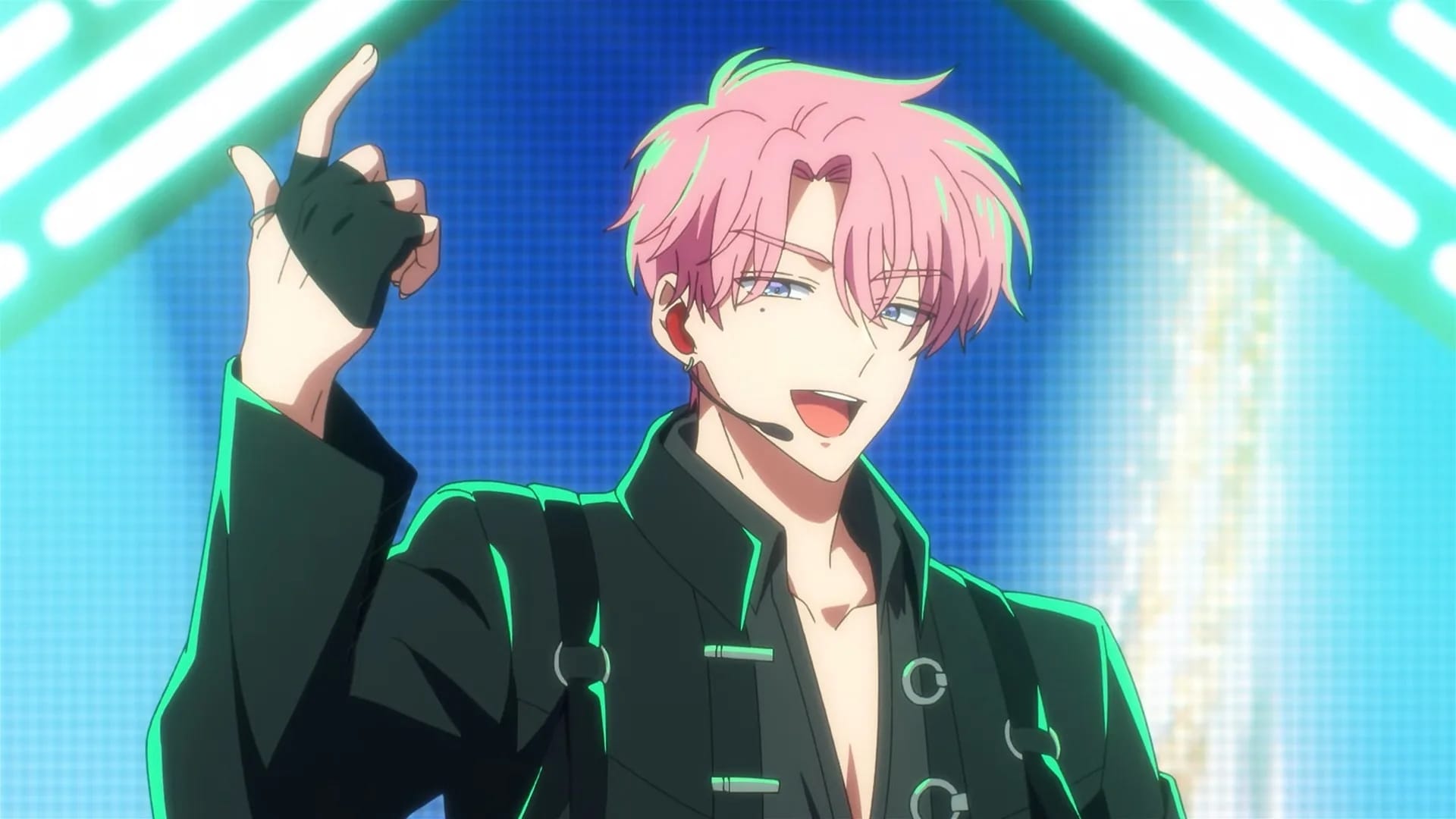
All the sociological stuff, though, plays out amidst a silly fantastical romance. Aforementioned 16-year-old Kinoshita is all in on pink-haired F/ACE member Tamon Fukuhara, a pure being running on coolness and suaveness. She watches any show featuring him (to the chagrin of her family) and her room is basically a temple to him. She works part time at a housekeeping company, and one day she subs in for a sick co-worker. The client? Fukuhara, who in reality is much more timid and anxious, but can switch into idol mode (and cause Kinoshita’s cranium to go boom).
From there its main plot becomes a slightly zany romance story that can feel a little too juvenile at times, not helped by a case of anime attention deficit disorder resulting in a flurry of gags that never get a chance to stretch out. Still, B-Side is a largely charming show made better by its attention to the current state of oshikatsu, a dose of reality amidst fantasy.
Quintet F/ACE is modeled after any number of 2020s groups put together via reality competition shows (think JO1 and BE:FIRST within J-pop, though it extends to the likes of KATSEYE and ZEROBASEONE), tapping into a boom in male idol outfits, albeit one with a long history in Japan via acts from the STARTO talent agency (formerly Johnny & Associates). F/ACE in the show exists a couple years after debuting, big enough to play a sold-out show in Tokyo Dome but still on the rise. They’ve achieved a lot, but not everything.
Which is the exact situation needed to cultivate fanatic oshikatsu. While a dream-like love story sits at its center, Tamon’s B-side shines when highlighting the details of this modern practice, whether it’s getting a glimpse of Kinoshita’s bedroom-turned-temple to Fukuhara or a quick reference by Kinoshita around her pay day of now being able to buy multiple copies of a recent single.
It’s a welcome inversion of how fandom has long been presented in Japan. This type of obsession used to be associated with the male otaku, the seemingly hopeless AKB48 fan buying boxes of CDs only to abandon them on a mountain or the type of dude who spends big bucks to shake their faves hand for two seconds. The truth is idol worship extends to all genders, and Tamon’s B-side updates many stereotypes for female fans — who, it turns out are just as eager to stand in a line to meet their oshi (and duke it out with those who badmouth them).
As a crash course in how pop fandom in Japan (and elsewhere) looks, it’s a solid point of reference. Yet what elevates it on this front is its ability to capture the experience of oshikatsu, and touch at the “why” of putting so much energy into cheering for a pop star they don’t know.
Consider Tamon’s B-side kind of a mirror partner to Oshi No Ko, also currently airing. The latter has been hailed for showing the “dark side of the idol industry,” though in reality it’s a series offering a look at the entire experience of being in Japanese entertainment (thus far, season three has argued “variety shows…a cancer on society”). Tamon’s B-side documents what it means to be a fan of all this, with the peaks behind the curtain more about comedy and humanizing than exposing the skeletons in the broom closet.
In the same way Oshi No Ko captures the thrill of being an idol, Tamon’s B-side shows what it means to be a superfan. The situation is elevated to the point of absurdity, but Kinoshita’s devotion to Fukuhara reflects how many approach oshikatsu. It’s about supporting your favorite and helping to make their dreams come true, whether by watching them religiously on TV or buying acrylic stands or going to every live show with a sign in hand. That devotion is key here, and the most interesting development.
Ironically, that very touch has spilled over to the real world, as F/ACE has gained momentum IRL. The series itself has become a surprise hit of the winter anime season, while the songs the fictional group perform — especially opening tune “Sweet Magic” — have crashed assorted streaming viral charts, racking up an impressive amount of plays.
Even a show shining because of how it captures fandom ends up benefitting from the practice — now that’s the stuff that can really get your head blowing up.