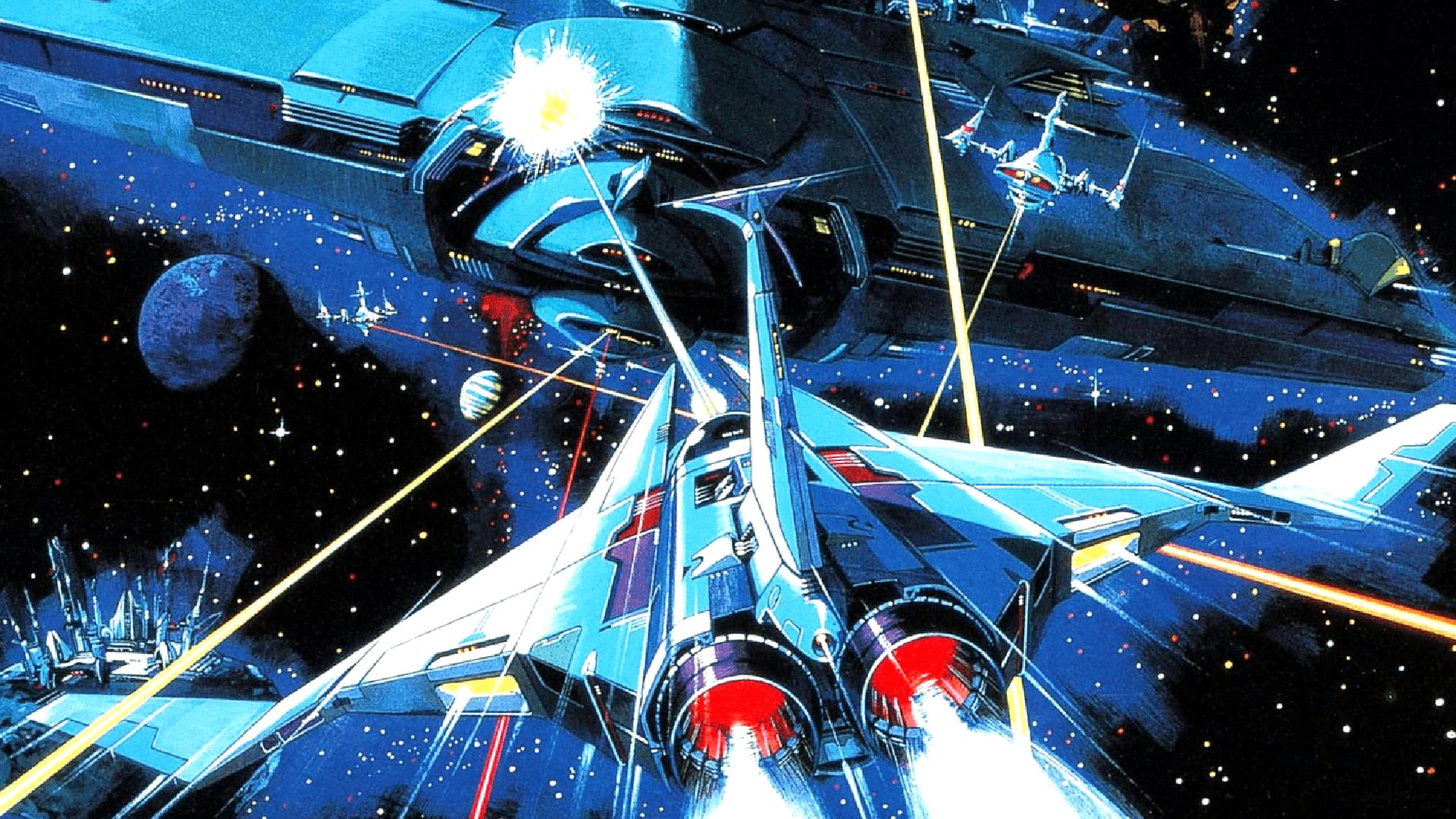
The late 70s and early 80s were a renaissance period for arcade games, with some prominent stand-out classics in the space shooter variety, such as Space Invaders and Galaga. Both featured rather simplistic gameplay, but were the beginnings of the shump genre – one where the player controls a spacecraft of some sort and shoots enemies such as aliens, monsters, or enemy ships. Konami, which had been releasing their own coin-operated arcade machines throughout the 80s, was working on a follow up to their 1981 shooter Scramble, which eventually morphed into the game we know today as Gradius.
Many of the precursors in the genre (and arcade style games as a whole) were single-screen games wherein clearing the board was the goal of any stage. Leading into the video game boom of the 80s with games getting more advanced, the concept of a stage was changing into something much more complex; a large area of different obstacles with a boss sometimes waiting to gatekeep the player at the end. Gradius marks one of the earliest attempts to delve into this style of gameplay in the horizontal shmup genre, while also innovating player power progression by giving the player some level of agency in which powerups to purchase through collecting capsules, and in which order to activate them. Not only did this diversify the gameplay directly, it also added a sense of strategy and risk, as choosing to hold off on cashing in for a weaker powerup to wait for a stronger one could often be dangerous.
Gradius tend to remain relatively similar in structure over its sequels
When you have an iconic formula that works, releasing simple variations of that formula as hardware power increases is a safe bet to success, and Gradius has always done just that.
The first sequel came in 1988 with Gradius II: Gofer’s Ambition, and featured a few minor tweaks to the power-up system, allowing for some more choices in terms of weapons and subweapons. It also borrows some inspiration from Salamander, a spin-off series released between the first two Gradius games that features the same Vic Viper spaceship. Gradius II was not very well-known outside of Japan, as the Famicom version was never ported due to using a special custom mapper that would be difficult to standardize for use with NES hardware. Konami most notably did the same thing with Castlevania III: Dracula’s Curse, although going out of the way in that case to standardize the mapper used in that case for other regions, which resulted in among other changes, different, less detailed music.
Gradius III was released in 1989, and featured some more powerup agency with the weapon edit feature to mix and match, and was known as one of the launch titles for the release of the Super Famicom console hardware a few years later. The SFC version did feature some amendments to level design, opting to completely remove or reorder some stages from the original release, and added some new Option types, Option in the Gradius sense of the word meaning the orbiting satellite power-ups that mirror the Vic Viper’s primary weapon.
Both Gradius IV and Salamander 2 were mostly kept to Japan, and didn’t receive foreign ports. However, Gradius V made its way globally to the PS2 in 2004, and was developed by Treasure, the company behind two other iconic shumps, Radiant Silvergun and Ikaruga, the latter of which is one of the most infamously well-known and challenging shmups of all time. Gradius V offers a fresh, moderately challenging, but ultimately much more casual-player friendly way to experience the old-school style gameplay found throughout the entire series.
Gradius is a piece of gaming culture even among those who might not know it by name
Perhaps one of the most iconic take-aways from Gradius in the worldwide sense is the so-called famous Konami Code, known as a piece of gaming history by older and younger gamers alike. Also featured in Contra, the code is exclusive to the NES versions of both games, which were considered difficult games at the time, as a way for the player to gain a large pool of lives and power-ups. References to the code have been embedded in gaming culture ever since, even decades later as now older players recall their oldest childhood gaming experiences being held together by the glue that the advantage of knowing the code provided, as if it were a rite of passage.
In the purely Japanese sense, Gradius is known as one of Konami’s historical iconic franchises in a broader sense, and is referenced in gaming culture more frequently. There is even a series called Parodius, that takes the same style of gameplay but skinned with whacky characters such as octopii and bunny girls.
While the series hasn’t been as impactful in western gaming culture, it is still regarded as a classic in the genre, and celebrated as such. Most recently, Gradius Origins released worldwide for modern consoles and Steam, offering a way to play many of the arcade titles on a console for the first time. For anyone looking to experience the classic Gradius gameplay and see how it has evolved over the years, it is a highly valuable purchase.