Where do you even begin with a manga that has over three thousand chapters? That’s the question many face when trying to get into Golgo 13, current Guinness World Record holder for the most volumes published for a single manga series with 201 books. Takao Saito’s seminal series has many acolytes across the industry, but the barriers to entry are immense.
My answer came one snowy day in Asahikawa, Hokkaido. We had taken shelter in a local Book Off while waiting for our turn at a conveyor belt sushi restaurant when my eyes fell upon a massive, 1000 page volume containing thirteen of the best Golgo 13 stories as chosen by readers in 2001. It even featured interviews with such figures as Osamu Akimoto, creator of KochiKame, playwright Kouhei Tsuka and journalist Shuntaro Torigoe about their favorite episodes.
Although a deep dive on Golgo 13 was always on the cards at some point in this series of articles exploring landmark manga, I never once imagined that it might follow the likes of Astro Boy and Ashita no Joe. Once the source fell into place, however, so did everything else. Could I really come to understand someone’s life work with such a small sample size? Or would the man with a thousand faces continue to elude me forevermore?
The Man Behind the Myth

Takao Saito never wanted to be a “manga” artist. Having grown up with the works of Osamu Tezuka, he saw the word as a part of the reason why comics in Japan continued to be regarded as disposable entertainment for children, alongside the influence of the God of Manga’s early works. Rather, he always wanted to be known for “gekiga”: replacing manga’s “man” with “geki,” meaning “dramatic” as opposed to “whimsical.”
Far from just simple semantics, this new name reflected the changing dynamics of the industry at the time. Despite assumptions to the contrary, those who spent their childhood reading comics in the postwar period continued to do so into adolescence and even adulthood, creating a demand for more mature works. No one knew this better than Saito: he was part of this generation and even started his career by penning adult-oriented works for lending libraries while based in Osaka.
That output earned Saito a place in the “Gekiga Workshop” alongside such figures as Yoshihiro Tatsumi and Masahiko Matsumoto. While short-lived, the group played a pivotal role in defining gekiga as a distinct style away from manga in response to changing circumstances. Alongside such works as Skyscraper and Musou, perhaps the most famous thing to come out from the group was a postcard sent to over 150 publishers in 1959 that reads, in part:
“The world is constantly in flux. The art of manga, stemming from the work of Tobo Sojo, has also been making steady progress. Not only has it now split into two halves with works aimed at children and those aimed at adults, significant genre divisions have since emerged, with adult manga now including political works, sexual works, works that focus on the family, as well as narrative works. Like different branches from the same tree, they are now heading in completely different directions.”
While it was from the Gekiga Workshop that Saito drew his preference for the term “gekiga,” he didn’t stay for long. After resigning from the group in 1960 alongside Yoshihiro Tatsumi and Masahiko Matsumoto just one year after joining, he formed his own company by the name of Saito Production. The idea of working as a team remained attractive, however, with Fumiyasu Ishikawa joining Saito’s staff roster from the workshop to work as an artist.
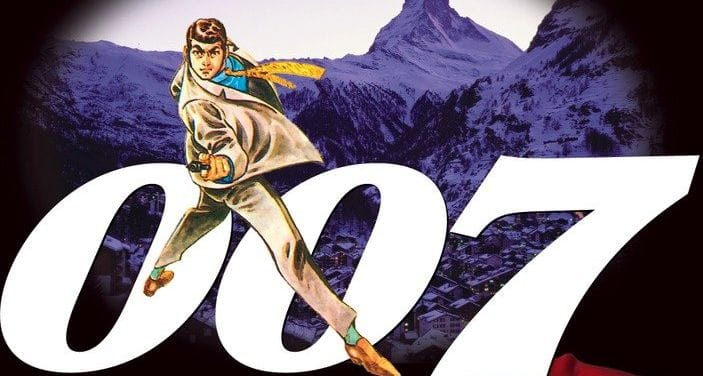
In hindsight, the road to Golgo 13 from here seems like a foregone conclusion. Nevertheless, the reality is a little more wonky: Saito had seen great success with the detective series Typhoon Goro in the late 1950s and continued to produce new stories with his new company for various publishers. He even penned an adaptation of Ian Fleming’s James Bond novels for Boy’s Life in 1964, which could have planted some seeds for the birth of the future assassin.
All of this begs the question: how did Golgo 13 come about? In a 2020 interview, Saito explained that he was told by his editor to draw something more mature following the conclusion of another series for the newly-established Big Comic. Given that Saito had been talking for years about the need for more mature stories in the medium, it didn’t take long for the general concept for the series to come together with the help of other Saito Production team members.
Somewhat hilariously, Saito admitted in the second part of that interview that he only had ideas for about ten different chapters when Golgo 13 began serialization in 1968. “Everything after that is just a detour,” he joked, drawing a sharp comparison to the series’ current length. His last feature for Big Comic only lasted for nine chapters, so the precedent was there. Little did he know that this work would end up defining his whole life and career.
The Man With a Thousand Faces
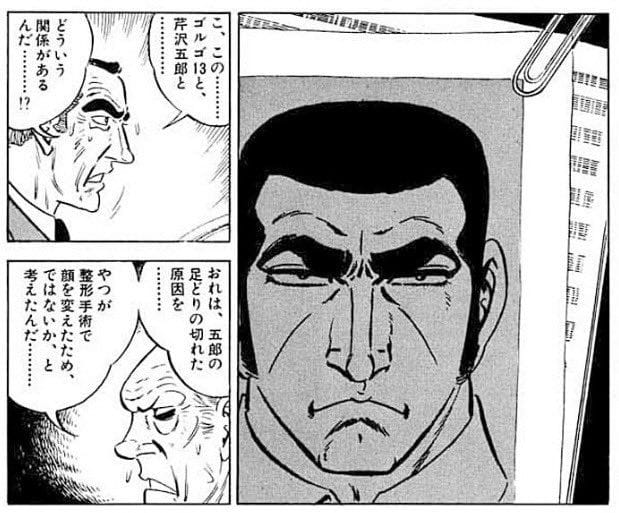
The structure of a typical Golgo 13 story is surprisingly varied. Sometimes it begins in rather typical spy fashion, with the titular character receiving a mission or target from a client, but sometimes he is nowhere to be seen. Part of the fun can come down to figuring out how exactly the story will weave Golgo into the intrigue of a scenario that gets more and more complicated: one example is “The Murder at Serizawa’s” from 1975, where Golgo is only shown through drawings and photographs before murdering the point of view character in the final few pages.
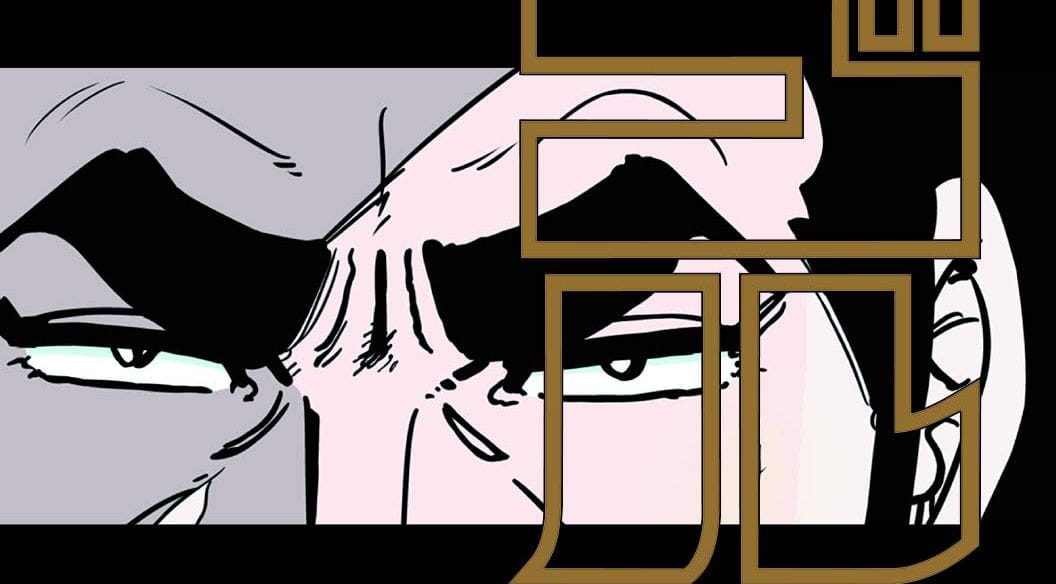
For those not in the know, Golgo 13 is the story of elite assassin Duke Togo, AKA Golgo 13. He’s the best gun for hire in the entire world with an expert level proficiency at sniping and a price tag to match. The series mostly revolves around his missions, which take place on an international stage and often touch on current events. No one knows where he came from, where he was born, or how old he is. Just that he gets the job done, no matter the circumstances.
Considering the series’ extreme length, you might expect that it would have little in the way of continuity. This couldn’t be further from the truth: while Golgo’s missions are more or less self-contained, they do occasionally reference events from past stories. While my frame of reference is limited, “The Queen of Mysteries” from 1979 appears to be particularly important as many characters subsequently reference the time when an English mystery author got close to publishing a book about the mysterious assassin’s origins. It all ends in death and destruction, obviously.
No fewer than three stories in the readers’ choice anthology touch on the idea of revealing where Golgo was born and how he became such a proficient assassin. “Azuma Kensaku, the Japanese” from 1972 posits that a young Golgo killed and murdered his parents in cold blood before being raised by a covert black ops organization, while “Mao Zedong’s Last Will and Testament” from 1981 even suggests that he could be the product of a eugenics program conducted by the Japanese army during the Second Sino-Japanese War. Both of these possibilities are never refuted outright, leaving the reader with more questions than answers by the end.
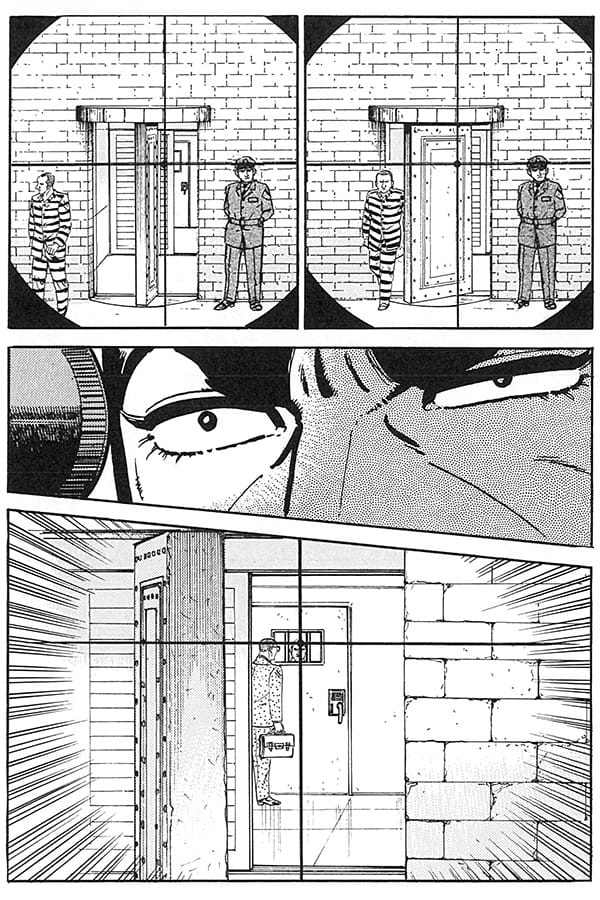
If anything, Golgo is represented as more of a force of nature than a human being with any real origins in society. By far my favorite story from the collection was“1 Second Out of 36,000 Seconds”: this relatively short adventure from 1994 sees Golgo take on the task of assassinating a man who is currently imprisoned in a high security facility. The only problem is that the only clean shot comes when two parallel doors happen to open at the same time to reveal the target’s cell down a corridor, the titular one out of 36,000 seconds.
Rather than rejecting the mission on account of these ludicrous conditions, Golgo instead tracks down a former East German sports scientist who can develop a doping solution to help him maintain the same sniping position for ten hours straight. He then simply watches, drugs in hand, waiting for his opportunity. There is no drama along the way: just slight inconveniences when an open shot is ruined by a passer-by or a centipede crawls up Golgo’s arm. Even when the scientist attempts to hand the fatigued assassin into the authorities at the very end, this is dealt with swiftly and efficiently in the manner of a true professional. Success is inevitable as rainfall.
The Man Above Men
Paradoxically, Golgo 13 isn’t really about Golgo 13 at all. Rather, the side characters that are introduced and usually die in each individual story are what make up the real emotional weight of the series. According to Saito, this is by design: he explained in the second part of that aforementioned 2020 interview that “If you start thinking about the story first, then things won’t go well. As long as you write the characters correctly, the story will write itself. That’s what we’ve learned after spending so much time in this world over the years.”
For Kouhei Tsuka, Eva Krugman is the ultimate example of this. Introduced in the 1974 story “Eva, Heading for the Sea,” she can be seen as a female foil to Golgo, albeit with a different method of killing. The two characters share a brief romance on a cruise ship before reuniting several years later, seemingly by chance… except for the fact that Golgo has accepted a job to kill her. He tells her as much, with the final pages leaving off on a view through Golgo’s sniper scope as her dead body continues to drive a motorboat into the horizon.
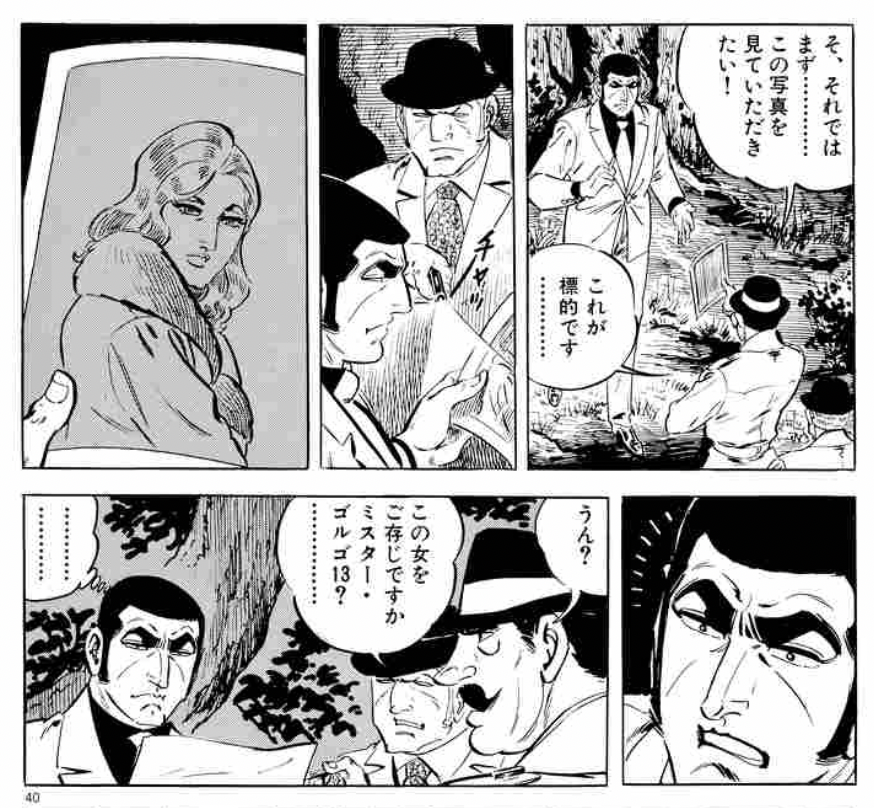
By his own admission, this singular scenario is something of an obsession for Tsuka. He imagines that maybe, just maybe, during the final days of her life, Eva may have even carried a fetus from Golgo, only accepting her fate because of the knowledge that her love was reciprocated. Despite the tragic conclusion, he ultimately sees their relationship as a liberating one, with Golgo providing Eva the opportunity to become a “normal” woman in a twisted way. The lack of perspective that the story provides on Eva’s inner monologue only makes it all the more intriguing.
For Osamu Akimoto, this interplay between Golgo and the side characters is precisely what makes the series so enthralling. He had actually been a fan of Takao Saito for a long time since before Golgo 13 ever launched, so it was something of a surprise to see the artist create a series with such a thin focus on the main character. Nevertheless, the growing cast only brought Golgo’s subtle idiosyncrasies further into focus, allowing the very occasional flashes of humanity from the usually silent assassin to carry more and more weight.
Speaking of the relationship between the protagonist and secondary characters, the very fact that Golgo almost never makes any kind of moral judgement on his missions empowers reader interpretation in a unique way. Another one of my favorites from the collection was “Snipe for the G String,” published in 1986: this story sees the main character take on a job for fictional violinist Thomas Simpson, who wants to inflict the same kind of embarrassment he suffered on a rival by severing his G string during the middle of a concert. The mission obviously goes off without a hitch, but Simpson is left gawking at the fact that his rival continues to play in a different octave, rendering his revenge utterly meaningless.
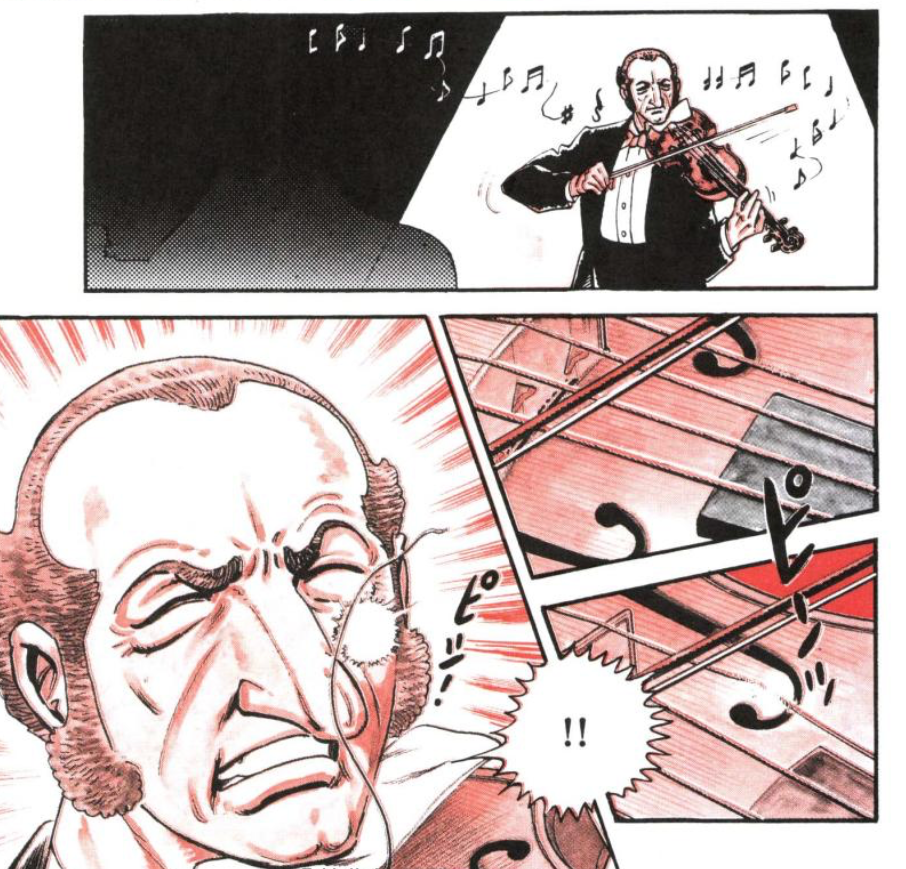
It’s often said that when seeking revenge, you should first dig two graves. Despite a doctor’s insistence that Simpson’s inability to play in front of others is nothing but a trauma response to the G string incident, he refuses to take a break. Pride then meets prejudice when Simpson learns that his replacement is Sergei Kelinsky, a famous performer from the Soviet Union. Simply unable to stomach the idea that a “Red” could take his place, he employs Golgo 13, ultimately leaving him with no money and yet more shame.
Finally, Shuntaro Torigoe points out that Golgo 13 always takes great pains to reflect the real world in a way that mirrors his work as a journalist. This was as true for the readers’ choice collection in 2001 as it is for more recent books: the fact that volume 218 features a killer AI is hardly unusual when considered alongside such stories as “Okinawa Syndrome” from 1996 and ”Pathogen: Level 4” from 1995 that explore explore American imperialism and the ebola virus respectively. Golgo is never a man out of time, only strengthening his existence as a force of nature.
Admittedly, Golgo 13 has courted some controversy for its depiction of certain conflicts and events over the years. The prime example of this is “Phantom Cultivation” from 1986: a story that has never been republished in volume format because of its treatment of the former Ayatollah and leader of the Iranian Revolution, Ruhollah Khomeini. Nevertheless, this is part of the risk that comes with trying to make a story realistic, especially when powerful interests are at play.
The Man Who Will Live Forever

Takao Saito passed away on September 24, 2021 due to pancreatic cancer. He was 84 years old. While the industry mourned his loss, his life work in the form of Golgo 13 continued in the pages of Big Comic unabated, not even taking a break in the weeks following its creators death. That persistence is both a testament to the series’ continuing popularity as well as the production process behind it.
According to one of Saito’s former editors, he never saw himself as an artist at all. Rather, he always referred to himself as a “craftsman,” relatively proficient at a certain skill but nothing remotely close to the other geniuses that are found throughout the industry. Hence why Saito always preferred to work as part of a team from the very beginning, first as a member of the Gekiga Workshop before forming his own company in the form of Saito Production.
To quote the aforementioned editor:
“What made Saito-sensei different from everyone else was that he succeeded by treating being a manga artist like a normal job instead of something special. Back when he first started working, there was no information about how to succeed in the manga industry, so he relied on the help of others. By incorporating the skills of assistants and other professionals into his work, he managed to create an environment where many different kinds of people were able to thrive, thus allowing his art to succeed as a kind of ‘job’.”
Osamu Tezuka is often credited with creating the modern system of assistants, but Saito took this one step further by relinquishing not just art but story duties to others. As a result, the staff roster of Saito Production is a bonafide roll call of some of the most famous names in the industry, including Kazuo Koike (Lone Wolf and Cub, Crying Freeman) and Yu Koyama (Ganbare Genki, Azumi). The company also acted as a safety net in times of insecurity, offering a steady salary as well as recognition since staff credits are always included at the end of each chapter in magazine format.
Saito’s legacy continues through other initiatives such as the annual Takao Saito Award, launched in 2017 with the aim of rewarding series that use the same division of labor system that has allowed Golgo 13 to continue for so long. There’s also the Takao Saito Gekiga Cultural Foundation that runs said award as well as promotes general education about the gekiga movement. If you’ve ever wanted to learn how to draw like the master himself, Saito’s 1980 gekiga textbook is actually available for free online thanks to the organization.
That being said, all of this conversation about Saito’s legacy tends to overlook the fact that Golgo 13 is still ongoing. Duke Togo’s story is far from over, even if the idea for the final chapter was thought up decades ago. As modern readers, we’re arguably in an incredibly lucky position to be able to explore the series’ past while looking forward to the future, just like those in 2001 or 1981.
My exploration of the Golgo 13 readers’ collection started with a question of doubt. Could I become a fan, let alone write an article like this based on just thirteen stories? While there’s obviously always room for more research, it’s clear to me now that any one of the assassin’s missions should be enough to win readers over. That initial attraction is then only deepened and rewarded by further reading.
It’s a shame that VIZ Media’s English releases are out of print, because they took the correct approach in picking and choosing different stories from different eras out of publication order. The ironic thing about Golgo 13 is that it is surprisingly accessible: anyone can pick up any volume and give it a go without worrying about prior releases. Saito Production even publishes tiny, pocket-sized versions of the series in Japan to go along with my massive 2001 collection.
So why not give it a go? If my glowing recommendation isn’t enough, then just take another look at the three men referenced in the previous section.
Golgo 13 lives, has lived, and will live forevermore.