Even in Japan, Osamu Tezuka’s instrumental role in the creation of modern shojo manga is rarely discussed and scarcely understood. In his 2013 book, Housei Iwashita puts this down to a lack of critical continuity between Tezuka’s work and the Year 24 Group: a group of artists born in or around 1949 that includes the likes of Moto Hagio, Riyoko Ikeda, and Keiko Takemiya. While these two movements are often seen as separate, many of the elements often associated with the group were popularized by Tezuka beforehand, most notably with Princess Knight.
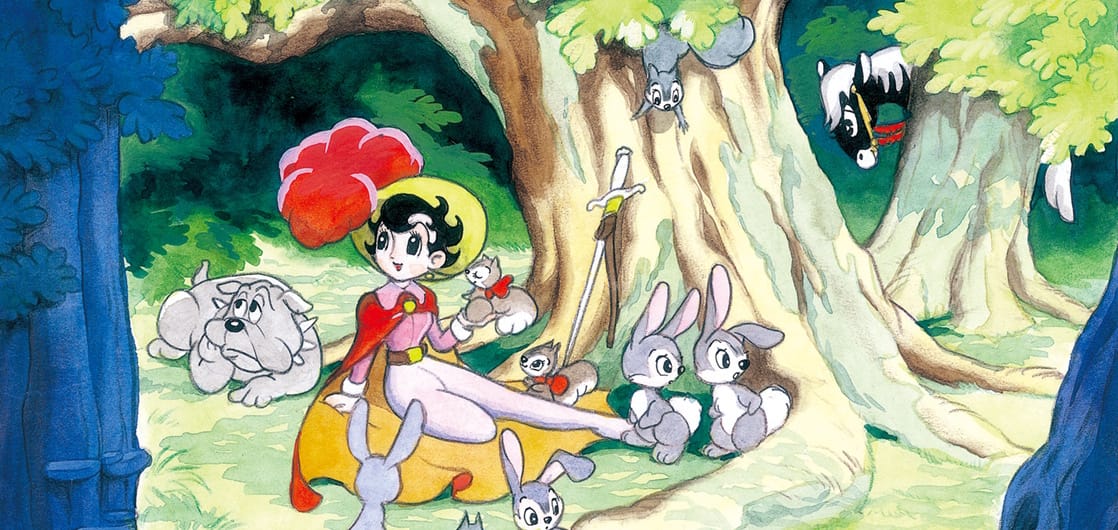
During his career, Tezuka produced more than twenty different manga for young girls. These include the likes of Unico and Queen Nasubi as well as shorter works such as The Four Fencers of the Forest and Tale of the Miracle Forest, but Princess Knight stands out as the very first long form serialization targeted towards this particular demographic. It's also the one with the most iterations: beginning with the original Shojo Club run from 1953 to 1956 and ending with a science fiction version published in two issues of Bessatsu Shoujo Friend in 1967.
Out of all of these different iterations, the version that ran in the Nakayoshi magazine is perhaps the most famous. This is because it continued for the longest and wrapped up just before the anime adaptation by Tezuka Productions aired in 1967, but nothing beats the original Shojo Club run in terms of influence. As the very first iteration, it had an immediate impact on the world of girls' comics and the wider world of manga as a whole.
Learning why is crucial to understanding not only how shojo manga evolved into what it is today, but also how much of an essential force Tezuka was for everything involved with Japanese comics.
The Narrative Revolution
When Osamu Tezuka passed away in 1989, the Asahi Shimbun remarked that one of the reasons why comics had become so popular in Japan in the first place was because “Japan had Osamu Tezuka, while other countries did not.” In particular, Tezuka’s visual style brought an electricity to the fledging medium by aping movies and cinema, while his focus on dynamic storytelling through complex characters gave manga a profound core that can still be found today.
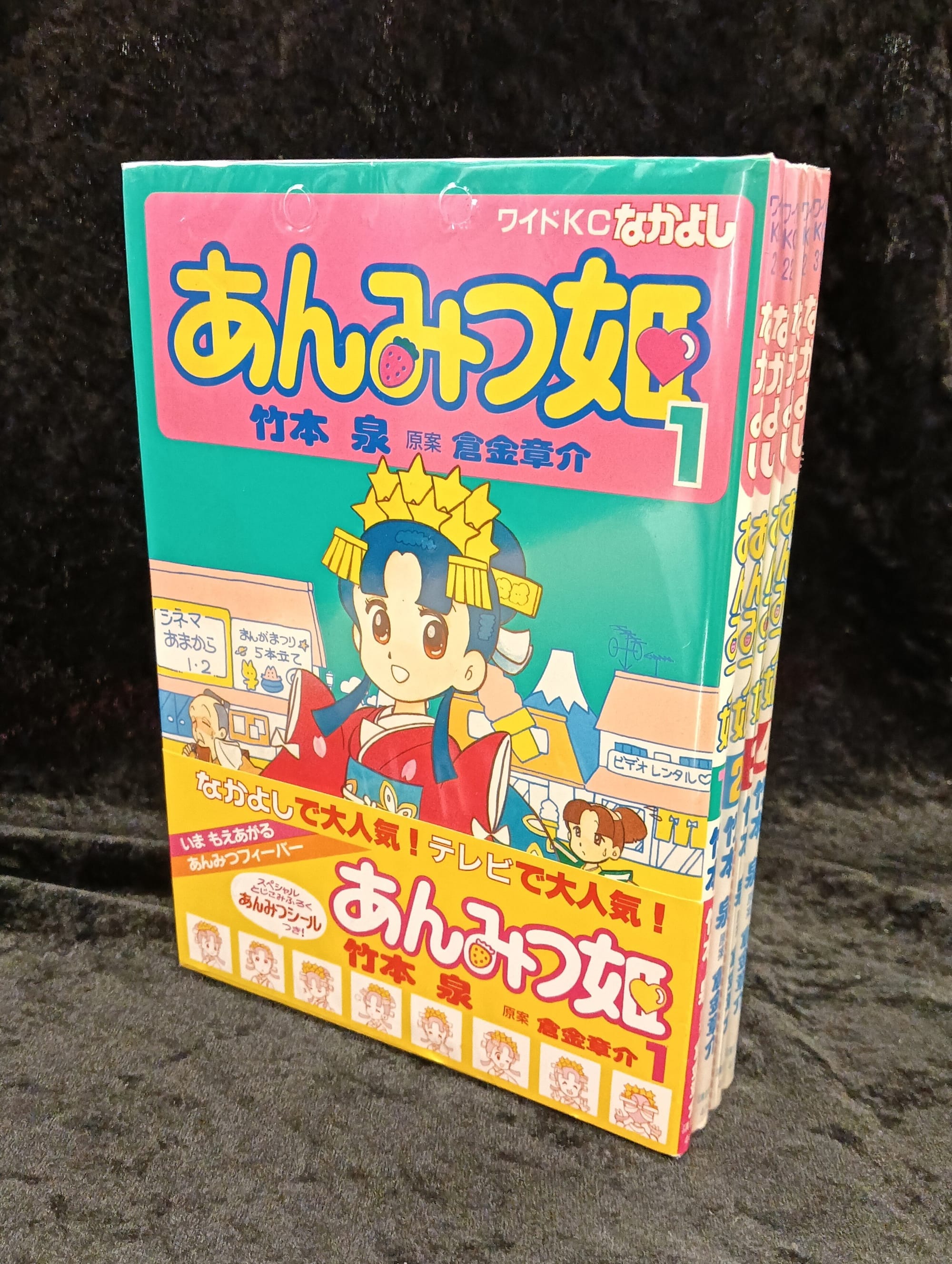
That last part is particularly important when it comes to shojo manga. Before Princess Knight, by far the most popular manga for girls was Anmitsu Hime by Shosaku Kurakane: a slice of life comedy series loosely set in the Edo period that centered around the titular princess. Her tomboyish personality arguably foreshadowed shojo manga’s later preoccupation with gender image and transgression, but the story was mostly light and episodic, not really interested in exploring this particular theme for anything other than a quick joke.
Compared to this, Princess Knight felt like a completely different beast. Not only did it transport the reader away from Japan and to a fairytale-inspired western setting, it delivered a narrative experience that completely eschewed the episodic format in favor of more continuous storytelling. What’s more, its characters were far more than just comic relief, instead showcasing complex motivations and layered personalities that even applied to the story’s antagonists.
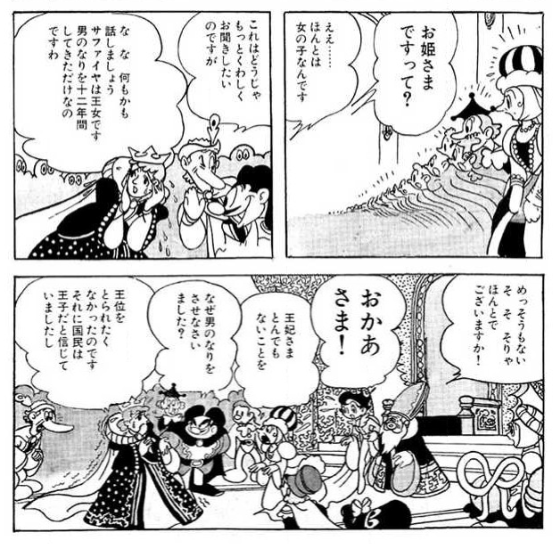
In terms of narrative, the version of Princess Knight serialized in Shojo Club goes through so many different story arcs throughout the course of its run that it might even take the modern reader by surprise. At the beginning, Princess Sapphire is the heir to the kingdom of Silver Land in the disguise of a prince before losing the throne to a royal rival once her secret is revealed to the public. She is then imprisoned, escapes, acts as a masked vigilante, makes a contract with an evil demon, gets turned into a swan, lives a happy life with her love interest before eventually taking the throne back at the very end.
Moreover, all of these story arcs are driven by the hopes and dreams of characters that always turn out to be more than meets the eye. Sapphire’s royal rival in the form of Duke Duralumin plots and eventually succeeds in making his son Plastic the king of Silver Land, but comes to regret this decision once Plastic refuses to grow up and act the part. The devil Mephistopheles is also often thought of as an entirely evil force, but is ultimately motivated by his desire to see his daughter grow up right and rages once she dies of heartbreak.
Even on the most basic level of setting and premise, the line between Princess Knight and later shojo works is plain to see. Both The Poe Clan by Moto Hagio and The Rose of Versailles by Riyoko Ikeda take place in European settings far removed from readers’ everyday lives, all the while taking up the narrative approach of Tezuka’s earlier work by focusing on continuous stories with active characters moving throughout. The pioneering works of Keiko Takemiya also used this historical framing, even though the outright romantic focus of early boys’ love remains a subsequent iteration.
We Have to Destroy Gender
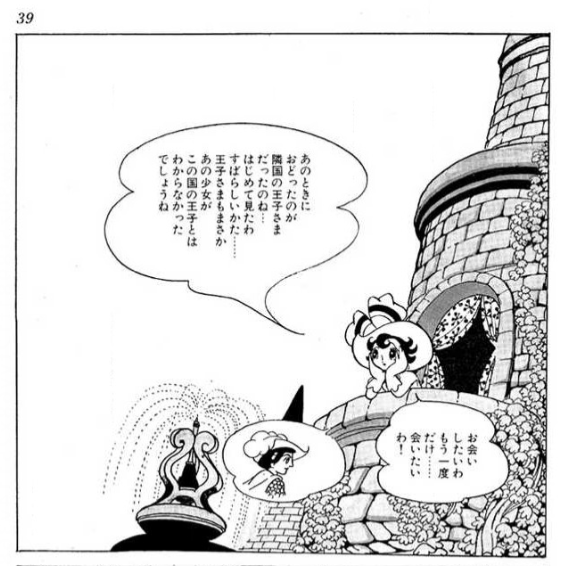
This theme of iteration can also be applied to Princess Knight’s treatment of gender image and transgression. While Tezuka never went as far as to challenge heteronormative ideals, his depiction of gender laid the groundwork for later developments and provided a powerful image that inspired future generations of artists. Furthermore, his interrogation of traditional gender roles ensured that shojo manga would play a positive role in allowing young girls to find new methods of self-expression.
As a character, Sapphire is said to possess the mind of both a boy and a girl. This comes about when the angel Tink literally feeds an infant Sapphire with a boy’s heart after already receiving that of a girl before God decides her gender in heaven, but ultimately reflects the real politics of Silver Land. Given that there are no other male heirs, Sapphire is forced to play the role of a prince in public and limit her time as a princess to private life, even though her earnest wish is to live full time as a woman.
Oscar from The Rose of Versailles is the obvious point of comparison here. Much like Sapphire, Oscar was raised as the male scion of the de Jarjayes family in order to inherit her father’s position as the captain of the Royal Guard much like Sapphire, but ultimately sees no inherent conflict between her male and female identities. She dresses like a man in military uniform, takes up roles traditionally reserved for males in high society, but refers to herself as a woman and ultimately falls in love with a man at the very end. Her conflict is less about gender than it is politics and the corrupt nature of the ancien régime.
In this sense, the particular expression of gender identity in Princess Knight is less important than the general idea of a character that straddles both sides of the binary. Yukari Fujimoto argues in her 2008 book that such transgression functions as a deconstruction of traditional gender roles and credits Tezuka’s work, among others, with popularizing this idea. Only by imbuing characters with traits usually reserved for others can new forms of self-expression emerge, particularly as young girls grow into puberty and beyond.
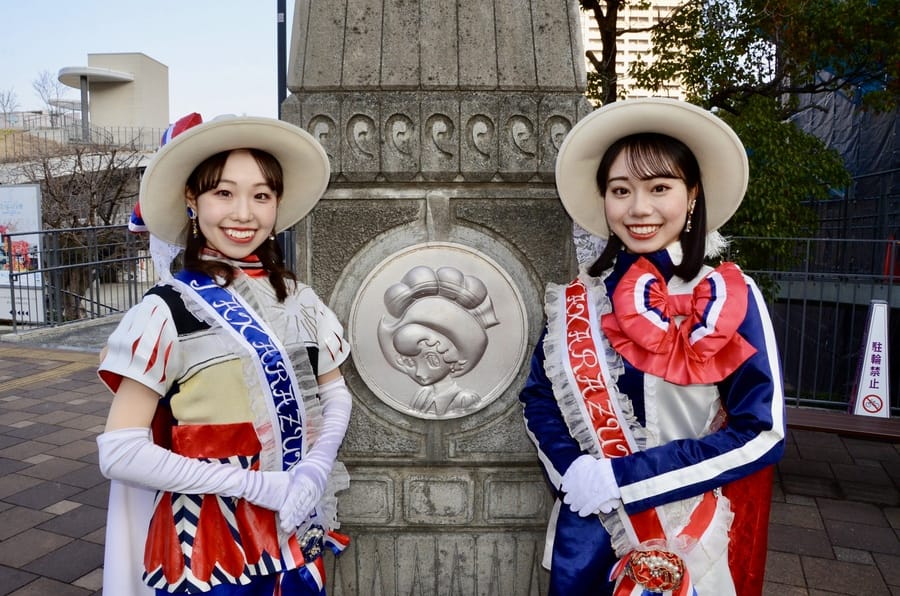
Of course, no discussion of gender in Princess Knight is complete without a mention of the Takarazuka Revue. As a resident of the city, Tezuka spent his childhood collecting bugs and going to see musicals with his mother at the Grand Theater, even going as far to tread the boards himself in college. The entire series can actually be seen as an homage of sorts to Takarazuka from the theatrical presentation to the dramatic storytelling, but the depiction of Sapphire as a character that inhabits both male and female roles is usually seen as the most direct tribute.
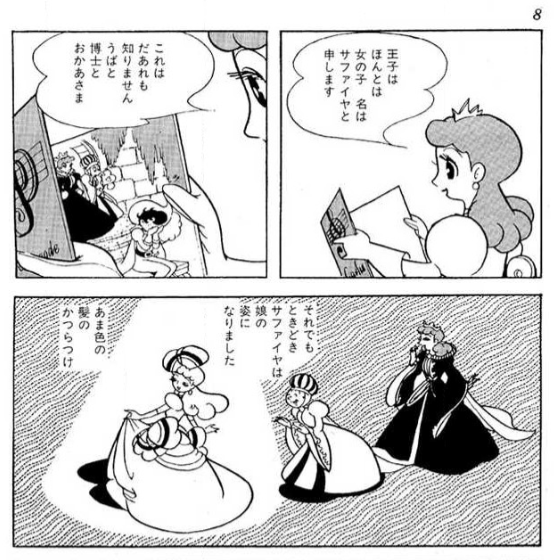
Much like the practice of otokoyaku and musumeyaku in Takarazuka, Sapphire must dress and act like different gendered personas according to the needs of each situation. Before the people and most members of the royal court, she plays the part of a dashing prince with perfection, but her relationship with Franz is mediated through another persona known only as “the flaxen-haired girl.” Note here that even Sapphire’s gender of choice is expressed through a costume or disguise, mirroring the costumes of a stage play.
The result is a presentation of gender that reduces it to outward signs and ultimately interrogates its essential essence. Even though Sapphire does end up in a heterosexual relationship by the end, readers were not quick to ignore all the times that the princess pined after Franz in male costume. While obviously not as explicit, this tantalising idea arguably paved the way for the subtext of The Poe Clan and the outwardly queer works of Keiko Takemiya later on.
Princess Knight and Magical Girls
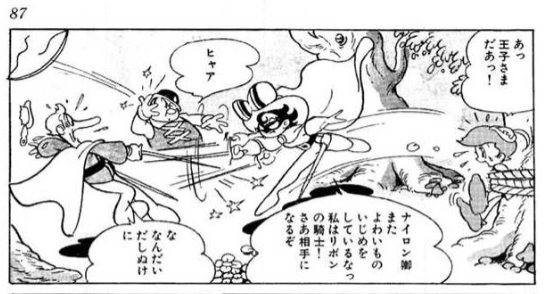
Speaking of personas, Sapphire actually takes on three different roles throughout the story. The first two are male and female, as discussed, but there is another that enjoys an outsized influence despite its relatively small amount of screen time. Shortly after breaking out of prison, Sapphire begins to operate as a masked vigilante to protect her citizens from the malevolent acts of Duke Duralumin and his minions: the titular Ribbon Knight.
Out of all of the tropes discussed up until now, this might actually be the most important. While the Year 24 Group is often credited with introducing current forms of romantic expression both heterosexual and otherwise into shojo manga, stories about normal girls who transform into powerful warriors to fight for good against evil also enjoy a significant amount of attention. This is most easily pigeonholed into the subgenre of magical girls, represented in their current form by Sailor Moon by Naoko Takeuchi.
Whether or not the magical girl subgenre can be reduced down to Sailor Moon is a debate in and of itself. Not only did Fujio Akatsuka already pioneer the idea of transforming with a special device through Himitsu no Akko-chan in 1962, Mitsuteru Yokoyama introduced the character profile of a literal magical girl in Sally the Witch from 1966, but Naoko Takeuchi codified the current formula for the subgenre by combining it with action tropes from tokusatsu. This arguably represented a full circle moment all the way back to Princess Knight as Sapphire’s own transformation was almost entirely meant for combat and action.
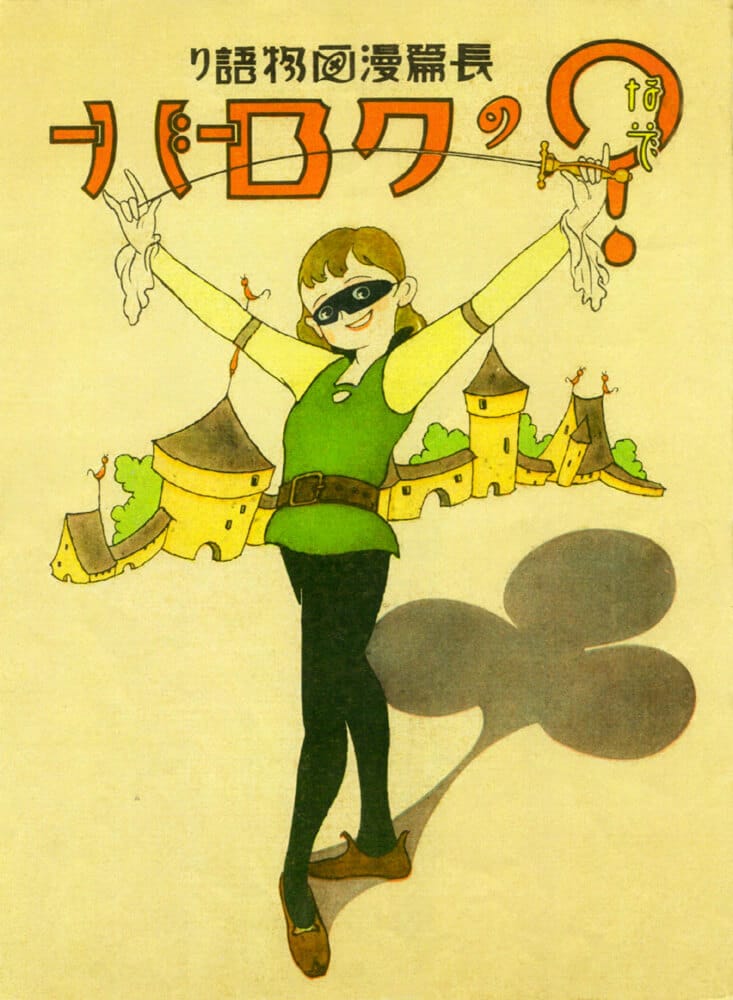
At this point, it is worth noting that Tezuka did not invent this archetype out of whole cloth. Katsuji Matsumoto already pioneered the idea of a masked female vigilante in the 1934 one-shot The Mysterious Clover, but the limited length of this series as well as the time of its publication meant that it has only recently been the subject of critical reanalysis. For all intents and purposes, Tezuka actually seemed completely unaware of this early work and undoubtedly eclipsed its influence by the sheer fact of his popularity in the 1950s.
In any case, the links between Sailor Moon and Princess Knight only grow stronger when considering the relationship between Sapphire and Franz. Much like Usagi and Mamoru, their romance is a comedy of errors mediated through costumes and mistaken identities, even though only one party is in disguise in this particular case. There’s even one section where Franz comes to hate the Ribbon Knight as a rival for Sapphire’s affections and ends up living with the male Sapphire, completely oblivious to reality.
Moreover, the importance of Sapphire’s true identity and the need to maintain a proper disguise is significant when considering that magical girl series have deemphasized this tension in recent years. The characters of Pretty Cure often transform right in front of their enemies, but this secret could mean life or death in Sailor Moon. It is true that the most recent Precure series ran a viral campaign to get fans to guess the identity of Cure Clear, but this is most likely due to the story’s roots in the mystery genre.
As discussed, the Year 24 Group had very little to do with the popularization of masked vigilantes and transforming warriors. Considering that Pretty Cure is by far and away the most popular multimedia franchise for young girls right now, it feels even more significant that Princess Knight included this element before anyone else. In fact, Mitsuteru Yokoyama worked with Tezuka on several short series, providing a direct link between the two creators.
A Lasting Legacy
The point of this article is not to downplay the works of any artists mentioned, nor place one above the other, but to introduce some of the debates currently taking place in critical Tezuka scholarship. Given the God of Manga’s inseparable association with the medium, there is often a tendency to try and pull away from his works in an attempt to discover what might have been overshadowed along the way. While The Mysterious Clover is a salient example of this, we must also be careful not to overcorrect and fail to give credit where credit is due.
Through Princess Knight, Tezuka not only foreshadowed the later development of shojo manga, but proved without a shadow of a doubt that certain kinds of stories could achieve critical and commercial success. His narrative approach moved the needle away from comedy and towards serious drama, his depiction of gender created a powerful image that empowered new forms of self-expression, and his main character has echoes within the magical girl subgenre. Who knows what the medium would look like today without him?
Beyond the very specific realm of shojo manga, Princess Knight is still seen as one of Tezuka’s most popular works. In a 2024 survey of 100 Tezuka fans, the series ranked in at number five below the likes of Astro Boy and Black Jack, but popular appreciation does not always lead to critical analysis. Modern readers must rediscover the importance of this story, particularly the Shojo Club version, in order to understand the industry today.
Without it, things might be very different.