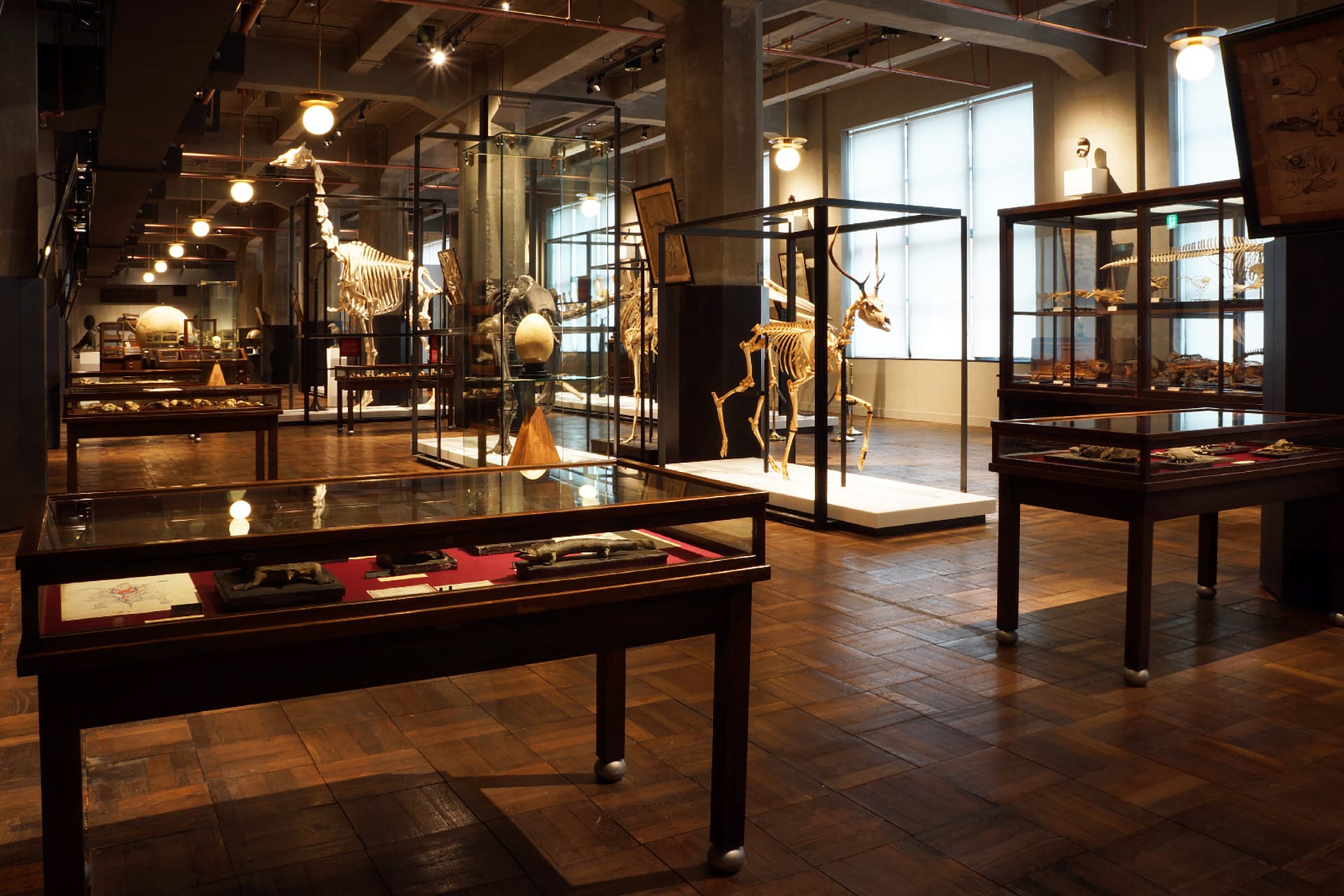
When you enter the intermediatheque, everything happens at once.
Between the giant ostrich egg and the sea life vitrine stands the skeleton of a Red Deer, itself overlooking a case of exotic, dismembered crab husks. Down the hall lies the massive frame of a Minke whale, its rib cage supported by brutal, Y-shaped steel beams imitating the thick concrete pillars that punctuate the length of the room. Beyond that, two bronze statues of Horus’s falcon flank a wooden carving of a human skull, handmade by an Edo period sculptor in a time when the study of real human remains were forbidden. The curve of a Pleistocene Mammoth tusk imitates the arcing lines of an antique globe, and a dried-out Horseshoe crab sits nearby, side-by-side with a wooden African mask.
A child points up at the whale and asks her mother how it died. She replies that she doesn’t know. The child turns back at the skeleton, studies its remains with squinted eyes, and proclaims with authority— arms outstretched— that it had died somehow, and they had brought it here. On the floor above, a ritual chinese bronze sits beside an ordinary fire extinguisher in a nondescript corner. A giant 1920’s clockface looms over the room, its cabinets filled with glass beads and propellers, phonographs and buddhist scrolls. Tokyo station, itself antique, looms brick-red and silent through the windows.
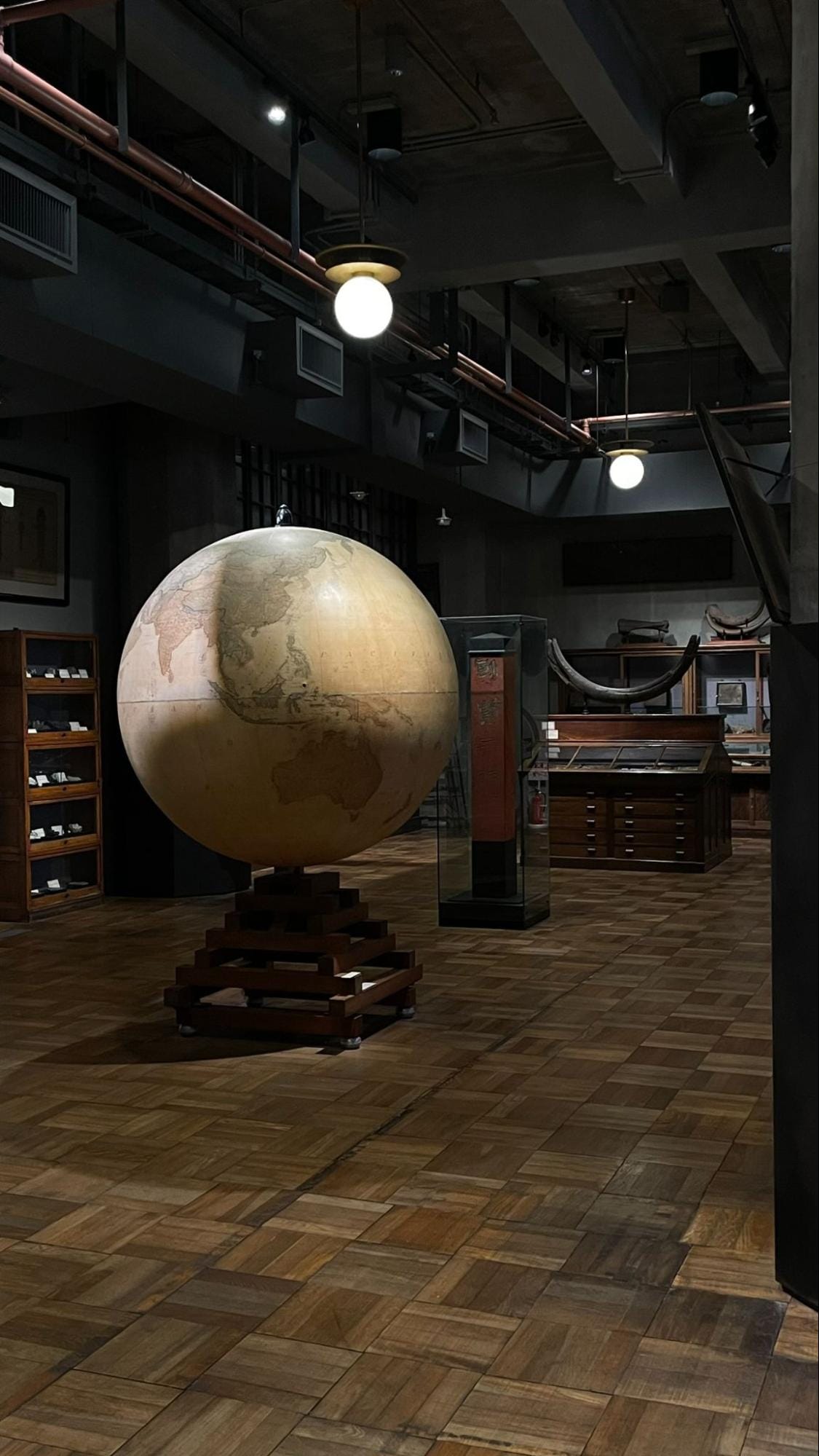
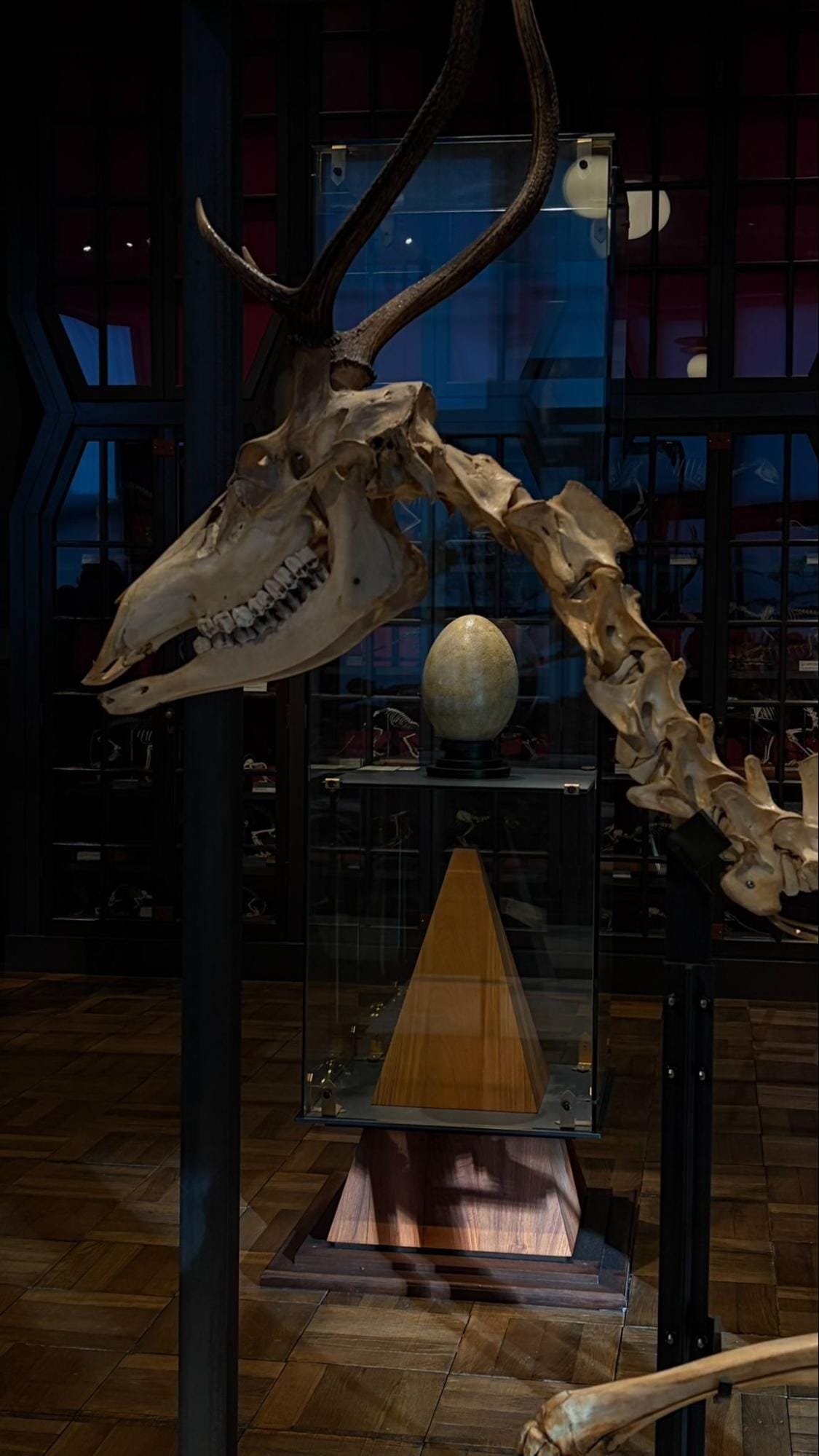
Photo: Caleb Wyckoff Smith
The Intermediatheque is an experiment in curation. By exploding the collection of the Tokyo University Museum and collapsing its contents into an uncategorised display of Biology, History, Technology, and Design in conversation, the Intermediatheque invites its visitors to reconsider their preconceptions of an institution: When the contents of a museum are relocated, dissected, and reconfigured in a new form, does that new museum become an iteration of its former body, or does it become a museum of itself?
The bulk of the museum’s collection dates to the foundation of the University of Tokyo in 1877, inheriting many of the gaps in both knowledge and interest contemporary to the era. In its everything-at-once approach to curation, the museum offers a subtle but critical gaze at its former self: The origins of the African mask are just as unexplained as those of the Horseshoe crab beside it. Instead, through comparison, the crab and mask exchange meaning– The crab becomes a faceless mask, the mask becomes a living fossil.
Meanwhile, in the atrium, the flawless mirrored surfaces of a sculpture by Yonekichi Tanaka reflect the shattered, defaced remains of an ancient Egyptian statue— once depicting a grand and holy falcon, its shape has been rendered unrecognizable as a bodiless stump, its talons chiseled null by the tandem conquests of ancient armies and time alike.
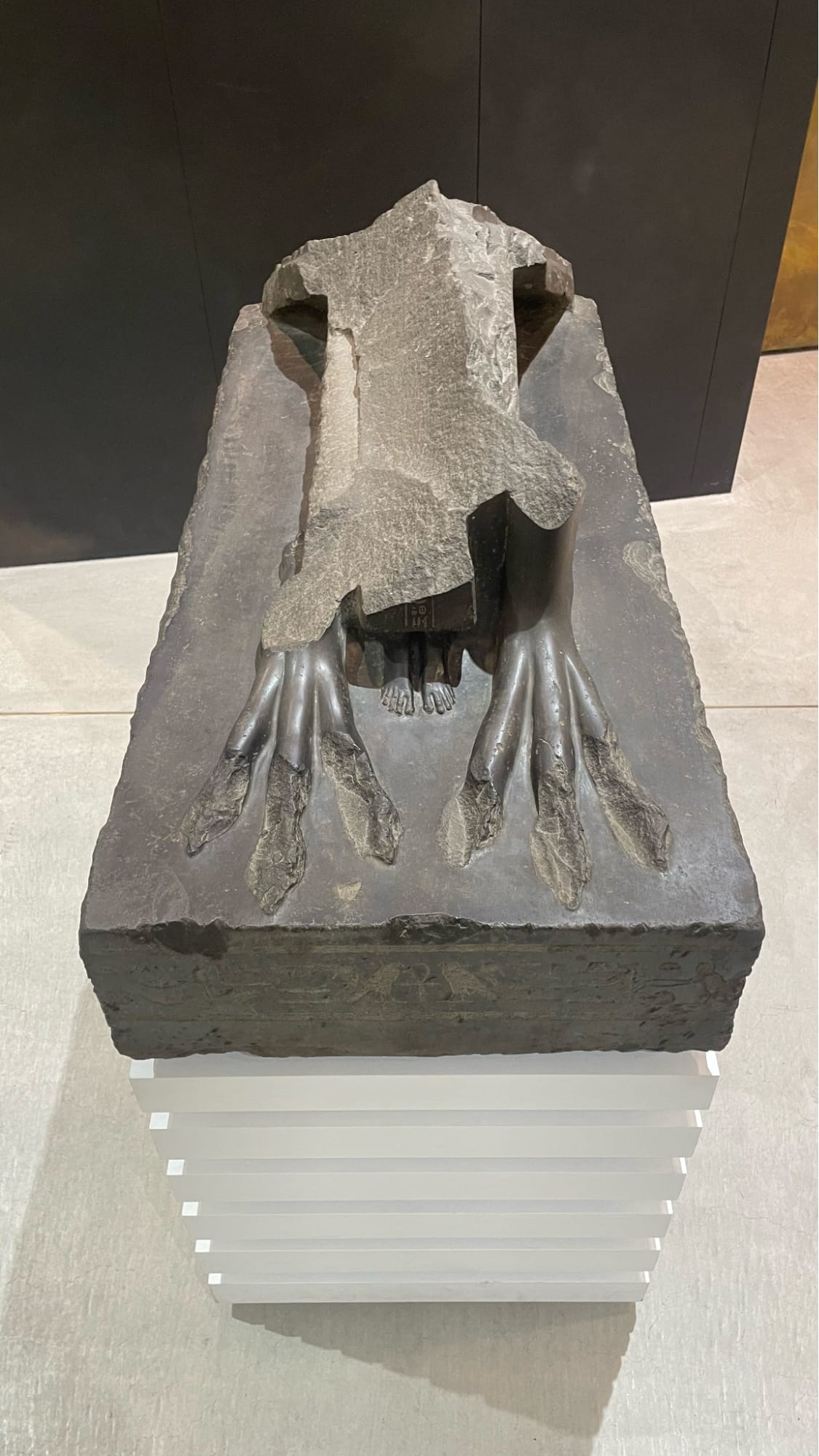
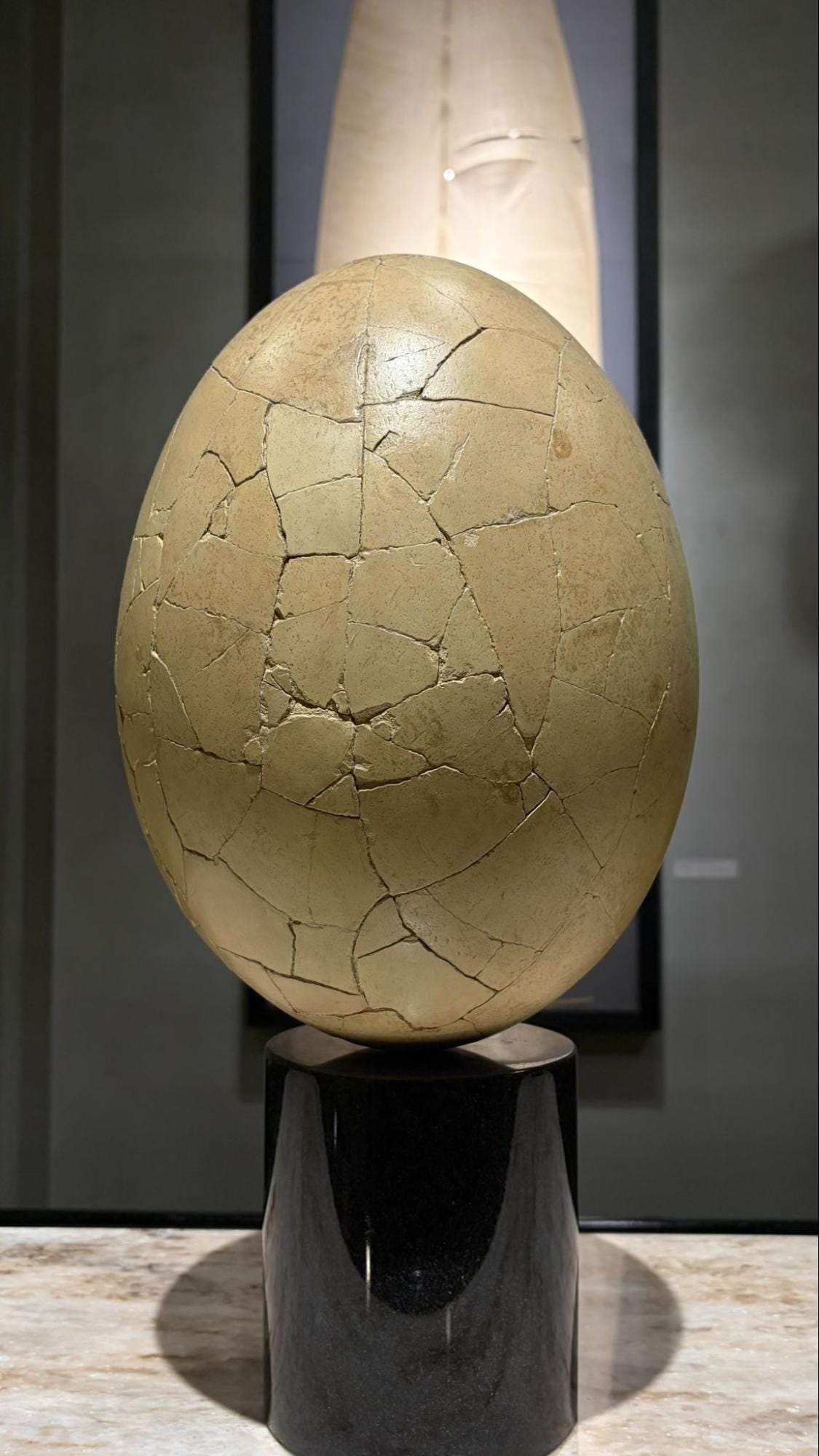
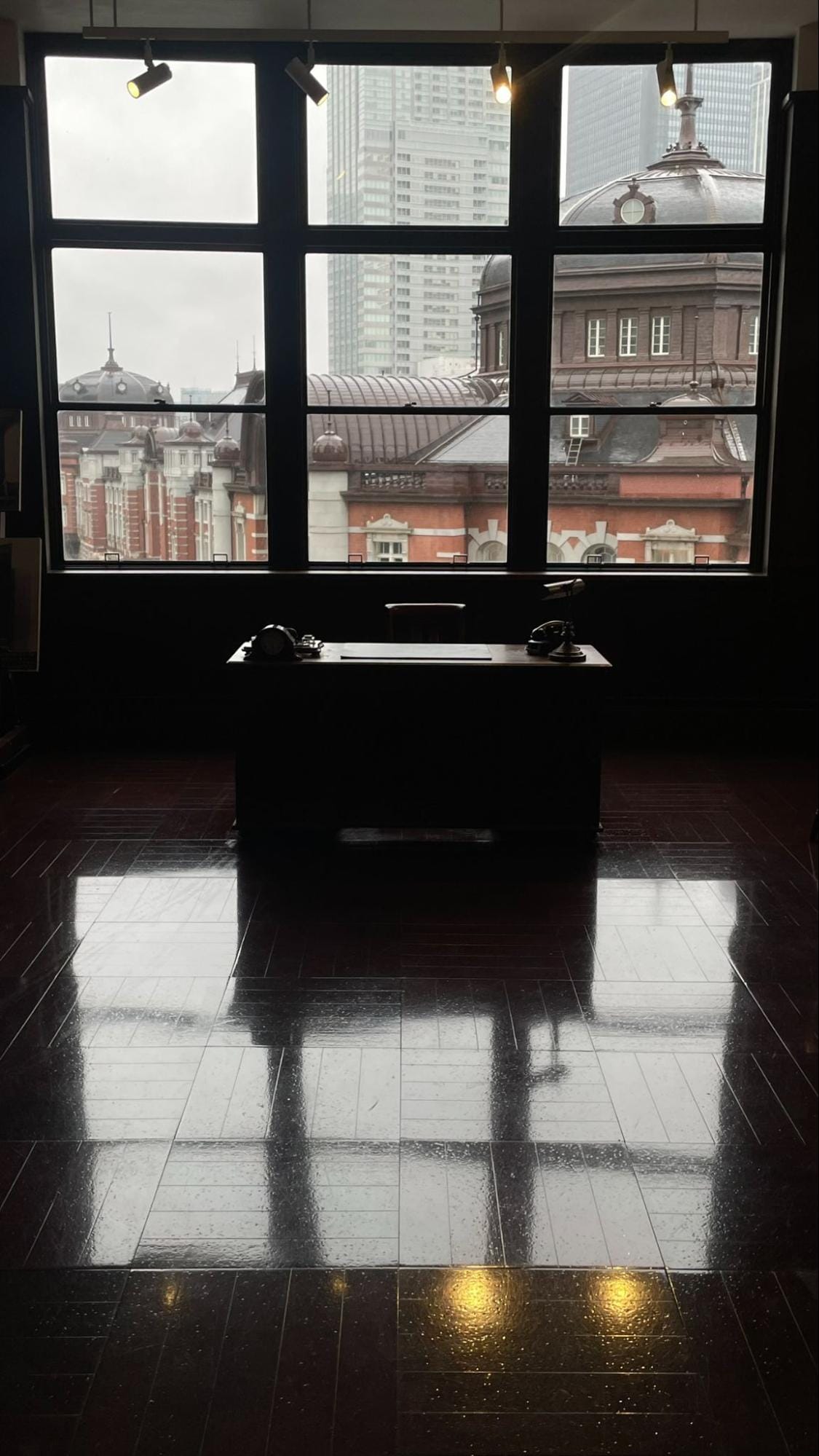
Photo: Caleb Wyckoff Smith
The museum’s director, Yoshihiro Nishiaki, explains that its aim is to both extract the artfulness inherent in science and to infuse art into the exploration of science. He also explains in his introduction to the museum that they aim to explore manmade objects as ‘media’ created to transmit meaning beyond function alone, utilising the unique capacity for the museum format to create the kind of poetic collisions impossible in daily life.
In many ways, the Intermediatheque’s experiment in radical curation has brought it closer in form to the origin of museums as we know them: the galleries, which stretch across two floors of the former Japan Post headquarters, resemble a massive Cabinet of Curiosities, the predecessor of the modern exhibition. Glass-and-mahogany panels expand in grids against the raw cast-concrete walls, having spilled their contents loose between the vitrines across the floor. Despite its apparent resemblance to a historic format, it could also be the first museum to capture the sensation of exploring information in the hyper-connective internet age, where context is as overwhelming and omnipresent as it is elusive.
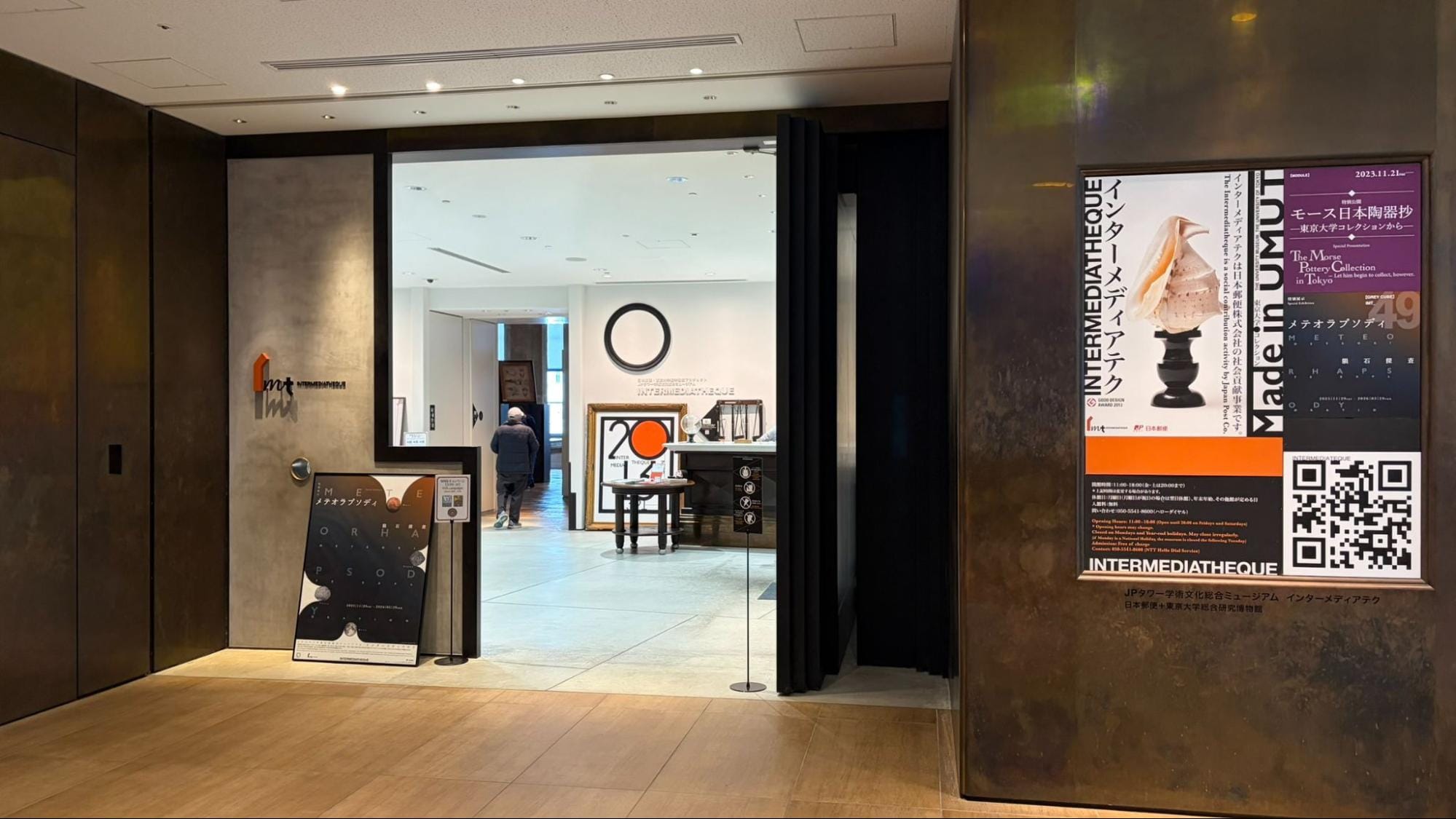
While small, its brevity is its benefit. Visitors are left with a deep impression of the width and depth of its ambition before becoming overwhelmed by the countless recombinations of time and place.
Across its diverse and storied collection, there is something to fascinate and inspire every visitor. And— like all good museums— there’s an excellent gift shop.
The Intermediatheque is located on the second and third floors of KITTE marunouchi, a short walk east of Tokyo station.
Open 11:00—18:00 Tuesday to Thursday
Open 11:00—20:00 Friday and Saturday
Closed Mondays
Admission: Free