With Puella Magi Madoka Magica: Walpurgisnacht Rising, finally being released in Japanese cinemas, 13 years after the release of the previous movie in the series, the industry within which this latest Madoka story is being released in could not be more different to the one which existed back then. At the time of Puella Magi Madoka Magica the Movie Part III: Rebellion’s release, the series was on top of the anime world following the critically-acclaimed broadcast of the original series that upturned audience expectations while telling a magical girl story unlike what many had become accustomed to from the genre.
Much has been said about Madoka in subsequent years, especially after its success led to a slate of stories that attempted to recreate the magic of a mature magical girl story targeted for an older audience than was typical for genre favorites like PreCure and Cardcaptor Sakura. Was it a deconstruction of the genre’s ideals? A revitalization of the formula?
Today, the industry has shifted towards high-caliber action hits from the Shonen Jump canon as anime has exploded into a global industry. Yet somehow, amidst it all, where its copycats fell, the series endured and became a classic. Excitement for the movie is high even if it no longer stands top of a scene molded by its image. To find success in the moment takes an alignment of circumstances - to persevere takes true quality.
But why is that? Revisiting the series from a modern lens reveals not a dark, twisted fantasy that many associate with it, but a story that embraces the genre, even if its natural endpoint in the non-ideal circumstances its characters face inevitably leads through challenging pathways. It’s not just sincere to the genre it exists with in, it’s honest to the ideals to the point of transforming its characters into near-myth. And the thing about myth, is that it endures, inspires, and transforms with its era.
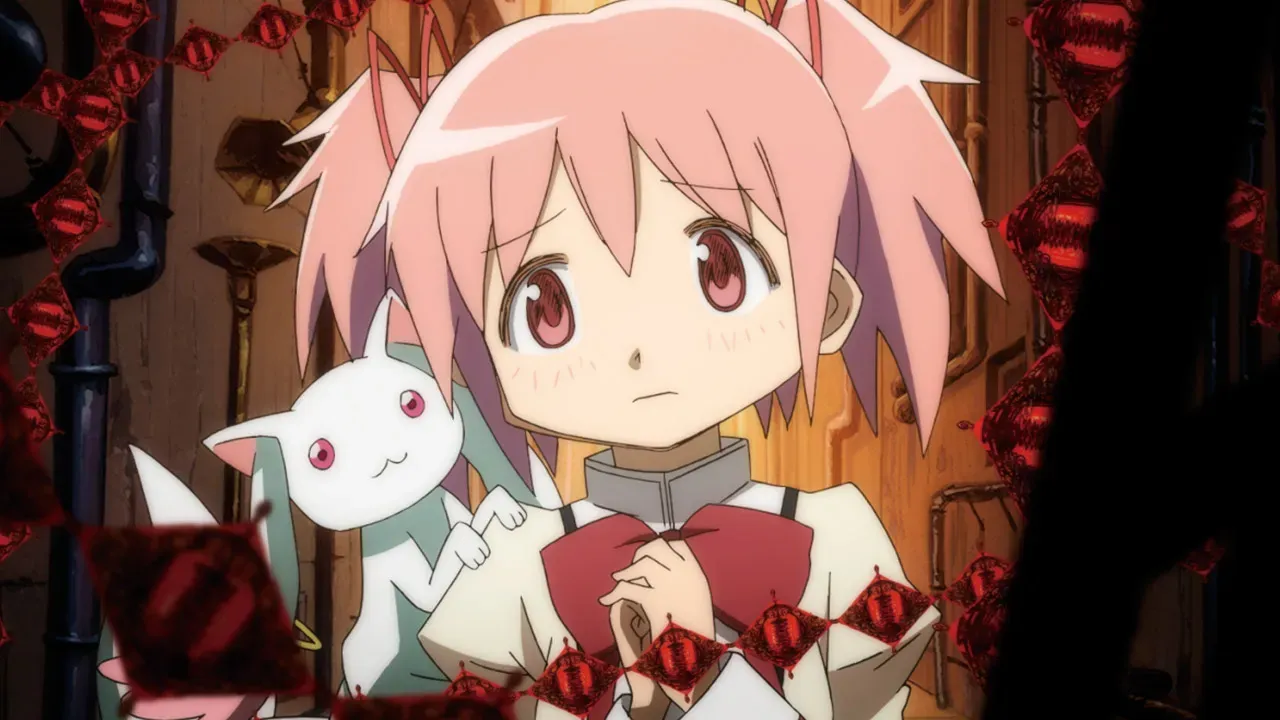
For those unfamiliar, Madoka Magica begins simple: a young girl named Kaname Madoka has a mysterious girl named Akemi Homura transfer to her class, one who knows her and warns her not to trust anything that promises to change their fate. As it turns out, she is a magical girl, and the figure she is speaking of is Kyubey, a cat-like alien creature that promises to grant any wish if you agree to fight witches and become a magical girl like her. At first, that doesn’t seem like a bad deal, even if these witches have an unnerving quality to their esoteric designs and there is danger if they are not careful in the heat of battle.
The extent of that danger only comes when the first magical girl to show them kindness, an older woman in their same school named Tomoe Mami, is murdered by a witch, the moment in which the threat becomes real and the series takes a harsh turn towards the hidden truth of the wish. One where to fight means to sacrifice your humanity, and where the cycle of violence begets more violence.
It has an otherworldly quality that few series can match. Animated by SHAFT at the top of their game in the early 2010s, hot off the heals of work on the Monogatari series, directed by its studio lead Akiyuki Shinbo. Its use of open space and deliberate symbolic cinematography tinge every moment in retrospective torment and a feeling that, amidst the seeming valiant justice they fight for, each character is trapped in a cage that their destiny, controlled by Kyubey, dictates.
The series can be bleak as it turns the double-sided blade of a personal wish into a sword that turns back on its characters. As Sayaka makes her wish to help her friend and crush recover from an accident that leaves him unable to ever play music again, she sees the wonder of her friend performing violin betrayed by a rival getting into a relationship with them instead, until the pain of her fight becomes so bad she transforms from magical girl into destructive witch. Another magical girl named Sakura Kyoko, once cold to her before becoming one of the few people to truly feel touched and moved by her selfless nature, finds her belief in a non-cynical future worth sacrificing her life to put her only friend to rest.
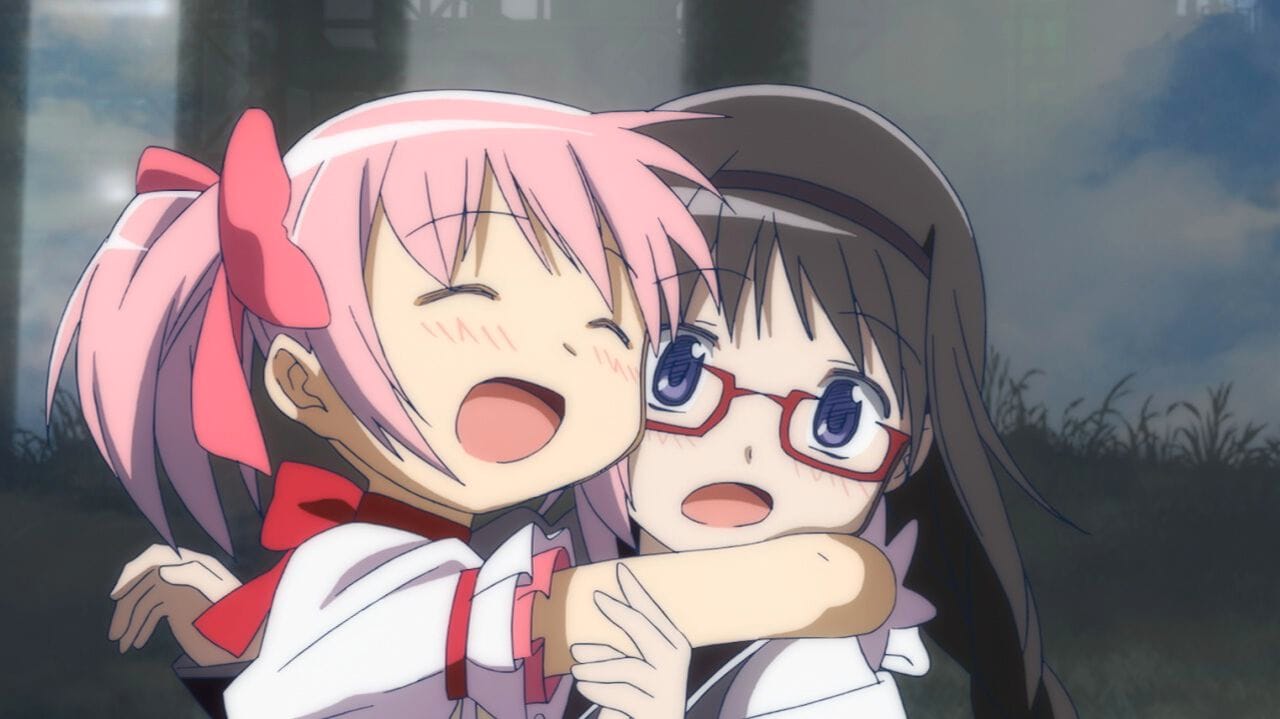
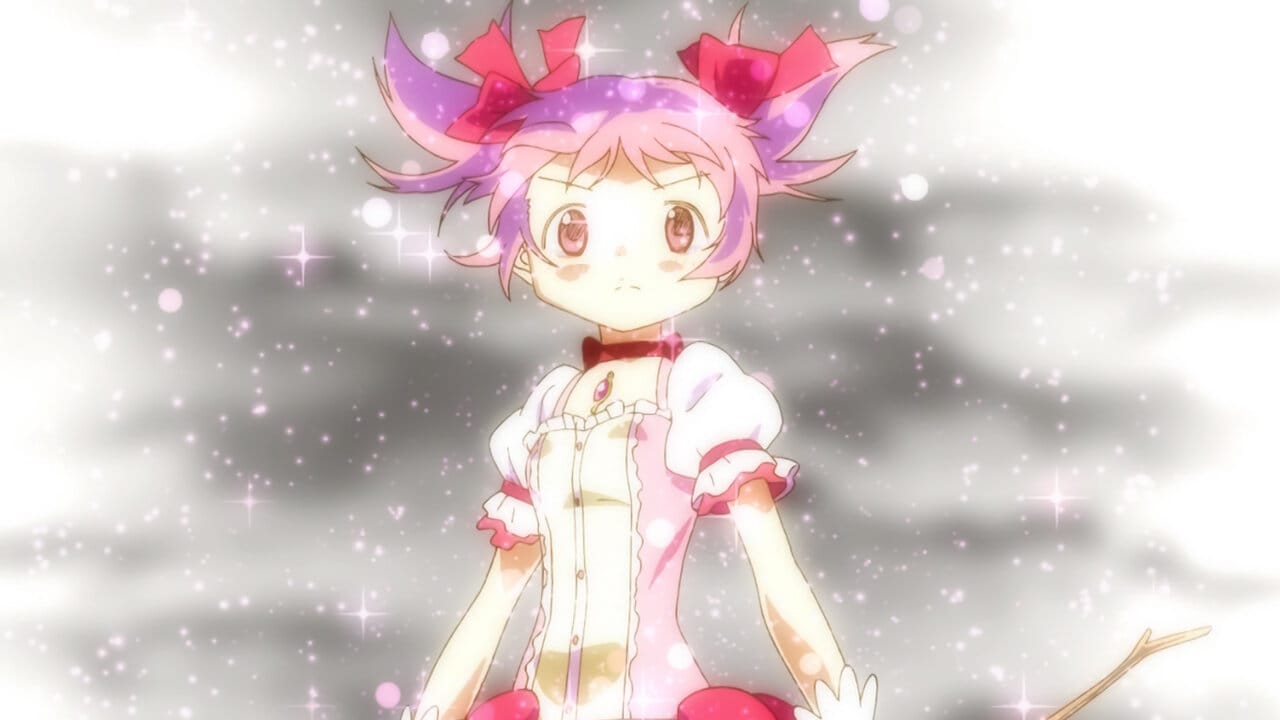
To believe means to hurt. Yet the true heart of the series comes from Madoka and Homura, two sides of a coin challenging faith with the power of hope. Homura, as it is eventually revealed, became a magical girl in order to try and save the friend who sacrificed her life to save, believing that her kind friend deserves a future where she can survive. Constantly turning back time till Madoka can never even become a magical girl in the first place, no longer tricked by Kyubey, it leaves Madoka still seeking to save others with a wish that transforms her into a god embodying hope itself.
The power of Madoka Magica as a series, and what has helped it to endure even as it has stood mostly dormant (beyond a spin-off mobile game and anime), is not just the quality of its animation and storytelling. Any great series can fall into obscurity despite its strength. It comes down to the myth of hope and kindness that transform Homura and Madoka into figures like that of a Greek tragedy itself.
Madoka and Homura are two characters trapped in a constant struggle to become hope for the other, until their initial identity is lost in the fight to transform what it means to believe. Madoka, in the initial world she meets Homura, is a girl who became a magical girl with assurance to save others, before having that sacrifice from her belief taken away by Homura’s wish to take her place. The Madoka we get from that is a person who sees herself as but a burden, watching others sacrifice themselves for her, while never believing herself worth saving. She eventually takes the ultimate selfless sacrifice to rewrite the world and prevent witches ever being even if it strips the world of her memory and existence, but its hard to say this act is truly hope and more a desire to no longer burden.
Which is the true Madoka? Homura can’t allow this and seeks to shift the burden, until she, too, becomes lost in her lack of personal identity as her existence becomes wrapped in that of Madoka. Her hope is in someone she becomes subsumed within in her fight to pay back the love she feels. It’s cruelness wrapped in a kind visir, with Kyubey the conductor of their torturous ballet.
To be a magical girl is to become a savior and fight for others, its power in the feminine form. But being a magical girl can’t be all you exist for. To live as a magical girl means to be rounded out as a human beyond your powers, with someone to love and a life beyond. Madoka Magica’s strength is that, amidst all its creative strives that challenge and stretch the form and medium of animation, it takes the question of a magical girl’s existence as hope, and considers the tragedy of what it means to be hope without humanity, even if that humanity includes cruelty, pettiness, wickedness.
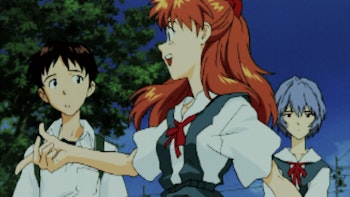
If your hope can turn you into a god, are you actually rightious, or are you becoming a demon? And is that a life worth living? Madoka and Homura represent both sides of that, and its this existential thematic crisis that does for the magical girl genre what Evangelion did by embracing every honesty of the genre to take it to its natural conclusion. That’s why Madoka Magica endures, beyond its series and movies, and what makes a movie exploring this concept further 13 years later so exciting.
A magical girl is hope embodied. But to truly hope, you have to suffer.