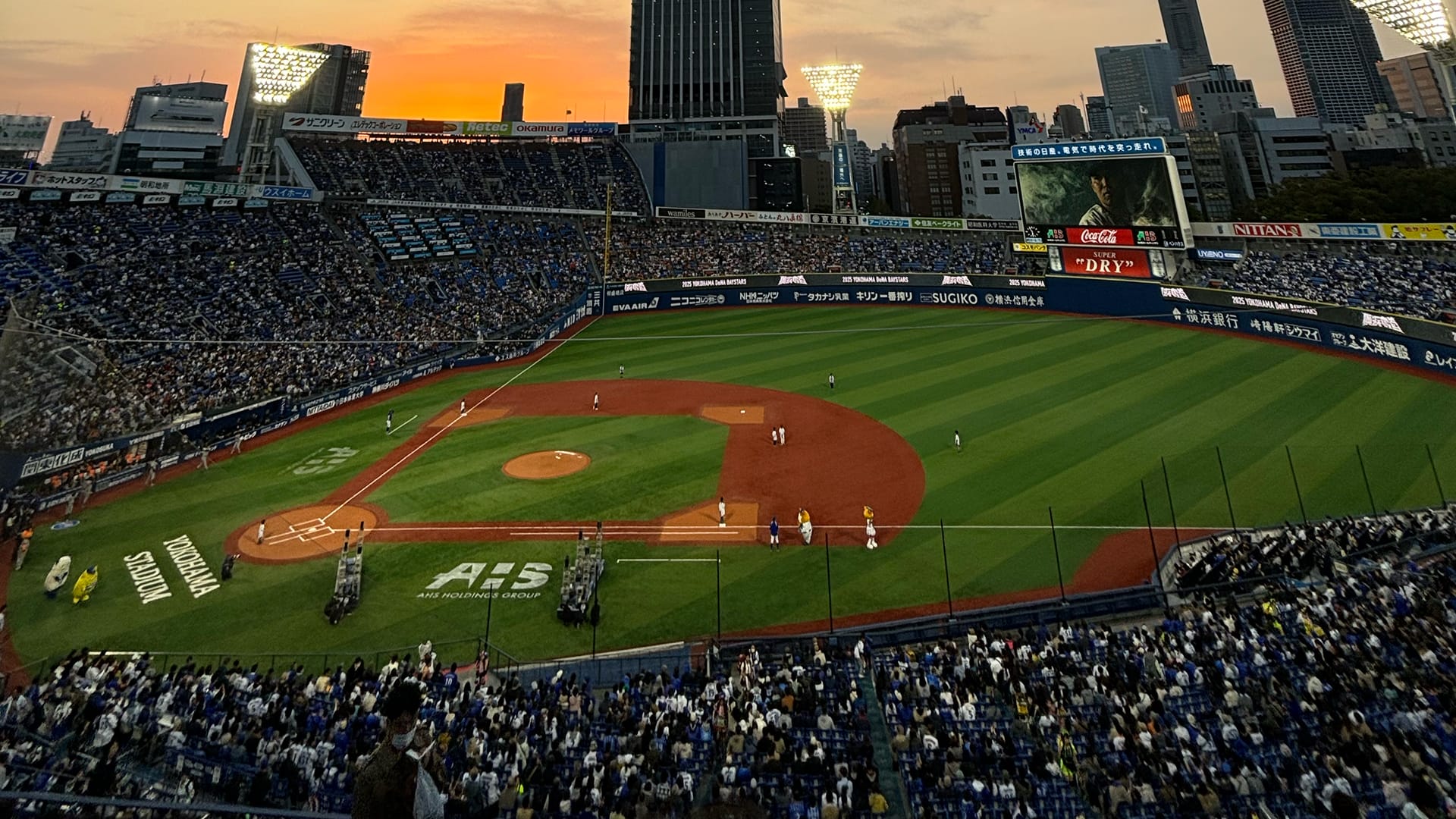
I grew up in Japan assuming that cheering at baseball games was simply how sports worked. As a kid I played baseball, and my family often went to professional games. The songs, the drums, the trumpets, and the synchronized chants from the stands all felt completely normal to me. I never questioned it. I thought this was just what watching sports sounded like.
Eventually I drifted away from baseball and toward music. Like many teenagers I became obsessed with bands and live shows. In 2015 I found myself standing alone in front of the main stage at Reading Festival when Jamie T performed “Zombie.” The entire field erupted into a massive singalong. Tens of thousands of people were shouting every word back at the stage. The sound felt enormous. The crowd was not just listening to the performance. It had become part of it.
Later I began working in the Japanese music industry and spent a lot of time around concerts by international artists touring the country. Something curious often happens at those shows. The audience is attentive and enthusiastic, but often quiet. Some fans try to sing along, but it rarely spreads across the whole venue. Even now there can be a slight hesitation about being too loud.
Then one day, I went back to a baseball game for the first time in years.
The noise shocked me. Trumpets cut through the air. Drums pounded in steady rhythms. Hundreds of fans sang together in perfect unison for every batter stepping up to the plate. It was louder and more coordinated than many concerts I had attended recently.
Japan has a festival often compared to Glastonbury. Fuji Rock was famously inspired by it. But if what truly defines Glastonbury is the sound of thousands of people singing together, then Japan’s closest equivalent is not a music festival at all. It is a baseball stadium.
Every player has a song
One of the first things visitors notice at a Japanese baseball game is that every player has a song. The moment a batter steps toward the plate, a familiar rhythm begins somewhere in the stands. Trumpets carry the melody, drums set the tempo, and thousands of fans sing the chant together. The song continues for the entire at bat, repeating until the batter either reaches base or returns to the dugout.
Not every player gets one immediately. Rookies often wait before receiving their own chant, sometimes until they prove themselves with consistent playing time. When a new song finally appears, it spreads quickly through the fan base. Within weeks, entire sections of the stadium know the melody and lyrics by heart.
The moment new chants debuts during a preseason game — Chiba Lotte Marines style.
These chants are not created by the teams themselves. They are usually written and organized by cheering squads made up of dedicated fans. The members are volunteers rather than professionals, but their influence on the atmosphere of the stadium is enormous. Trumpet players, drummers, and lead callers coordinate the rhythm while the rest of the crowd follows along.
Even some of Japan’s biggest baseball stars once had their own stadium songs. Shohei Ohtani had a chant during his years with the Hokkaido Nippon Ham Fighters, long before he became an international superstar. Fans would sing it every time he stepped up to the plate, just as they did for every other player on the roster.
Shohei Ohtani's chant while with Nippon Ham Fighters
Beyond individual player chants, stadiums also have songs reserved for specific moments in the game. When a team builds momentum at the plate, the crowd often shifts into a special chant known as a chance theme. Some teams even introduce seasonal chants that appear only during the summer months, adding new rhythms to the atmosphere of the ballpark.
Hanshin Tigers cheer song
One of the most famous examples comes from the Chiba Lotte Marines, a team based in Chiba that plays in Japan’s Pacific League. During the summer months, their fans often sing a chant based on “Cho,” a well-known song by the Japanese punk band B-DASH. The melody is instantly recognizable to many Japanese listeners, but inside the stadium, it transforms into something else entirely. Thousands of voices shouting the same rhythm together turn a punk song into a baseball anthem.
Chiba Lotte Marines cheer song
Many of these melodies are surprisingly familiar. A large number of player chants borrow elements from Japanese pop songs, television themes, or older stadium traditions. Over time, they are reshaped and simplified so thousands of voices can sing them together. The process resembles musical sampling in hip hop culture. Existing melodies are reworked, repeated, and transformed into something new that belongs entirely to the stadium.
By the middle of a game, the effect becomes unmistakable. Dozens of different melodies cycle through the stadium over the course of nine innings. The crowd sings for one player, then another, then another again. At some point, it stops feeling like background noise. It starts to feel like a setlist.
Where the songs come from
To understand where all of these songs come from, you have to look toward the outfield.
In most Japanese stadiums, the cheering squads gather in the right field stands. This section is where the most dedicated supporters stand for the entire game, singing and clapping in perfect rhythm while drums and trumpets carry the melodies across the stadium.
If you want to experience the full atmosphere of singing together with the cheering squads, the right field stands are the place to sit. But if you want to hear the music itself more clearly, many fans recommend the infield seats on the third base side. From there, you can face the outfield and hear the chants and trumpet melodies, almost like a live band performing across the stadium.
Each team has its own traditions and visual rituals that shape the sound of the crowd. At Yakult Swallows games, thousands of fans raise small umbrellas and wave them in unison during the seventh-inning stretch. Hiroshima Carp supporters perform the famous squat cheering routine, repeatedly standing and crouching while chanting together in rhythm. Chiba Lotte Marines fans are known for their particularly intense style of support. Unlike many other teams they rarely use megaphones, and their chanting culture often feels closer to the atmosphere of a football stadium. Their supporters have openly taken inspiration from the supporters of Urawa Reds in Japan’s J League, creating something that sometimes resembles a disciplined army of voices driving the rhythm forward.
Spectators singing “Tokyo Ondo” at Meiji Jingu Baseball Stadium
Hiroshima Carp fans squat cheering
Chiba Lotte Marines cheer
Perhaps the most remarkable example of this culture appears once a year during the Marines’ Narashino Day. Usually held in early summer, the event invites the marching band from Narashino High School, one of the most famous and accomplished school bands in Japan, to perform the team’s cheering songs inside the stadium. The result is extraordinary. The powerful brass sound of a championship-level high school band blends with the voices of thousands of professional baseball fans. The atmosphere feels like a collision between two of Japan’s great sporting traditions. The disciplined sound of high school baseball culture meets the scale and energy of the professional game.
School band performs at Chiba Lotte Marines game
The idea has proven so popular that other teams have begun organizing similar collaborations with high school brass bands around the country. For one day each season the stadium transforms into something even closer to a full orchestra, where the sound of baseball cheering merges with the tradition of Japanese marching band culture.
Another way music enters the stadium
The organized chants are only one layer of music inside a Japanese baseball stadium.
Another appears every time a player walks to the plate.
Like in Major League Baseball, many players choose a walk-up song that plays through the stadium speakers as they step toward the batter’s box. These short musical cues last only a few seconds, but they add another soundtrack to the game.
Japanese players often choose songs from the country’s mainstream pop canon. J-pop hits are common, but so are older classics that almost everyone recognizes. It is not unusual to hear something by Southern All Stars echoing across the stadium as a player approaches the plate.
Southern All Stars playing during Kazuma Okamoto at bat
Foreign players bring something different. American and Latin American players often select hip-hop or Latin pop tracks. Kendrick Lamar, Rihanna, or Bad Bunny suddenly blasts through the speakers for a few seconds before the next pitch.
"Run This Town" playing during Tyler Austin at bat
The result can be strangely surreal. In a single inning, you might hear a Kendrick Lamar track followed immediately by a stadium sing-along melody rooted in Japanese pop history.
If the batting order were a concert setlist, it would be a lineup that could never exist anywhere else. Kendrick Lamar and Southern All Stars sharing the same stage, one after another, in front of tens of thousands of people.
Yet during baseball season in Japan, that is exactly what happens almost every night.
Strangely, baseball stadiums may now be one of the few places in Japan where global pop still plays at full stadium volume.
The loudest choir in Japan
Back in Japan, it happens almost every night during baseball season. From March to September, games are played across the country almost every day except Monday. Trumpets echo across the stadium. Drums set the rhythm. Thousands of fans sing together for every batter who steps into the box. The sound rises and falls over nine innings until the final out finally brings the chorus to a stop.
Seen from this perspective, a Japanese baseball stadium starts to look less like a sports venue and more like a giant open air concert hall.
It might be happening every night in a baseball stadium.