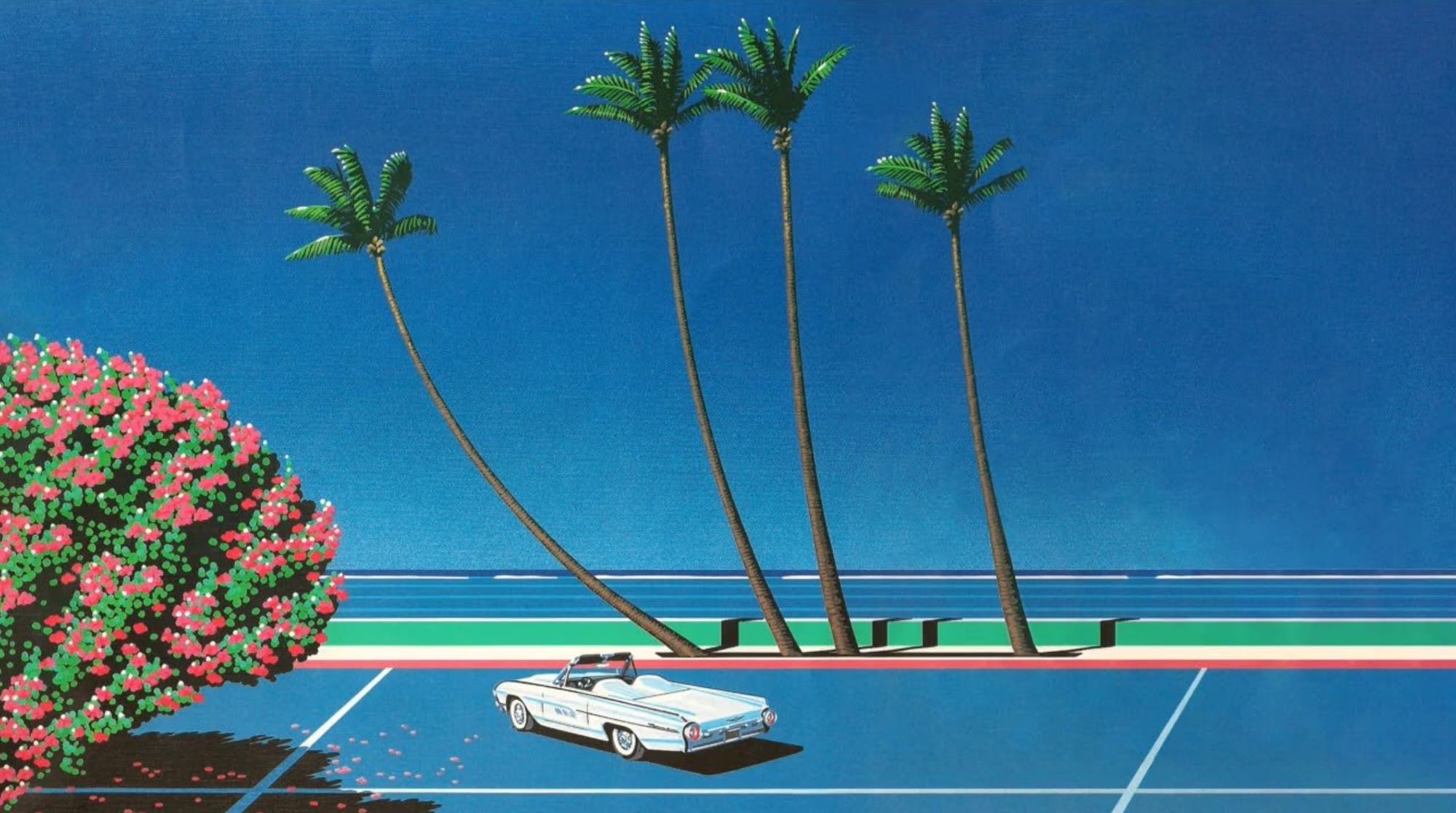
There’s an aesthetic to the jazz-fusion, city pop-infused global surge in interest in a lot of 1980s Japanese music and it’s, somewhat ironically, Americana. The image of blue skies, pristine beaches, palm trees, convertible cars and grand skyscraper-defined cityscapes bring a distinct visual look to the album covers of these albums, and often deeply infuse with the sound and intent of the music itself. Sometimes it would be photography of cities like San Francisco or the sunny beaches of Hawaii, and other times it would be beautifully-crafted hand drawn and pop art. Few of these art pieces are more iconic than the work of Hiroshi Nagai, better known as Hiroshi Penguin Joe.
Many of the most beloved albums of the era, from much of Eiichi Otaki’s discography like A Long Vacation, to albums like September Wind by Naoya Matsuoka & Wesing, are adorned by his art defined by its bright colors and visuals calling back to the pop art movement pioneered by people like Andy Warhol and the idealized landscapes of the United States in the 1970s and 1980s. Specifically, as he noted in an interview with Kaput Magazine, “without American pop art I would not have to start painting the way I did.”
What ties the images together is a distinct brightness to the point of simplifying ideas into a piece over the idea of painting a specific object or place. When you compare the core of A Long Vacation to that of another of Otaki’s works not to use Nagai’s art such as Each Time, while both evoke the image of the American pop cultural identity, both are distinct from one another in the ways in which they classify that image.
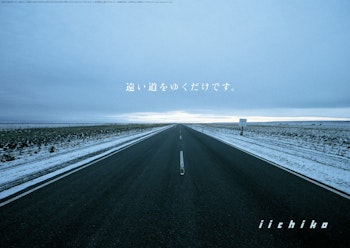
Each Time uses a photograph that hones in on the reality of the American open road with its capitalist-consumerist high-contrast visual advertising on full display, bright and bold yet real. Nagai’s art almost attempts to put the advertised America into a piece of art, and the thing that both share is a clear summers day that represents a clear and bright, prosperity defined by abundance. One shows that abundance in the unvarnished luxury of relaxing landscapes, and one does it through the potential opportunities that exist under that same blue sky.
Whether we talk to Nagai’s art or the broader genre, the unifying identity of the visual identity of these genres could be defined in a single word: prosperity. These works are unified by an almost-showboating luxury and leisure-focused lifestyle defined by spending power and time over labor. The fact this visual aesthetic was so dominant in the 1970s and 1980s in Japan to the point of defining these genres should be no surprise considering the rapidly-changing economic and political state of Japan during an era that transformed Japan.
Following Japan’s necessary post-war reconstruction under the occupation and later monetary support of the United States, the countries began to form political and economic alliances that would dictate the two country’s shared postwar trajectories. The US needed a wealthy Japan as a tool to showcase capitalist prosperity in a Cold War world, while Japan was rapidly seeking to modernize and grow its economy to match a new order. Both countries looked to the other for their own futures, which saw many view the United States as an economic force that Japan needed to emulate if it was to prosper.
In the following decades, Japan would come to achieve with some verve. Heavy investment in manufacturing and technology made Japan an advanced producer of the technological tools driving 20th century home life, from refrigerators to TVs. When you think to the technological inventions that would define the century, they came from Japan in this era, from the Walkman to the radio. Which made Japan one of the wealthiest countries in the world, with the yen one of its strongest currencies. Having viewed the United States as an economic example to learn from, US products and culture were viewed as desirable by many.
Tourism to the country and an emulation and embrace of American cultural exports, was synonymous with success, because the United States seen as an ideal in these fields. When businesses prospered, they invested in American real estate and companies to further bolster their portfolio, or would invest in the US market as representing their own success. At its peak in the 1980s, this is a major factor in a number of American celebrities featuring in advertising for Japanese products, like Arnold Schwarzenegger.
Jazz in Japanese music found its way to the country through the American occupation, and became transformed by Japanese musicians who found it and remade it in their own style. These sounds, and the songwriters behind them, would create for themselves but also for major artists, and as the mainstream of Japanese pop evolved from the kayokyoku sound to the J-pop we are more familiar with, some of these sounds resonated. It all came from the United States and an interest and transformation of its imagery and ideas in its own style. Coupled with prosperity that placed them now as equals, it should be no surprise that the sound and visual identity of this music would at least embrace Americana, pop art, and the visuals and association of the US.
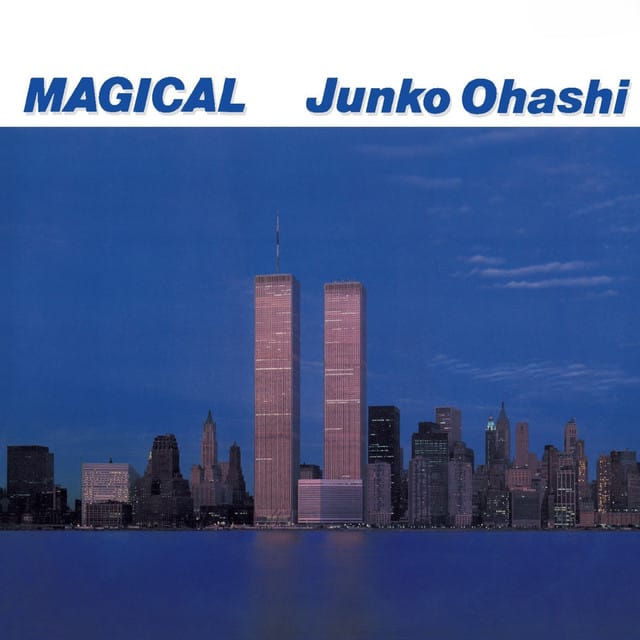
From the city pop staples to the jazz fusion hits, you can see American imagery everywhere. Many of Masayoshi Takanaka’s albums feature album artwork with the beaches of Okinawa and Hawaii in the background. Junko Ohashi’s Magical features the New York skyline, as does Yoko Minamino’s Global. And of course, returning to where this piece began, a number of albums by Eiichi Ohtaki featured photography of US monuments or the pop art of Hiroshi Penguin Joe.
As this music has received a growing global resurgence for the past decade, this artist’s work has surged as a visual embodiment of the sound and feeling of this movement. The relaxing sun lounger by a pool, quiet, tranquil, beautiful and simple. You want to exist in this moment, and the image of the US as a prosperous country for all (regardless of how true this is), aligned with the optimism of the Japanese economy, is as much a defining aspect of this music as its sound. It’s within his art that we see this embraced most strikingly, with evocative works that not only stand as striking album covers, but beautiful pieces of artwork in their own right.
This work exists today not just on albums, but in artbooks, museums, and more. With A Long Vacation, Hiroshi Nagai even noted that the sound for that album was based on the art he created. It’s the graphic design, ideas and identity of a generation of music, and the fascinations that are hidden behind it.