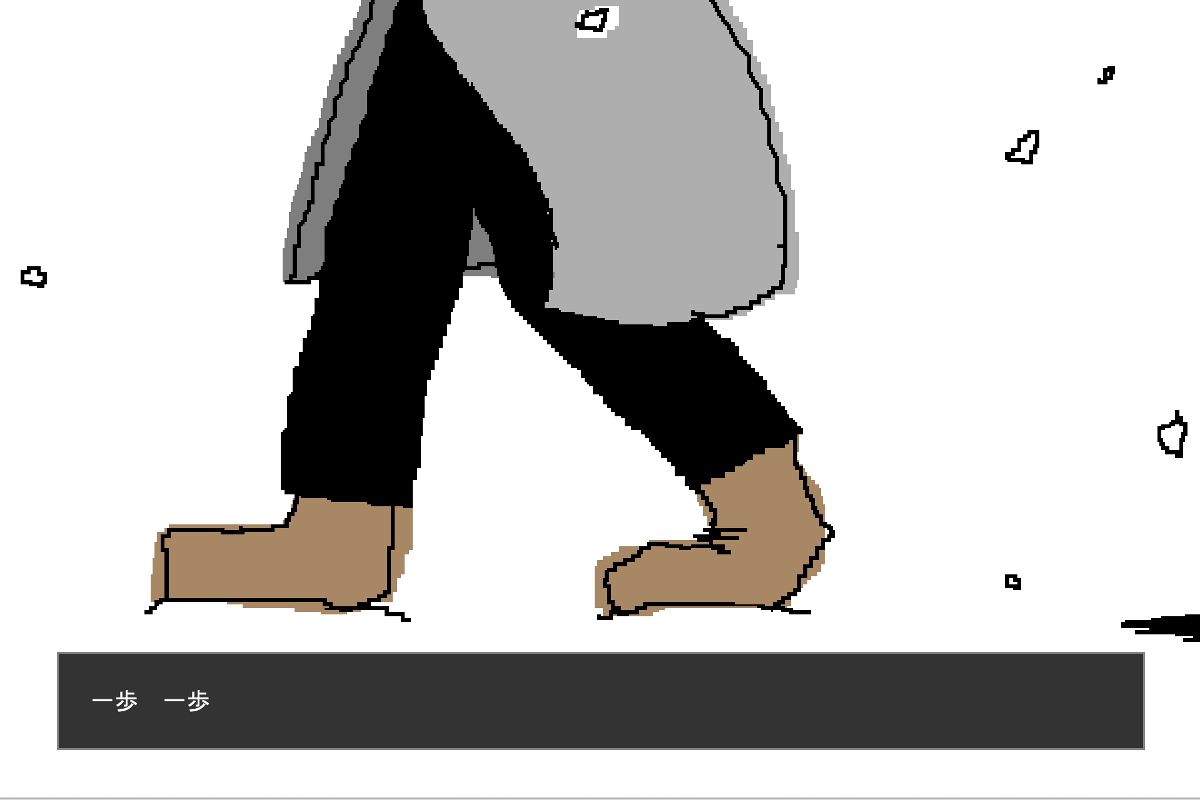
She takes one step after another. The cold seeps into her bones. Scraps of paper tumble in the wind. Her life is like that paper—transient, torn, borne ceaselessly into the future. There is no going back. There is only the now, and what comes next.
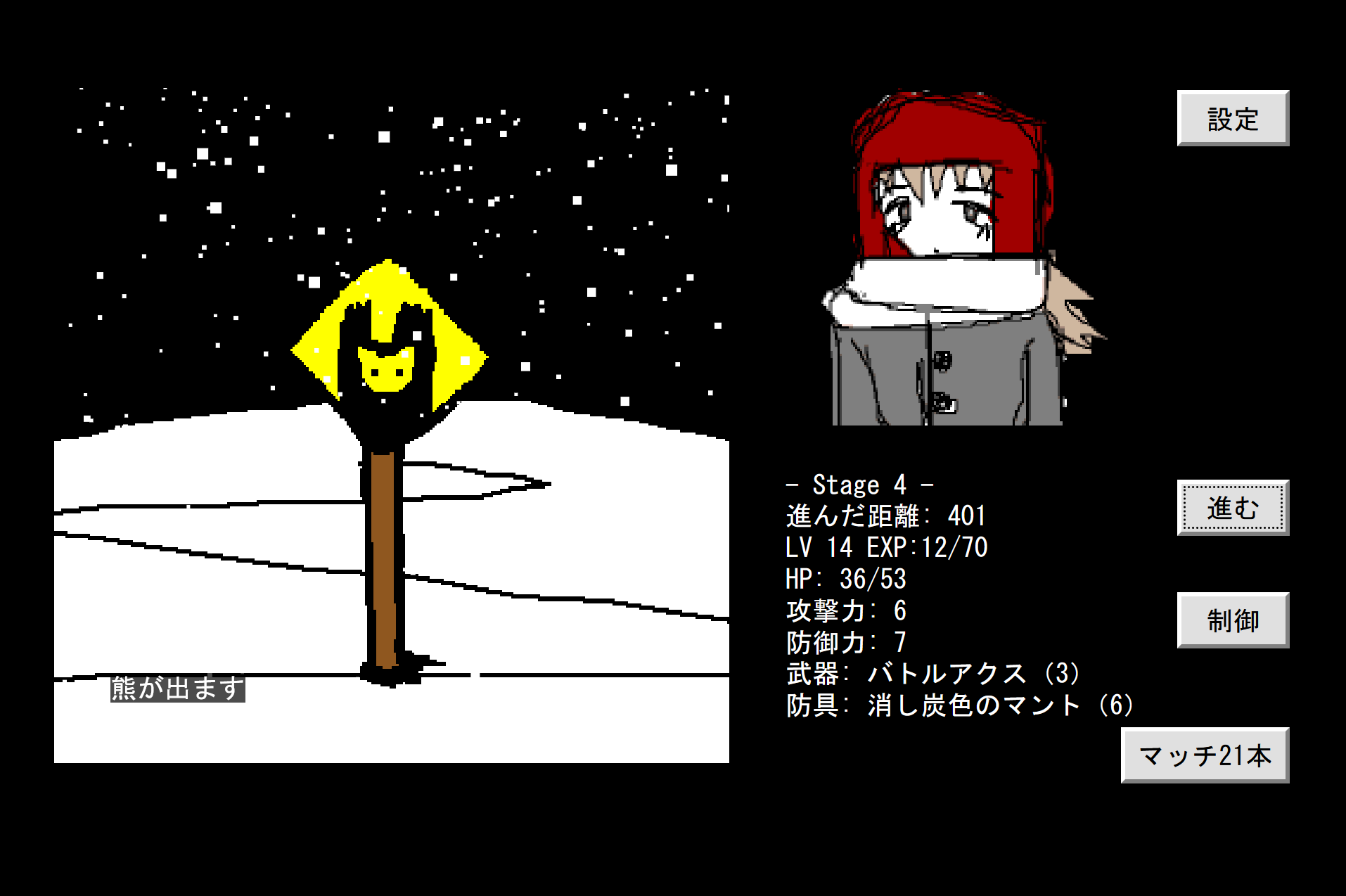
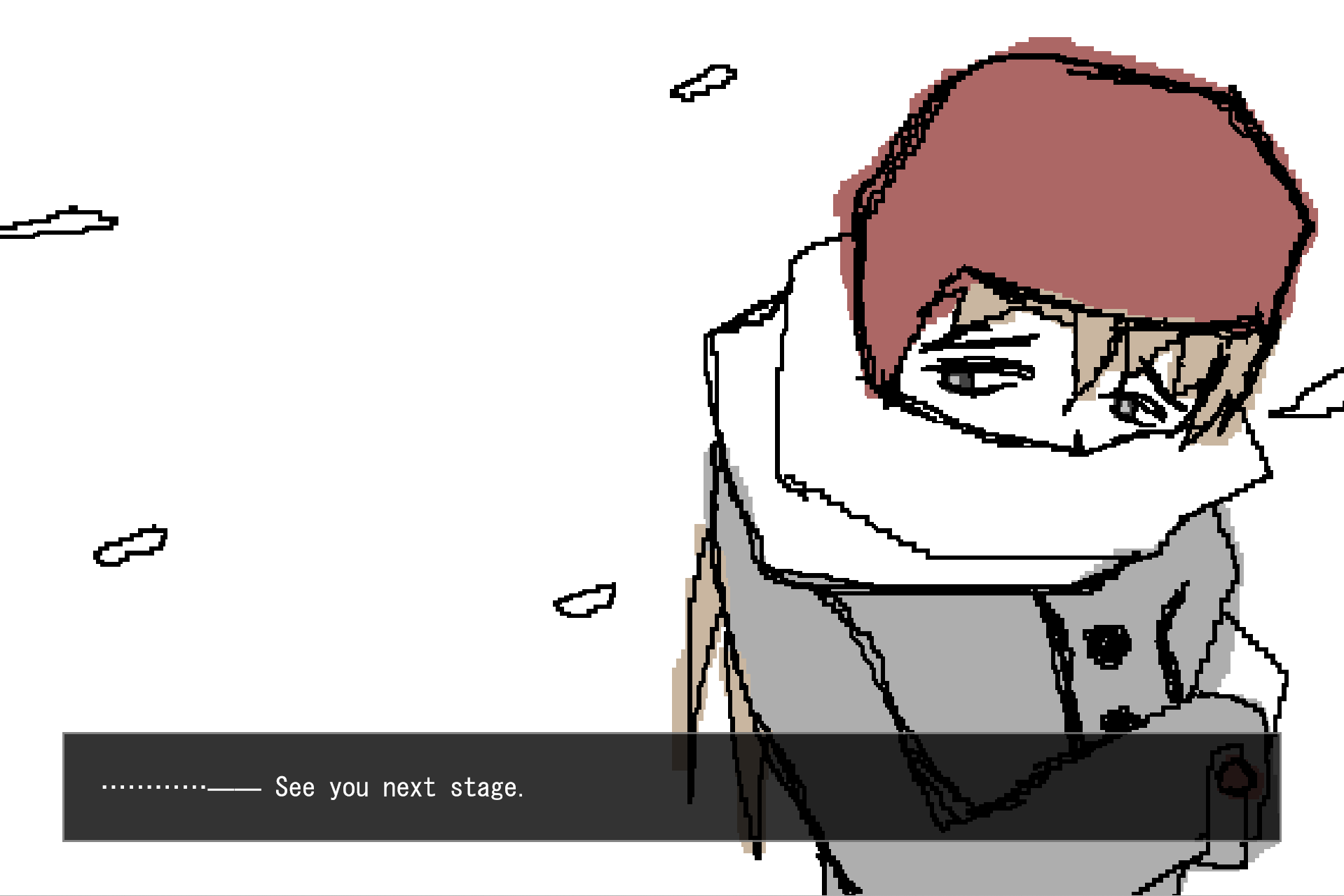
Snow Road, developed for PC in 2005 by Steppers’ Stop, is a brutally simple game. (You can play it online in Japanese, English or Chinese.) The player character can only step forward. Along the way she might encounter monsters or find matches. She fights monsters with her HP, Attack and Defense values. She spends matches on inns (to heal), candles (to save) and vending machines (to purchase weapons, armor and other items.) Every hundred steps a boss appears that must be defeated. Should she fail, she dies face-down in the snow. Should she succeed, she moves on to the "next stage.”
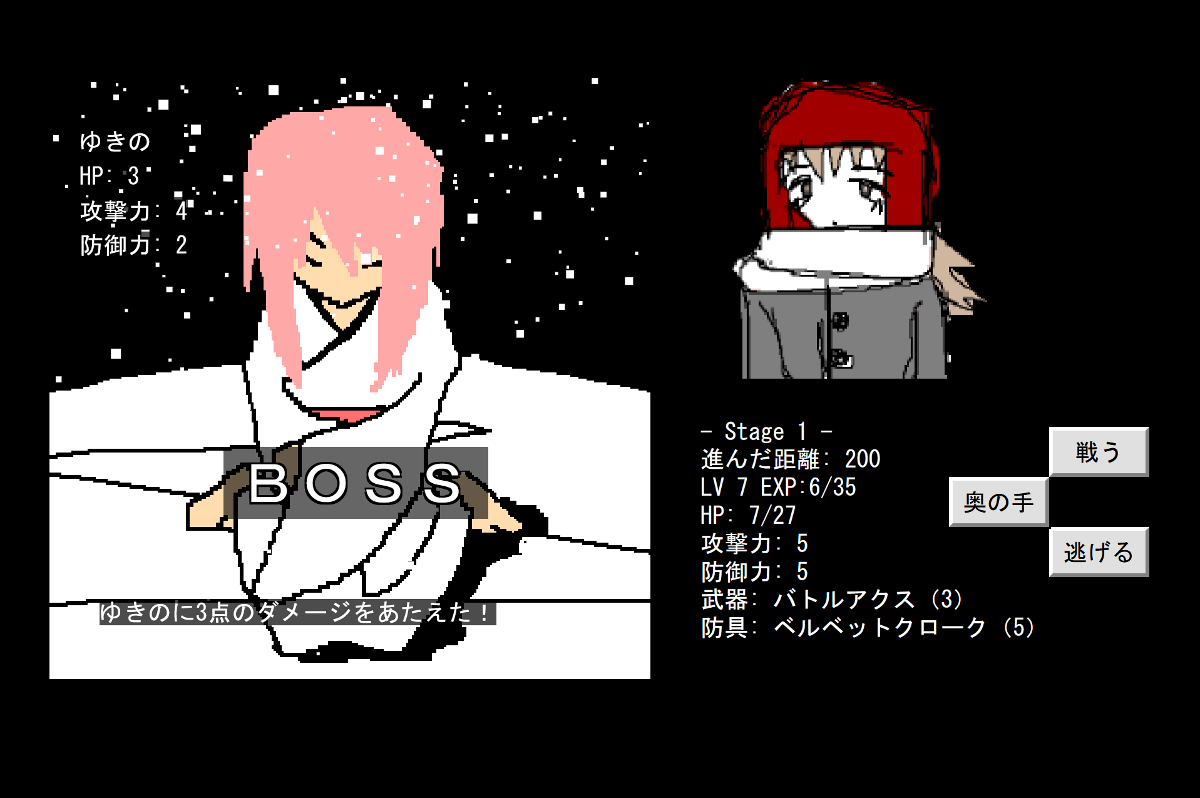
Battles are decided by strict numbers. A hatchet deals 2 damage. If the player character attacks a monster with a hatchet, and the monster has 1 defense, it will receive 1 point of damage. If that monster has 2 defense, the hatchet will deflect and the monster will take no damage. (Occasionally a deflected attack will break through, but you can’t count on it. The same is true for the monster’s attacks.) Whether the player character or the monster attacks first is decided randomly.
The player must accumulate enough experience, health and equipment for the player character to defeat the boss at the 100 step mark. Yet this is easier said than done. There is no predicting when an inn or a vending machine will appear. When they do, inn prices are randomized, as is vending machine stock. The player is at the mercy of random numbers, left to make the best of what boons and cruelties they are dealt.
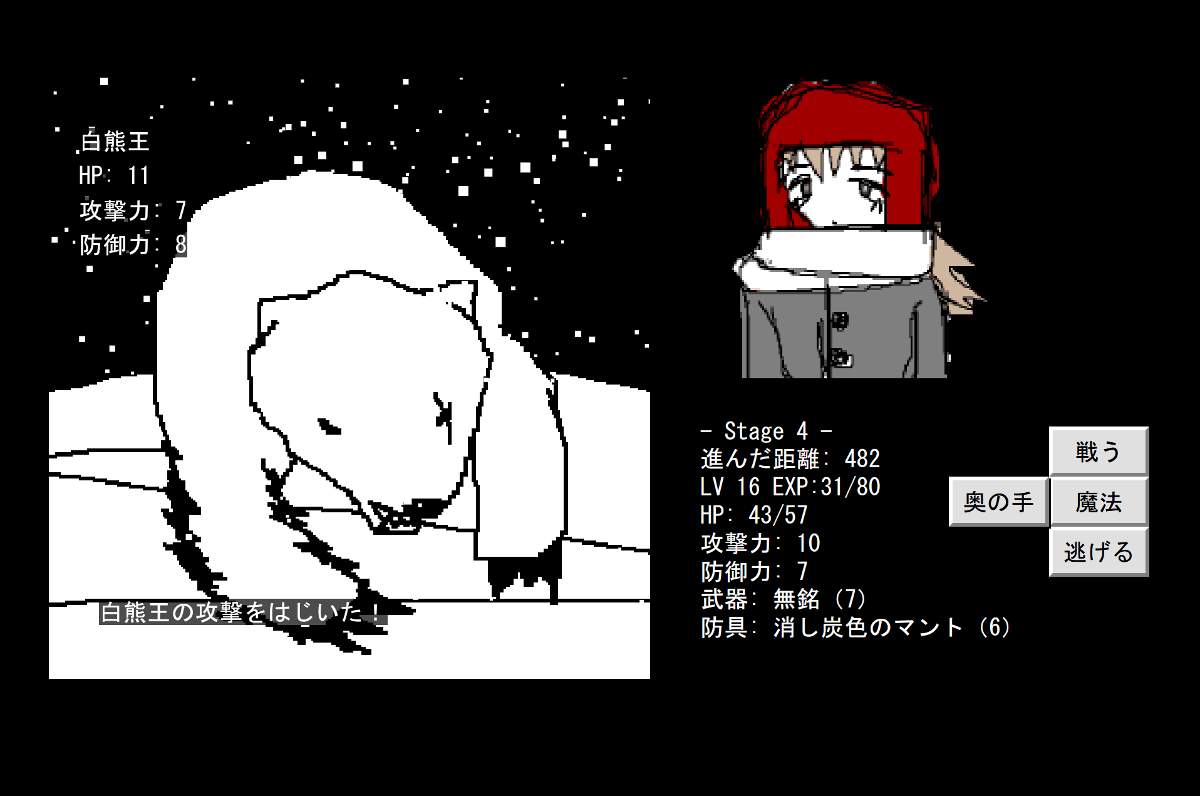
Some enemies, like white bears, are far too powerful for the player character to defeat at first. The bear’s fur is too thick for hatchets. Its claws tear through armor. Any assault is doomed; unless the player runs away, which they can do without much consequence. Once the player realizes this, the rules of the game change. Battles are no longer an inevitability. They are a choice. You ask yourself, “is this enemy worth my time? What will I get if I win? Even if I win this battle, will I lose the next one?”
There are other ways for the player to stack the game in their favor. By using the “Control” function, they can buy additional abilities and stat points. Attack is crucial for surviving early encounters. Drive consumes weapons to temporarily buff the player character’s attack power. But buying these abilities comes at the cost of her total HP. Are they truly worth the price? If so, why not go all the way by purchasing the Secret ability, which kills any enemy in the game at the cost of HP? Any enemy except for bosses, that is.
Seen from the perspective of 2026, you could call Snow Road a roguelike, in the vein of modern classics like Slay the Spire or Dead Cells. It’s a game about false starts, grotesque failure, and the ever-present possibility that this will be The Run. Yet the roguelike as we imagine it today was not particularly popular in 2005, relegated as it was to niche PC games like ADOM and the console-based Mystery Dungeon series. “Pick from three” was not yet a cliché. Spelunky wouldn’t be released for another 3 years, and nobody except folks on TIGSource would care until the game was remade for general audiences in 2012.
Fans at the time had a different label for Snow Road and its peers: the “non-field” RPG. Unlike other games that had the player explore dungeons or towns, non-field games were strictly limited to battle screens. Dragon Quest’s veneer of classic adventure scraped away, revealing what the genre always was—resource management. Not a trade that would appeal to every player. Dragon Quest’s vibrant art and writing is, for many, the point. Yet the non-field RPG is a fascinating challenge for developers. How do you capture the player’s imagination with so little? Could the numbers themselves be enough?
Snow Road has a few more tools in its box than just numbers. One of the most important is the music, which changes after every stage. Each track strikes a note of melancholy that invests every battle with deeper meaning. Unlike in other RPGs, the player character isn’t necessarily happy about fighting battles to become more powerful. In fact, she’s sad about it. But why?
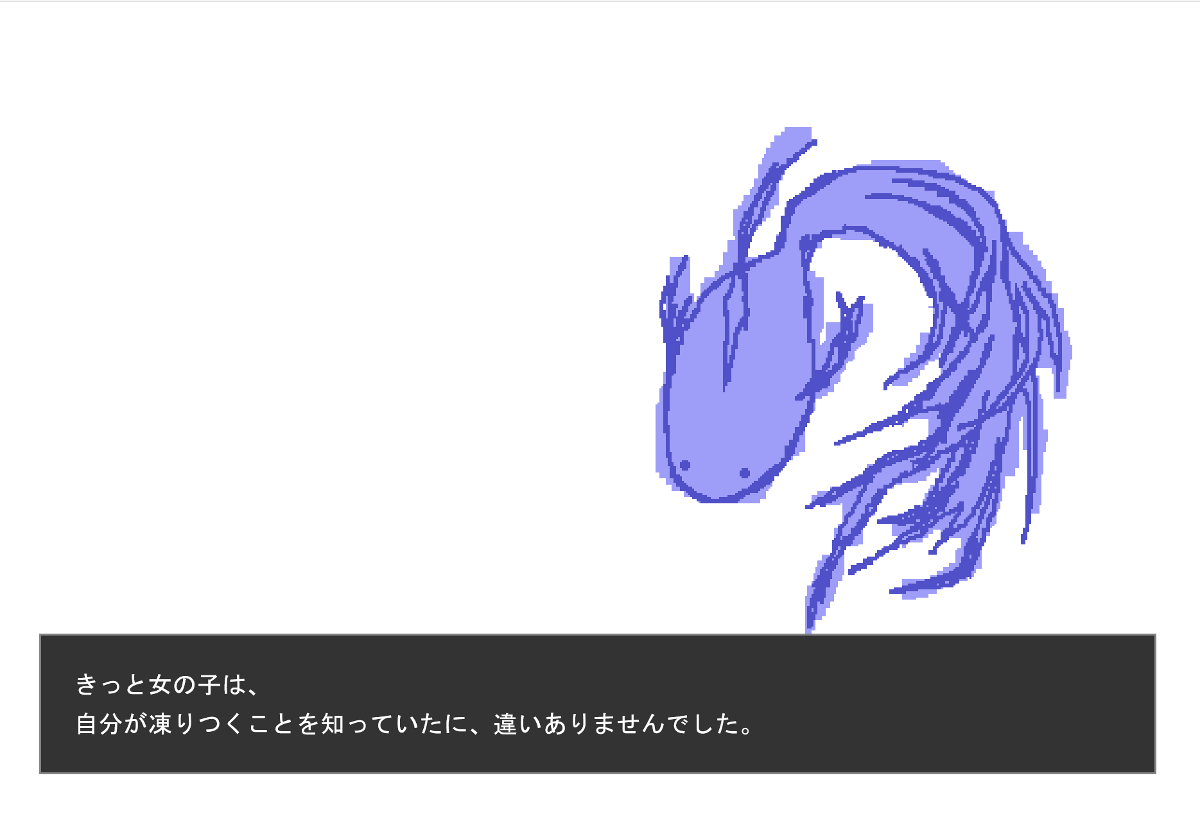
Short cutscenes after bosses offer possibilities: fate, technology, sexual trauma. But there are no answers. The player must put the pieces together themselves. That assumes, of course, that they have the pieces, because they won’t unless they learn to reliably defeat bosses. For many players, Snow Road will only ever be the first stage: wandering in the cold, dying to monsters, cursing your bad luck. That may be enough.
There are plenty of mysteries in the game I have yet to unravel. You can purchase a book from a vending machine that lets you learn magic, but I have no idea how to learn magic spells. Pages litter the landscape but offer only fragmentary sentences like “Become charcoal” or “Burn.” I still don’t know what the ability “Flip” does, or how the player character’s max HP affects stat gain on level up. When I do discover something new, like that some enemies are items of equipment you can equip if you defeat them in battle, it’s an incredible feeling.
Developers are still making non-field RPGs to this day, such as the fan-favorite 2019 title Aim for the End. Steppers’ Stop itself is still very active; its 2024 non-field RPG Princess of Destruction is available on Steam with an English translation. Not only that, but Steppers’ Stop’s webpage reveals that it’s created and sold multiple deckbuilders, too. Snow Road is just one expression of the circle’s multi-disciplinary interests. It may not even be the central one.
When I play Snow Road I am reminded of RPGs made in Flash like Sonny and the Epic Battle Fantasy series, which were published online a few years later. Like Snow Road, those games made the most of strict limitations. These days, Flash is dead, and both Sonny and Epic Battle Fantasy are relegated to Steam. They are a living reminder of the 2000s freeware scene, long abandoned after developers of that time abandoned youthful exuberance for professionalism and best practices. (New developers have since taken their places, but that’s another story.)
In the same way, Snow Road represents a period in Japanese indie game development when there were no “best practices,” when developers were figuring out in real time what kinds of art they wanted to make. Like the player character in Snow Road, I can’t go back to that time. What I can say is that Snow Road’s particular mix of 2000s edge, ambiguity born from compromise, and total earnestness, stoked a memory in me of the freeware scene that I grew up with. I’ll take that memory with me as I move forwards, through the cold, to the next stage.