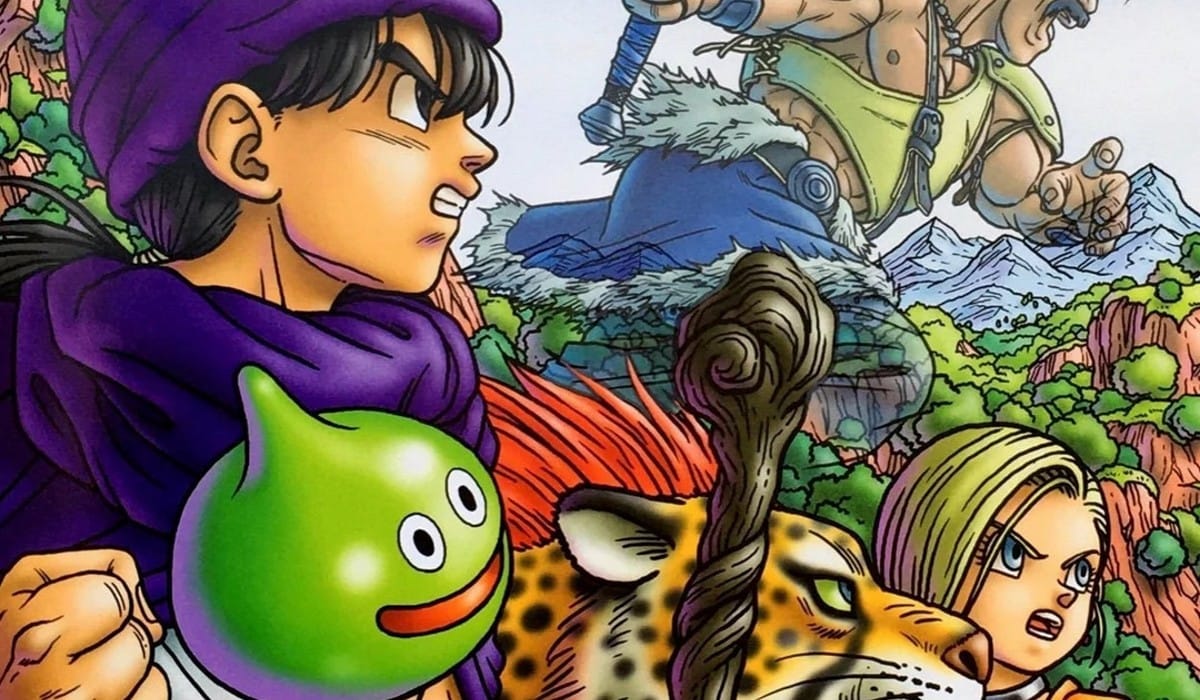
The first four Dragon Quest games begin similarly. The player character is chosen as the hero to smite evil. After buying equipment at the shop, they leave town for the world map, where they defeat monsters to become stronger. Gradually they venture out and find new towns, befriend additional allies, and investigate dungeons hiding treasure and even more powerful monsters to defeat. Even Dragon Quest IV, which trades the hero’s journey of the first three games for an anthology structure, starts with a relatively simple tale of a hero saving kidnapped children from a tower.
When Dragon Quest V begins, though, you are a child. You cannot venture out onto the world map because you have no business fighting monsters in the first place. Instead your father, Pankraz, fights those monsters for you. As he travels from town to town on a mission he refuses to explain, you have no choice but to follow. After all, you are still so small that you can’t even look over the side of a bridge without Pankraz’s help.
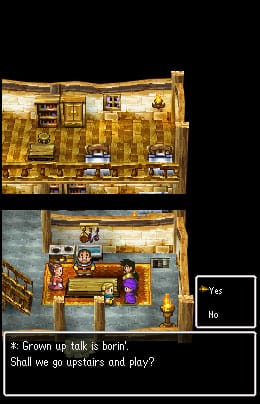
Every dungeon is reframed as a childhood misadventure stolen behind your father’s back. Following Pankraz into a nearby cave, marked by a “DO NOT ENTER” sign you can’t read; investigating a haunted tower with your pet and childhood friend; traveling to the world of the fairies, a place where only children can go. As your level increases, you grow to stand on your own two feet. No longer are you following in Pankraz’s footsteps. Instead you become his trusted helper and friend.
Of course, in the end, Pankraz dies. As monsters hold you hostage, he chooses death rather than to put you at risk. The monsters condemn you to a decade of slavery. Yet your father’s final words linger in your mind. “Your mother…she’s…still alive…”
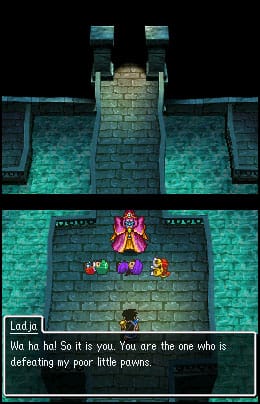
This opening section of Dragon Quest V is a triumph of narrative design. Every choice foregrounds the protagonist’s youth, from the player’s lack of agency to the re-contextualization of traditional Dragon Quest tropes through a child’s perspective. The early level curve of traditional Japanese RPGs, in which the player grows from a coughing baby to a skilled (but not yet heroic) fighter, also lends itself perfectly to the story’s gradual maturation. Pankraz’s death doesn’t hit unless you, the player, have grown mature enough within the game’s world to understand what his sacrifice means. Mature enough to recognize you have never had to fend for yourself, until now.
There are Dragon Quest games with better individual vignettes (VII) and Dragon Quest games with more impressive graphics (VIII). But few have as satisfying a structure, especially considering V came out in 1992. It’s a game that sticks in the memory not just for its triumphant Hero’s Journey beats, but for the downswings: the destruction of your childhood home, your inability to wield the magical Zenethian equipment your father worked so hard to find, and (much later in the game) the eight years you spend as a stone statue, robbed of the chance to see your children grow. No other RPG for the SNES captures the same feeling of experiencing somebody else’s life, with its joys and fears. Which is why, when I finished the game myself a few years ago, I was so frustrated by where and how it fell short.
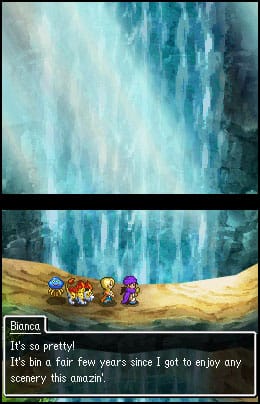
Dragon Quest V keeps its momentum following Pankraz’s death. After escaping from the monsters and ensuring your friend Harry finds his rightful place as king, you wander the world with wild creatures as your only allies. Eventually you stumble across a merchant who is offering up his daughter Nera’s hand in marriage (and the rights to a treasure your father once risked his life for) to a noble soul. Do you take Nera for your wife? Or do you instead choose your childhood friend, Bianca, with whom you once climbed that haunted tower? (DS players may also marry Debora, whose harsh tongue and haughty demeanor makes her a fan favorite.)
The marriage arc is another ingenious example of how Dragon Quest V puts a new spin on conventional RPG tropes. It isn’t just a matter of selecting a new party member, but choosing somebody you will spend the rest of your life with. The problem comes afterwards. Your protagonist’s new wife soon becomes pregnant and begins to suffer from morning sickness. She is spirited away and taken to a safe place to rest. Later she is kidnapped by the villain. Once again, you are torn away from your family, suffer alone for years, and must work to reunite with your loved ones. It’s a gut wrenching twist–for the player.
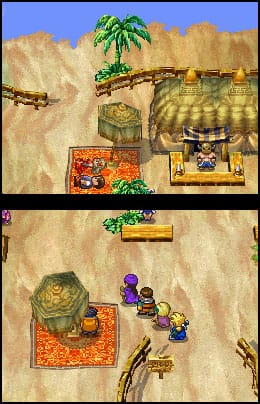
What about for the player’s partner, though? She is given some personality in dialogue and in battle, yet her story is ultimately subordinate to the player’s. Her life becomes a bargaining chip within the framework of the Hero’s Journey. This is blinkered, sexist writing, and (to be fair) not out of the ordinary for 1992. Other RPGs at this time like Final Fantasy V and Shin Megami Tensei had similar blind spots.
The problem is that Dragon Quest V wants to be a romance. Sometimes it succeeds; making the protagonist’s love interest a party member that levels up alongside the hero gives the player a reason to invest in her. But a good romance isn’t just one-sided. There’s give and take. Dragon Quest V can’t do this, because it’s too invested in the player’s perspective. You feel empathy for the protagonist because you stand in his shoes. The protagonist’s wife is never given that advantage, despite the fact that Dragon Quest experimented previously with multiple perspectives in IV. She remains an NPC.
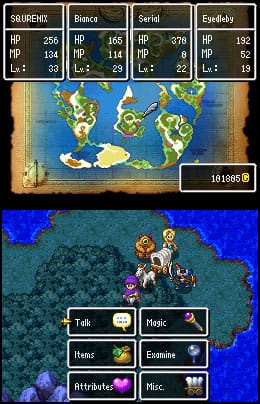
The player’s children suffer the same fate. On paper, the idea of a family as an RPG party is a great idea. Dragon Quest V milks it even further by making those children the fulfillment of your father Pankraz’s dream. While you cannot wield the Zenethian equipment your father spent his life searching for, your children can. A brilliant twist efficiently told via RPG mechanics. Yet your children, too, cannot have lives of their own, like you once did. They remain subordinate to the player, because Dragon Quest insists again and again that this is your story. (Just as the 2019 animated film adaptation is titled Your Story.)
As a result, even after defeating the final boss and watching the cast embark on their happily ever after, I couldn’t help but find the ending to be hollow. Who was this family I had spent so much time working to save? What were their goals, their dreams? I had no idea. I was only ever a ghost inhabiting the body of their father, walking the road of the Hero’s Journey, alone.
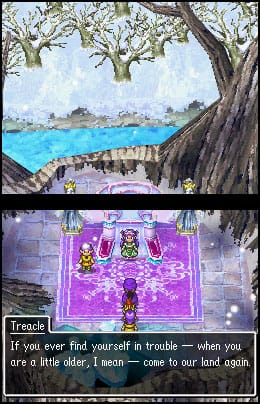
V was released in 1992, the year I was born. RPGs have spent the past three decades building on what Yuji Horii and his team accomplished back then. Rather than Dragon Quest's economy of storytelling, though, or its willingness to experiment with structure, later games like Persona and Fire Emblem chose to iterate on its player-focused philosophy. That philosophy is what made RPGs accessible to the masses. It is also a curse that haunts the genre to this day, limiting its horizons such that players might not even be aware of what lies beyond their reach.
What might another kind of game look like that gives the hero’s family their due? That elevates their perspective to the same level of importance as the player’s? Dragon Quest VII offers a possible response, in that some of its vignettes meet unhappy endings regardless of the player's actions. Its NPCs stubbornly live their own lives. Yet every successive remake of that game (including this year's Reimagined) has sought to defang it. Meanwhile, Horii is busy these days chasing the dragon of generative AI. I don't think Dragon Quest as it exists today is able to resolve the contradictions it butted up against back in the '90s.
But another game might. After all, it is the child, not the father or the grandfather, who wields the Zenethian Sword.