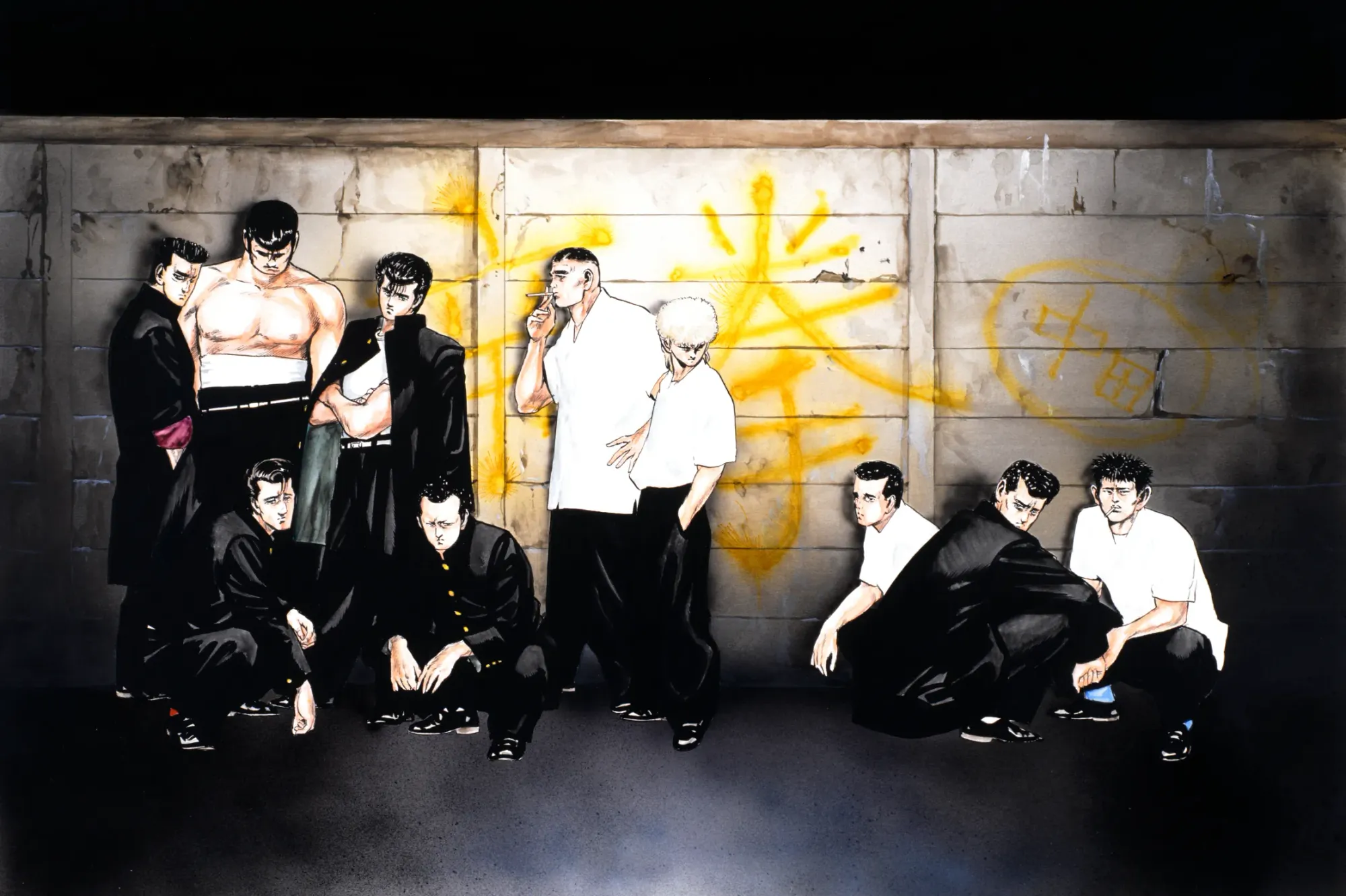
Rokudenashi Blues by Masanori Morita was not the first delinquent manga, nor is it the most popular. The honor for the former belongs to Otoko Ippiki Gaki Daisho by Motomiya Hiroshi, serialized in Weekly Shonen Jump from 1968 to 1973, while the latter is arguably currently taken by Tokyo Revengers. According to figures published in 2024, Ken Wakui’s series has 80 million copies in circulation, far outpacing Morita’s 60 million in the scant nine years it has existed.
Even so, no other series has exerted as much of an influence on the subgenre and its public perception. The modern image of the delinquent, complete with a pompadour and a school uniform, can be traced almost entirely back to Morita’s work and the generations of readers who fell in love with it. You could also argue that Tokyo Revengers relies on a certain sense of nostalgia for a lost golden era of ne’er-do-wells, with many characters lamenting that delinquents used to be respected more back in the good old days.
For those born outside of Japan, however, the legacy of Rokudenashi Blues is scarcely understood. As of the time of writing, the series has never been translated into English or received a proper anime adaptation outside of two movies, posing many problems when it comes to accessibility. This feels like a black hole akin to the situations surrounding Ashita no Joe and Fist of the North Star a couple of years ago, both of which are finally being remedied by Kodansha and VIZ Media respectively.
In lieu of official licensing, this article hopes to demonstrate the importance of Rokudenashi Blues while also dissecting why it is so beloved. At first glance, the lack of accolades as highlighted at the beginning would seem to contradict its place in the industry, but the true value of Masanori Morita’s comes in execution over invention. Moreover, one particular arc has served to cement it in the minds of many as a masterpiece, showing the importance of long form storytelling.
Beyond the Golden Age
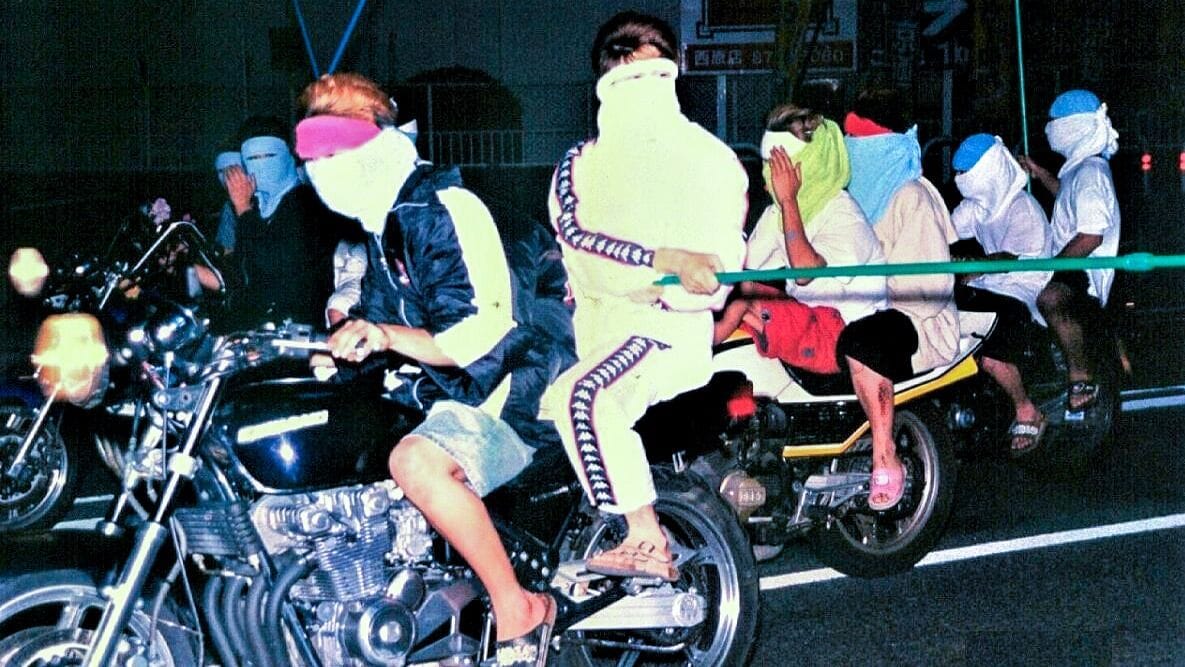
When Rokudenashi Blues burst onto the scene in 1988, the delinquent subculture was arguably already in decline. Throughout the 1960s and 1970s, it had grown from post-war protest movements alongside the rise of biker gangs such as the Bousouzoku, but the halcyon days were over scarcely before they had begun. Not only did the new generation yearn for their own forms of self-expression, the explosion of the bubble economy in the latter half of the decade temporarily alleviated many of the economic motivations underpinning rebellious feelings.
For Masanori Morita, the decision to draw a delinquent manga was almost accidental. In an interview with Zebrack, he admitted that he was not a delinquent himself at school and seems to remember basing the designs on a magazine he’d read at some point. While slight, these details suggest that Rokudenashi Blues itself was based on a collective memory of a bygone era that expressed itself more through style than actual substance.
“For a serialization, you have to draw on what you know, but I joined the manga industry just after I left high school. The only world I really know is school, so I decided to do a school story with some jokes. I also wanted to have an active protagonist, so I made him into a delinquent.” - Masanori Morita, 2026
In popular media, the archetype of the delinquent had already been popular for many years. When defined more broadly as one who refuses to play by the rules and bow down to authority, there appear to be many links to the idea of ronin in traditional folklore, but Otoko Ippiki Gaki Daisho was the first to place this general concept in the specific milieu of a school. This combination, itself a product of the increasing academization of Japanese youth, is what sets the modern delinquent apart from such proto-delinquents as Miyamoto Musashi and Yabuki Joe.
Moving into the 1980s, another aspect of modern delinquents was incorporated into the archetype: style and fashion. While the rough and ready characters of Otoko Ippiki Gaki Daishou definitely had an imposing aura, their appearance was nothing short of ramshackle and echoed the struggles of Japan in the post-war period more than the modern economic miracle that followed. It was within this cultural milieu that Kazuhiro Kiuchi launched Be-Bop High School in 1983, depicting his protagonists with perms and pompadors that reflected the trends of the time.
Even though Kiuchi beat Rokudenashi Blues to the punch in this respect by more than five years, Masanori Morita’s series is usually more widely remembered and ended up selling more by the end. There are arguably two reasons why: audience and publication. Not only did Be-Bop High School target an older and therefore more limited readership, Rokudenashi Blues just so happened to launch in Weekly Shonen Jump right in the middle of the magazine’s golden age, calling such classics as Dragon Ball and Slam Dunk its contemporaries.
The Here and Now
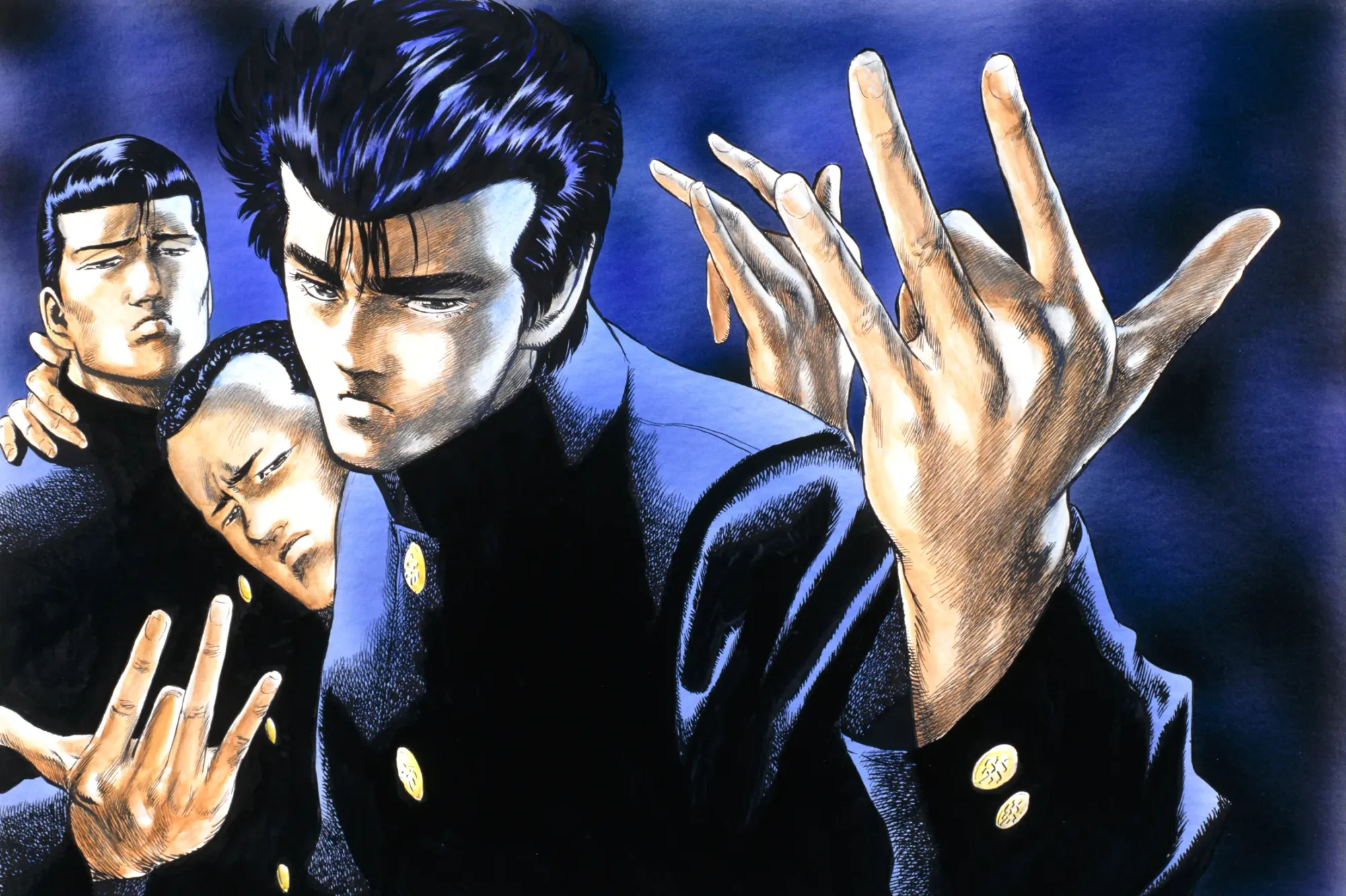
With this in mind, it’s easy enough to label the success of Rokudenashi Blues as nothing more than a lucky break. Many critics have done so in the past, but circumstance alone does not explain why it proved so popular while others in the same position failed and are now forgotten. It’s time to uncover why Morita’s series is so beloved, beginning with where the story takes place.
In the 2018 book Shonen Jump: Ougon no Kiseki, former Weekly Shonen Jump editor-in-chief Hiroki Goto explains that Rokudenashi Blues was one of the only series at the time to use a setting rooted in real life. Although most manga were set somewhere in Japan, few specified where this was nor made an effort to gather reference materials in the name of realism. Not only did Morita’s series specifically take place in Kichijoji, his team regularly made trips out to local high schools to take photographs in the name of consistency… without permission, of course.
When combined with the aforementioned fashion trends, this made Rokudenashi Blues into a series that strongly reflected the here and now. It is worth noting that the school featured in Be-bop High School is supposedly based on Kazuhiro Kiuchi’s own alma mater in Fukuoka, but the story itself is set in Kanagawa. This contradictory set of influences contributed to a sense of fantasy, while Morita’s story contained a kind of realism that echoed among readers whether they lived in the capital or not.
Helping with this sense of realism was the series’ visual style. Despite beginning his professional career with an admiration for the likes of Osamu Tezuka and Fujiko F. Fujio, the first job that the young artist received upon moving to Tokyo was as an assistant for Tetsuo Hara on Fist of the North Star. This experience rapidly transformed Morita’s art from a more cartoonish aesthetic to an intensely detailed one, full of shadows and complex facial expressions.
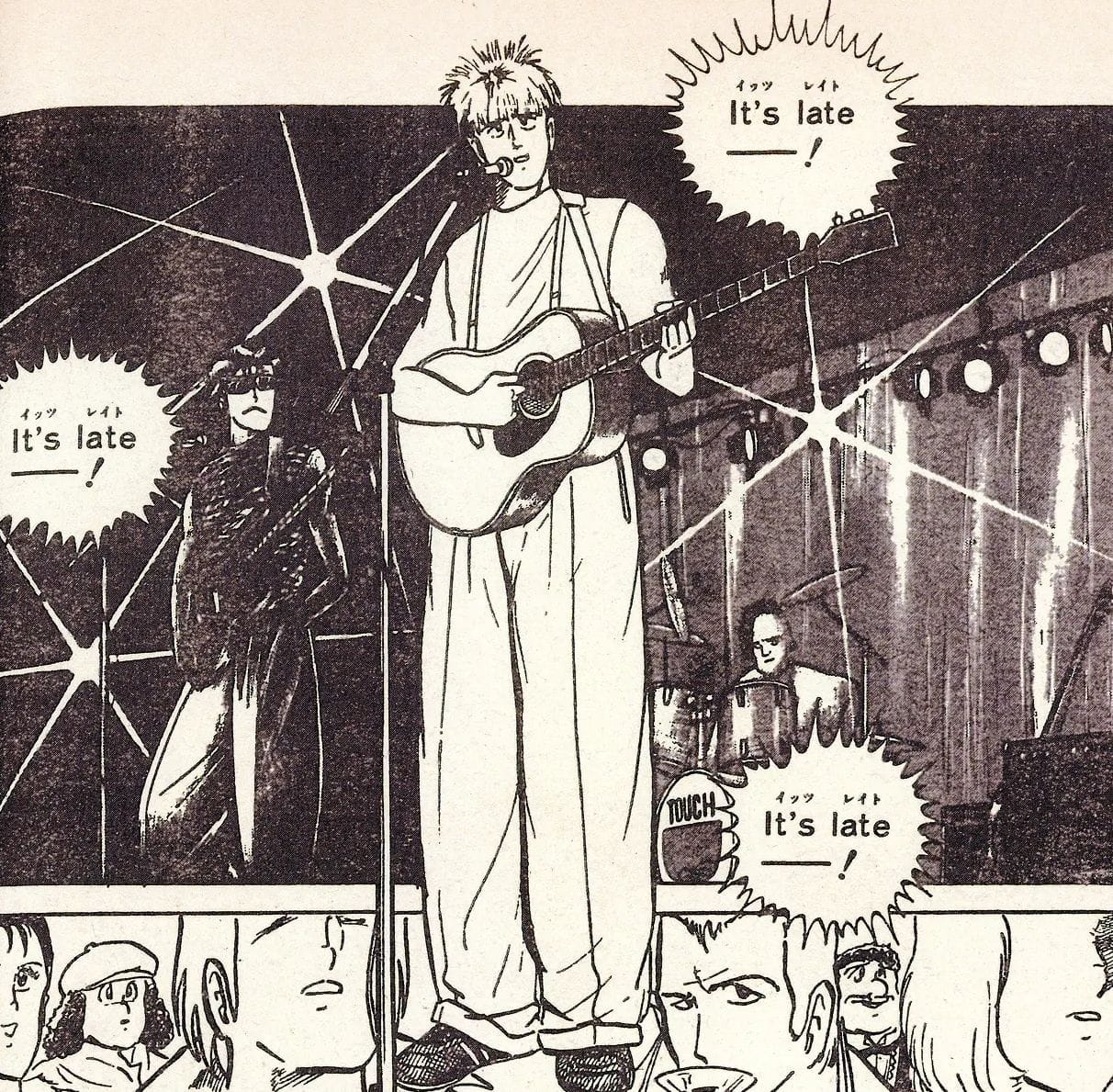
Even if this attention to detail would prove crucial in selling both the verisimilitude of the setting and the emotions of each character, it would be inaccurate to say that Rokudenashi Blues was nearly as hard-boiled as something like Fist of the North Star. When reading the series, there is a surprising amount of focus on both romance and comedy as there is action and drama in a way that appears to contradict the series’ reputation. Nevertheless, these are exactly the kind of features that made it so beloved.
Regarding the former, one thread that runs throughout the story is the relationship between the main characters and their love interests. Maeda is paired with Chiaki and Yamashita with Kasumi, even if only one of the couples would end up getting together by the very end. Both of these female characters also play an important role in the story, causing fights as well as putting a stop to them, appealing to a broad audience and arguably foreshadowing the importance of female fans in future delinquent hits such as Tokyo Revengers and Wind Breaker.
Finally, Morita claims that his editor told him at the start of serialization to put in at least one gag for every two pages. That comedic focus definitely shines through in the early part of the story, even if it never comes at the expense of real drama and high stakes action. Rather, the kinds of jokes that Rokudenashi Blues employs feel like ones that real high school boys would make, including lots of toilet humor and light bullying. Be-bop High School, on the other hand, would only incorporate humor later on into its run, perhaps because of the popularity of Morita’s series.
One Marvellous Arc
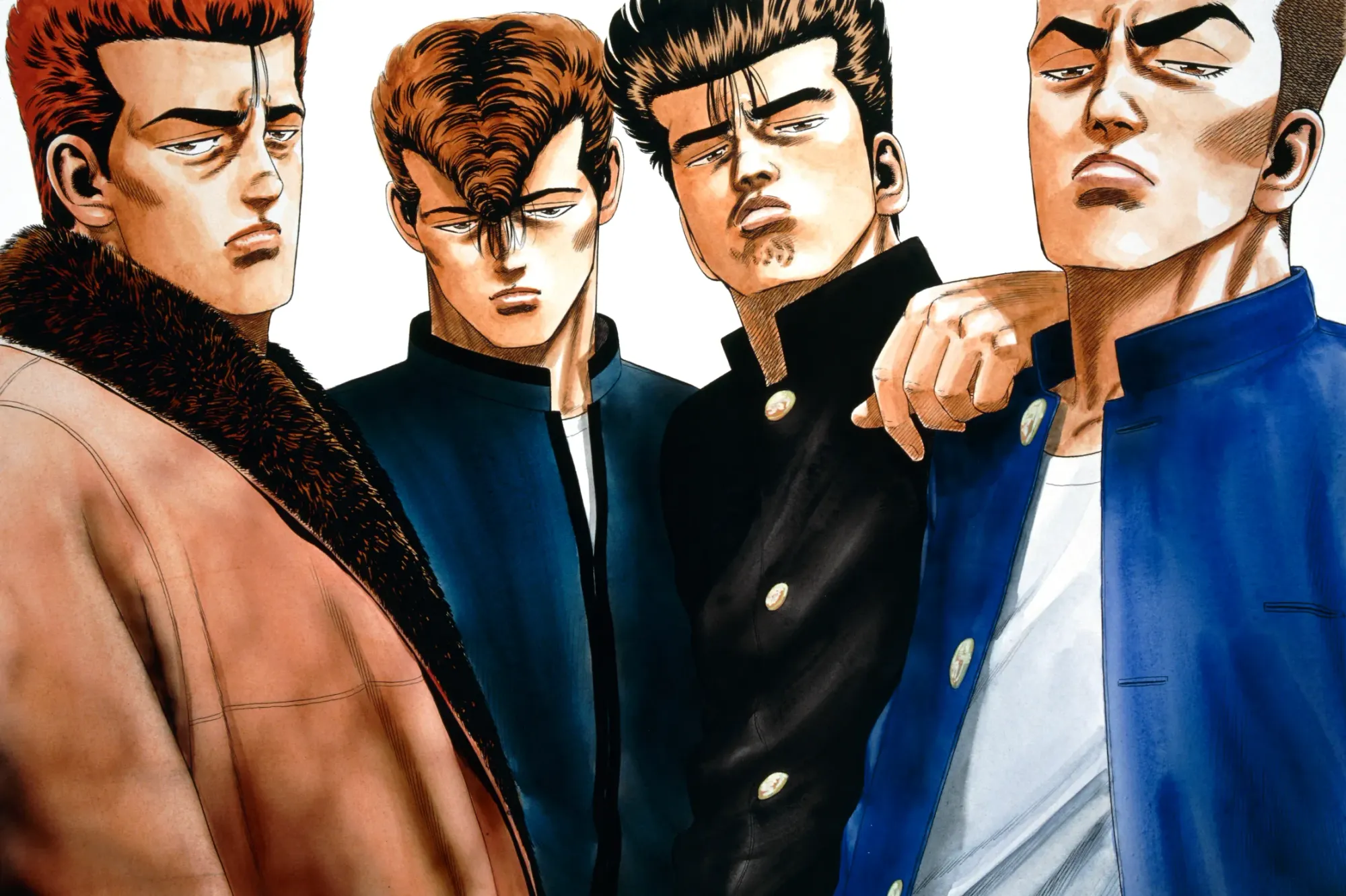
Aside from the look of its main characters, one of the main things associated with Rokudenashi Blues in the popular imagination today is one particular narrative arc. Despite starting about a quarter of the way through, the Four Heavenly Kings storyline is widely regarded as the high point of the series and a landmark moment in the delinquent subgenre, expanding what was possible in one fell swoop. Hiroki Goto even candidly admits in his book that sales numbers after this point were like night and day.
In terms of why this arc is remembered so fondly, the first reason that often comes up is the characters. While Maeda and friends are plenty iconic, the titular monarchs are some of the series’ most imposing and powerful figures, each the master of their own domain with plenty of lackeys to match. That being said, only one of them has proved popular enough to receive a spinoff almost thirty years after his debut: Onitsuka, leader of the delinquents of Shibuya Rakusui Academy and famous for ruthlessly beating down all who oppose him.
Compared to Maeda, Onitsuka is a completely different kind of gang leader. Instead of seeing his fellow delinquents as part of one big family, he prefers to rule with fear and awe, even going as far as to punish his own subordinates for daring to step out of line. This contrast is precisely what makes the eventual clash between the two characters so interesting, as well as the fact that Onitsuka comes to appreciate Maeda’s leadership philosophy by the end of the story.
Moreover, the Four Heavenly Kings storyline marked a huge shift in the setting of Rokudenashi Blues. Up until that point, the narrative had been almost entirely contained to Kichijoji and the ne’er-do-wells of Teiken High, but the scope suddenly enlarged to include gangs in schools from Shibuya, Asakusa, and Ikebukuro. That pattern only continued into the next major narrative arc, where Maeda travels all the way to Osaka to settle a score with a local rival.
Given that the Four Heavenly Kings storyline continued for dozens of volumes and spilled over into subsequent conflicts, there isn’t enough space to dissect everything in this article. For now, it’s worth pointing out just how important this narrative development was in ensuring that the series was remembered by subsequent generations in the same way that a bad arc can ensure a relegation to the dustbin of history. Tokyo Revengers, in particular, seemed to fall off a cliff following the controversial ending.
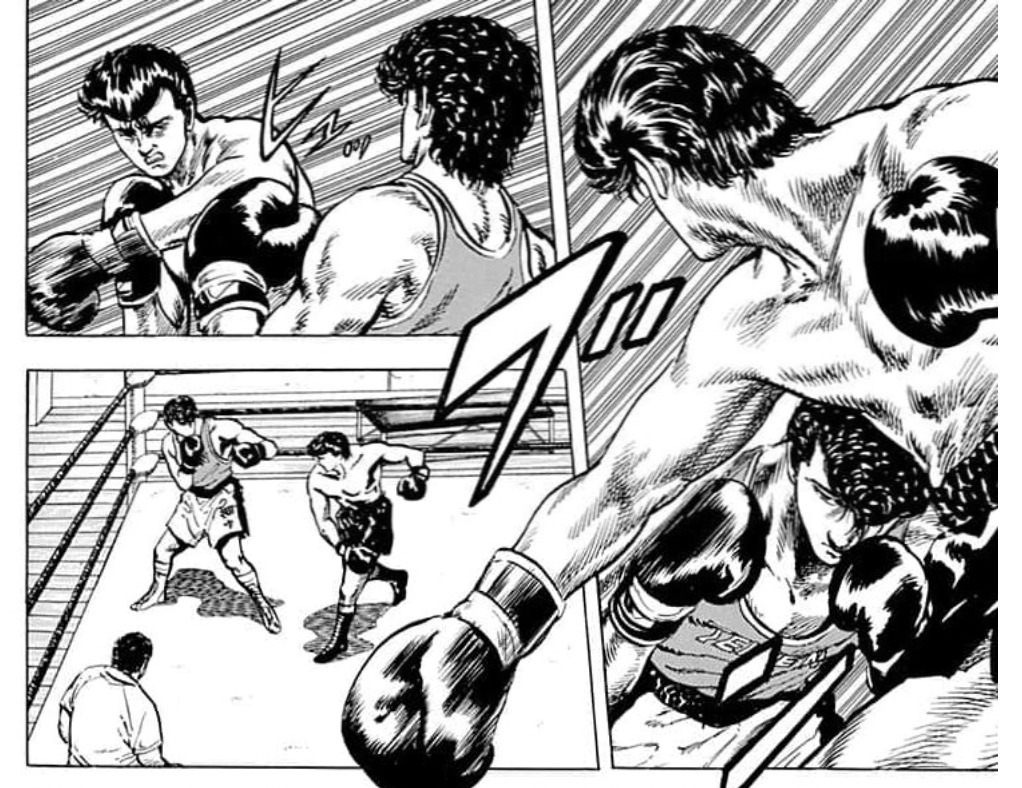
At the same time, it would be inaccurate to say that the legacy of Rokudenashi Blues is entirely indebted to this arc. Goto certainly seems very cynical about the early portion of the story, but these chapters are perfectly entertaining due to the aforementioned focus on romance and comedy. No discussion of this series is also complete without a mention of the fact that boxing runs through its veins: Maeda’s objective is to become the best boxer in the world, echoing the soul of the proto-delinquent Yabuki Joe.
There are certainly reasons why some landmark series in Japan never see the light of day in English. Length is definitely an issue for Golgo 13, for example, but no such problems exist for Rokudenashi Blues. It would be a steal of a license and a true justice for the community if someone were to pick it up.