In 2015, following the release of When Marnie Was There, Studio Ghibli announced that they would no longer produce new films, transitioning instead into a legacy company focused on its past releases and popular IP. The film was successful, but it underperformed when compared to other recent Studio Ghibli films, and left the company without a clear successor with Hayao Miyazaki seemingly retired and Isao Takahata having produced his final film with Tale of the Princess Kaguya. The company, it seemed, was at an impasse. Of course, they would reverse this decision, with Miyazaki coming out of retirement to create The Boy and the Heron after his son, Goro Miyazaki, had released the CG film Earwig and the Witch. But this reversal never answered the underlying questions that spawned the original discontinuation of studio production.
After all these years there’s still no clear successor to the current aging generation at the top of the company, an issue admitted by Toshio Suzuki, the long-term producer that spearheaded Studio Ghibli alongside the famed creative pair of Miyazaki and Takahata since its founding. Yet the company is also more successful than ever, riding the wave of interest in Japanese anime and pop culture with their acclaimed legacy. Their movies remain global hits on streaming and home video, with merchandising another major success story. Ghibli Park opened in 2022 as an outdoor attraction built around their films in Nagoya. A new wave of remasters released to cinemas in IMAX has been an undeniable success. Financially, the company is secure, and they remain a figurehead for Japanese media on a global scale.
Yet the question remains. What is the future of Studio Ghibli? Over a decade later, that seems even more uncertain. Is the solution to find new successors? Or is it to leverage the past indefinitely, allowing the company to remain tied to the identity of its founders while utilizing its IP in new ways in lieu of creating new films? The company appears torn between the two.
One thing is for certain: Studio Ghibli in 2026 simply lack the creative capacity to develop films at the pace they did during the 1990s and 2000s. At this time, the company had not just Miyazaki and Takahata at the helm, but an array of cultivated young minds who could take charge of new projects of their own. Of the seven films the company released throughout the 1990s, two of these films were directed and managed by young, diverse teams taking the company’s creative style in fascinating new directions. The most famous of these was Whisper of the Heart, directed by Yoshifumi Kondo.
While today considered a Ghibli classic, the film was notably very distinct from the works of Miyazaki and Takahata. If the former leant into fantasy draped in historical aesthetics the latter created mature human dramas, this was a teenage love story set in the ordinary everyday. Its protagonist is merely a young girl with a love of reading and a desire to create, falling in love after a chance meeting with a determined boy whose aim is to craft violins. Its thematic through point is “Take Me Home, Country Roads,” an American song that protagonist Shizuku translates and sings throughout, representative of her desire to find her place. While thematic similarities can be found elsewhere in Ghibli’s filmography in stories like Kiki’s Delivery Service, none are driven quite like this.
The same can be said for Ocean Waves, a made-for-TV movie with the distinct creative agenda of being a project entirely handled by and serving as a training ground for the next generation. At this time it was possible for Studio Ghibli to work on numerous films at once and train new animators in their style. While unfortunate circumstances were also a factor - Kondo was once seen as a successor to the company before he tragically passed away just a few years after his directorial debut - it’s also true that no creative was ever truly seen as being able to stand alongside its two figureheads as a successor.
Thus, their classic works became the singular image of Studio Ghibli. Films like My Neighbor Totoro, Princess Mononoke, Spirited Away, and Howl’s Moving Castle are all the films most often cited first with the company, and all come from Hayao Miyazaki. Many of the creatives trained at Ghibli have dispersed when unable to continue creating at the studio, including Hiromasa Yonebayashi, who would go on to develop films alongside many ex-Ghibli animators at Studio Ponoc.
It was Yonebayashi who directed When Marnie Was There, the last film before the company chose to shut down production. When it resumed with The Boy and the Heron, it was a much smaller team, only able to produce a single film at a time, with Earwig being produced mostly independently with a mix of outsourcing and limited internal CG teams. It also felt like a film reflecting on a legacy, glancing to what may follow. Even now, with Miyazaki seemingly working on another film at the age of 85, it is the only new film in production.
Could Studio Ghibli die with Miyazaki and Suzuki? While ten years ago this seemed like a natural possibility, recent moves suggest that the future of Studio Ghibli may not solely lie in nostalgia. In 2023, long-time production partner Nippon Television purchased 43% of the company, a move described at the time as one allowing the company to focus on filmmaking while securing the future following its aging founders. Ghibli Park, opened in the World Expo 2005 commemorative park, will also soon be the home of the first new film not produced by its primary directors since 2015.
A Night in the Valley of Witches, directed by Goro Miyazaki and Akihiko Yamashita, will be an all-new short film premiering exclusively in the park. Yamashita’s prior directorial credits are on A Sumo Wrestler’s Tail, a 2010 short produced for the Ghibli Museum, and on the Invisible short film for Ponoc’s Modest Heroes short film compilation, arguably the strongest of the three films produced by the company in that selection.
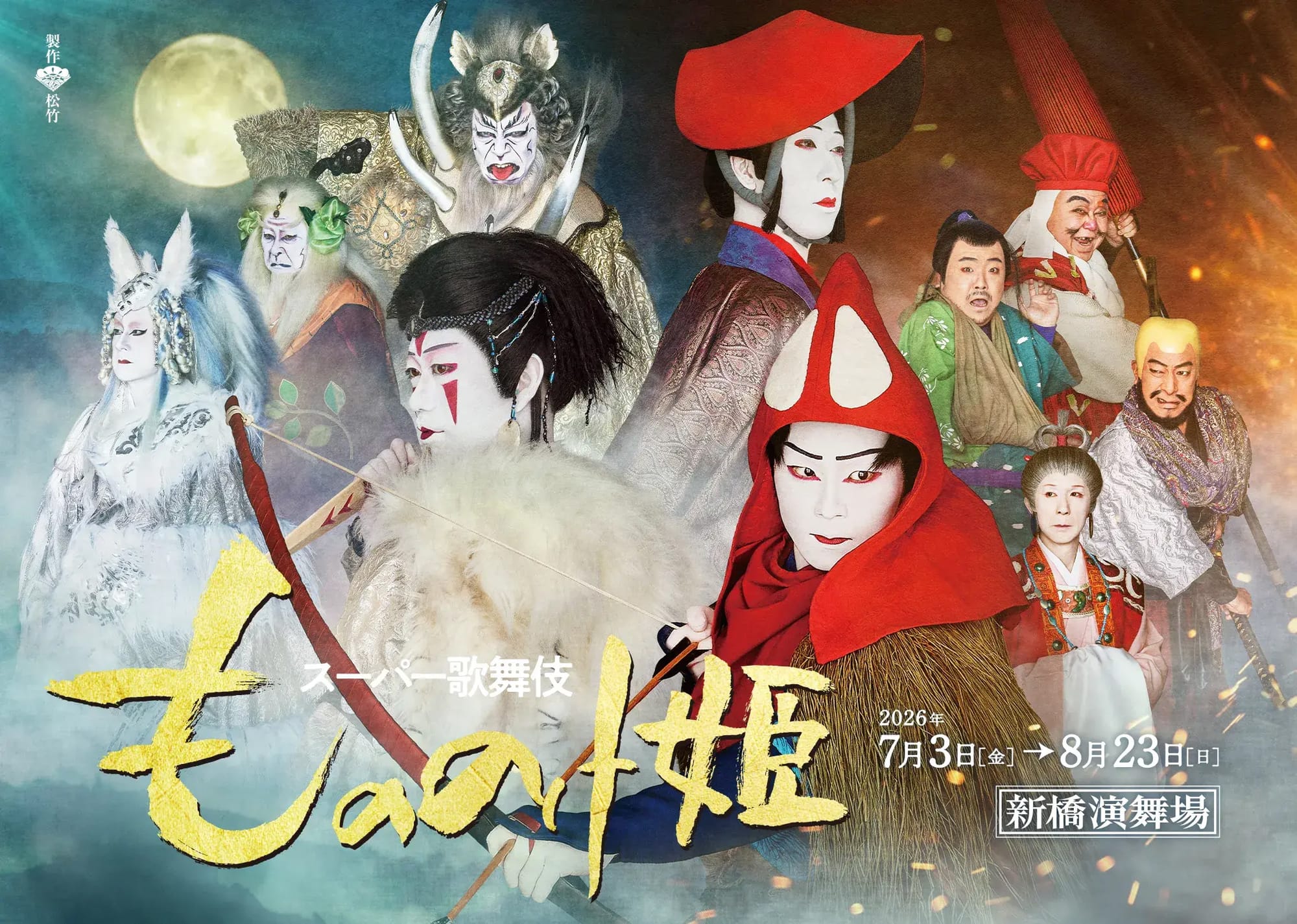
Further, the company are taking new risks with their classic IP that are genuinely-transformative interpretations of their older films. Starting in July, an all-new Super Kabuki production of Princess Mononoke will premiere, reinterpreting the story within the steeped traditions of the artform. In a press conference for the production, Suzuki admitted that they were allowing free reign to the creative team more astute to what makes a great kabuki performances to adapt their classic work as they see fit.
Princess Mononoke is perhaps emblematic of the fascinating crossroads the company finds itself at today. It’s the face of the studio, in many ways, and a key source of their expansion in many areas. It’s also distinctly in the past. Will the future of Ghibli continue to be Mononoke, proudly leveraging its kabuki, home in Ghibli Park, and merchandising, to remain one of the studio’s many icons? Or will it be joined by something new, perhaps from a new creator, perhaps from Yamashita and Goro Miyazaki, supported with the approval of its past owners and partnership with its new part-owners? The studio is at a crossroads, but perhaps the answer to the question is already coming into view.