In the mid-to-late 2000s internet, Nico Nico Douga was the center of the otaku universe. It’s the birthplace of many Japanese memes, of MAD music videos that would parody anime of the period. All because the site’s easy ability to upload and share videos with anyone made it a breeding ground and accessible entry point for a new form of online communication for a new generation. It was a place to share jokes, ideas, and to connect. This is why the site was the origin of Vocaloid culture, also: it was an easy, free way for anyone who had created music using the software to upload their results and get it in front of a public curious about this new frontier of music.
Where the world flocked to YouTube, Japan flocked to Nico Nico Douga for the same reasons with a local alternative. The internet itself was far more localized in Japan than it is today, a Galapagos Syndrome that consumed the country’s garakei phone market and much of the technological advancements of the era, isolated by technical and cultural quirks that made these options more attractive. Yet another reason for Nico Nico Douga being the early platform of choice in Japan comes from a very universal phenomenon: the trendsetters dictate the culture, and the early adopters lead the path. The online, from 2channel chat forums to other otaku circles, chose Nico Nico Douga, so by the time the general public were interested in the technology, the audience flocked to what was already popular.
Today, that has certainly shifted. YouTube successfully entered into the Japanese market through localization, strong advertising, and local outreach that supported domestic creators and encouraged celebrities and musicians to the platform. Now, if someone wants to make an online career, they dream of being a YouTuber before becoming a Nico Video personality. The limits on Nico Nico are a major factor in this, with video size limit restrictions, stream quality restrictions for non-paying users and others seen as unappealing compared to the free-for-all approach of YouTube, especially when personality-driven original content over memetic, derivative content became the default. The biggest online personalities like Hikakin could only get their start on YouTube.
Today, Nico Nico is a shell of its former self. It has under 1 million paid users, and compared to 2010 when the site boasted 40 million page views a day from its Japan-only audience, viewing figures have declined steeply. Specific subcultures still upload to the service, with most utaite and Vocaloid producers uploading their content to Nico Nico. This comes in addition to YouTube uploads that far dwarf these uploads in terms of total views, making it more a tradition and heritage than an active part of defining the culture like it once was.
Still, the site perseveres. It’s had setbacks, most notably a multi-month takedown as a result of a ransomware attack in 2024 and the temporary restriction of payment methods by Visa and Mastercard due its secondary illustration service allowing the upload of adult material. In many ways, the success of Nico Nico today is removed from its origins as a video platform and where it exists beyond video within the otaku and entertainment landscape. It may not be an online video juggernaut anymore, but it remains the trendsetter.
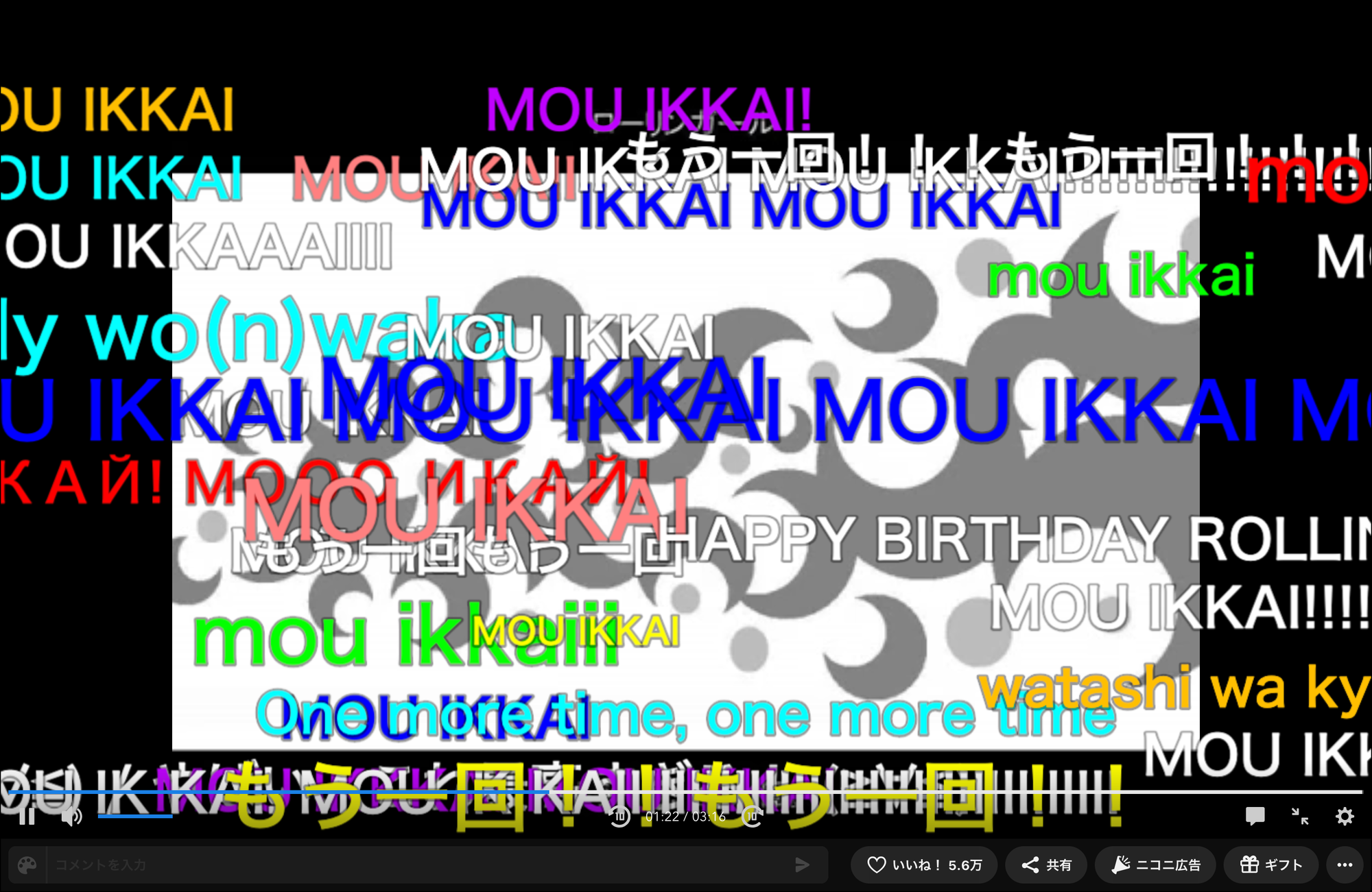
Initially, Nico Nico served the Japanese market in ways that YouTube couldn’t. Before becoming its own video site it was a hub for YouTube content that translated comments into scrolling text above the video being played. Its popularity led to YouTube blocking access, leading to the decision to relaunch as a video hosting platform offering this same sort of interactivity to the video being displayed.
At the time, YouTube was unavailable in Japanese, meaning that beyond being a method of watching content in this primitive era for online video it was a means of accessibility. There was no reason for users to make the jump to YouTube at the time when online video lacked a coherency, form, or encouraged a form of subscriber-driven loyalty that kept people aligned to a platform, when the site was not accommodating to Japanese users. Further, without smartphones being dominant, Nico Nico launched phone services that made them accessible on garakei platforms when people were on their commute, aligning themselves to Japanese lifestyles.
It made the site appealing, but its core user base remained the more online communities of the time. While Japan may have been one of the most connected countries in the world at the time, its use beyond basic functions for many remained low, while those creating and communicating on these platforms still drove what was fast becoming the early years of digital social media.
The earliest online video memes anywhere in the world trace back to the specific ways these communities structured on IRC chats, Geocities, and 2channel communicated, groups largely dominated by otaku who sought out the niche communities they couldn’t find in person. In the ways that Comiket spawned as a place for fans to share passion in a single space, these online communities offered that, and Nico Nico offered a video hosting platform to upload clips of the media and edits of the shared media they enjoyed.
The rise of the site can not be separated from the specific online cultures that spread this content in its early days. Animated MADs, videos that blended funny commercials to anime songs or just about anything, comedic animated music videos, dominated because they were immediately absurd but also recognizable. People knew Ronald McDonald and Touhou, so they could laugh.
With a site like this established and, notably, offering an online space to easily upload and share visual and audio content with others, communities beyond these that needed such a space naturally gravitated towards this. The Vocaloid community making this site their home comes as a perfect storm of timing and convenience in that sense. There was no other place for uploading video online in Japan in the late 2000s when the Hatsune Miku voicebank for Yamaha’s Vocaloid software launched, but the early producers who saw the character not just as a sample voice for composing but a singer in her own right wanted a place to create and share.
They saw Hatsune Miku, unlike any music synthesizer before, as a personality and singer in her own right, and wanted to create music for her, rather than simply using her for producing music demo as was the standard. Communities liking her character design drew fan art, but they wanted to share her music, too. Nico Nico was a natural source for that, as it allowed the easy upload of 3-4 minute videos of songs that could be easily shared.
Art and sound intertwined was key to Hatsune Miku’s identity, making online video sharing a core part of what helped the character to explode amongst otaku circles, and later the general public in the late 2000s and early 2010s. Without Nico Nico, the idea the character would be the iconic symbol she is today, a musical movement and genre in its own right commending events hosting thousands, a platform for new composers and a singer of her own, would not be possible.
When moments like these fall into place, it becomes clear that much of the Japanese entertainment landscape, so intertwined by the trailblazing of otaku communities and the online world online in the 1990s and 2000s, would be vastly different were it not for Nico Nico Douga. Legacy importance doesn’t guarantee eternal relevance, and it was Hatsune Miku herself that begun this shift.
“Tell Your World,” even almost 15 years later, remains one of the most recognizable songs from the virtual singer, even featuring in the Cosmic Princess Kaguya movie released earlier this year. What’s easy to overlook is that the song was originally produced for a Google Chrome advert, and not only promoted the service but was one of the first Vocaloid songs primarily uploaded to YouTube as it begun to expand into Japan. The song’s success brought millions of new eyes to the international video upload competitor, and it had far fewer restrictions compared to the limited uploads of Nico Nico, even before discussing the features locked behind premium subscriptions.
The decline of Nico Nico in the years that followed has been a slow but noticeable trend, as outside of core communities most have overlooked the platform. A large-scale ransomware attack that shut down the service for a whole month only hastened the decline. To call the service irrelevant would be wide of the mark, however. Even ignoring the fact that Nico Nico’s other services, from online live streaming for general users and of official broadcasts of anime and sports, alongside news services and other utilities, offer a specific use case that benefits Japanese users and is viewed as reliable by large swathes of consumers, the company maintains a relevancy by broadening the definition of what Nico Nico means to Japanese otaku.
For all the site is not seen as the primary source for video uploads, many still note and remember Nico Nico for its legacy as a Japan-specific video uploader which has undoubtedly shaped aspects of internet culture. Even younger audiences know that Japanese MADs originated on the platform, and will still upload there over YouTube due to looser copyright restrictions. Even if Nico Nico is not at the forefront of defining new trends, it is still seen as a home for fandom and a supporter of niche communities and particularly the anime and manga industry.
What this has allowed is for Nico Nico to establish itself beyond video uploading as a company supporting these communities and providing physical spaces for these fans to meet. Ikebukuro Halloween is a yearly event hosted by Nico Nico that serves as a multi-day celebration of cosplay. More than a festival for fans to cosplay and take photos, this is a celebration and a takeover of the city. When cosplay in public is frowned upon if not outright prohibited, permission is granted to cosplay across the city, with specific stores authorizing people to come and take photos in-character inside their stores.
Nico Nico Choukaigi celebrates the history of Nico Nico as a video platform, but also serves as a yearly convention for anime and otaku culture beyond the mainstream. You have major anime companies coming to promote their new anime, but space is offered to Vocaloid producers and doujin creators to sell their work, and it’s a spot for online communities to let loose. With Haruhi Suzumiya enjoying a revival in popularity to mark its 20th anniversary, this year’s event saw fans young and old come together to revive an infamous video of otaku taking over the main street of Akihabara to do the “Hare Hare Yukai” dance before being dispersed by police.
While in early days Nico Nico offered the online space that never existed for otaku to share their passion, now the role has reversed. Online spaces on social media give people more spaces than ever to share their passion, while in-person rules on gatherings in public become stricter. Instead, Nico Nico retains its online links and legacy, but maintains its relevancy by adapting this ideology to the modern era. More spaces for online denizens to find solace in-person are deeply desired by these communities, as the grand gatherings of old in places like Akihabara are no longer possible. In an ever-connected world, a chance to find real-world connection grows harder. If Nico Nico was always designed as a place to connect, moving offline maintains that mission on a new frontier.
Nico Nico Douga is declining in relevancy as a video uploader, yet endures because it continues to support the people who helped it grow in finding a space to belong. Even those audiences who didn’t exist during this peak era for the site recognize that mission and importance, and it’s the edge that allows the idea of Nico Nico to endure even as its initial mission begins to fade from view. The site is less relevant than ever, but the company has arguably never been more important. Community is a powerful thing.