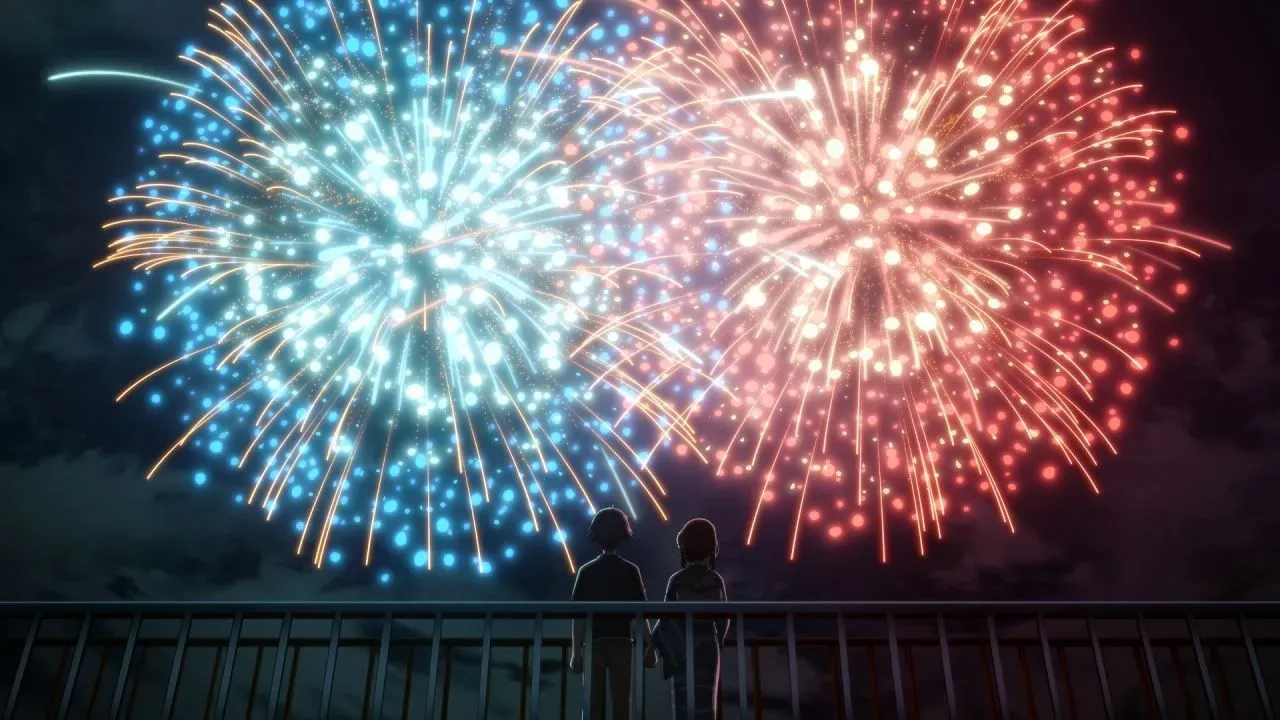
Summer in Japan is the season of fireworks festivals. Wherever you go, there’ll be some sort of fireworks show, and with them you’ll have food stalls, people and couples in yukata, and the sky illuminated in technicolor explosions viewed with awe by anyone close. They’re a thing that brings thousands of people together, united by the spectacle and beauty that comes entirely from human hands.
If you wanted to tie this back further, there’s a roundabout joy to fireworks festivals today, and what it represents historically, which is somewhat the point that You, Fireworks and Our Promise is attempting to make with its ode to the ways in which fireworks have become a symbol of hope and human connection in contrast to isolation and strife and inner pain. The problem, is that such an idea requires nuance, care, thought and intrigue in order to effectively portray, something this movie clearly lacks. Instead it feels like it knows of other stories that have executed on these ideas, and copied them without considering how it makes you feel the way it does.
Opening the film is not a shot of modern-day Tokyo, the time period our romantic couple Makoto Natsume (Shori Sato from the music group timelesz) and Aki Hayama (Nanoka Hara) live in, but the streets of Tokyo during the firebombings of World War II. As planes fly overhead and rain destruction upon the city, a young girl named Haru (Rie Takahashi) is attempting to flee the destruction. Just as it looks like she’ll be hit, we return to the modern day to meet our two leads. Makoto is a listless boy, an artist with an online following losing the motivation to paint, tracked down on his first day of high school by Aki because she loves his art. Particularly an artwork of a firework from the renowned Nagaoka Fireworks Festival.
Only, he never drew this. At least, he has no memory of it.
Romance through the memory of war has become a noted topic in Japaneze media in recent years. It’s notable, perhaps, that one of the most beloved Japanese romantic movies of recent years was one called Till We Meet Again on the Lily Hill, where a modern schoolgirl is transported to 1945 Japan and falls in love with a kamikaze pilot, with enough romantic fluff contrasting the escape from the war even as the film can’t help becoming a propagandist shell under closer scrutiny. If anything it revived interest, not just in romance but beyond, in stories linking the memory of war to the present day.
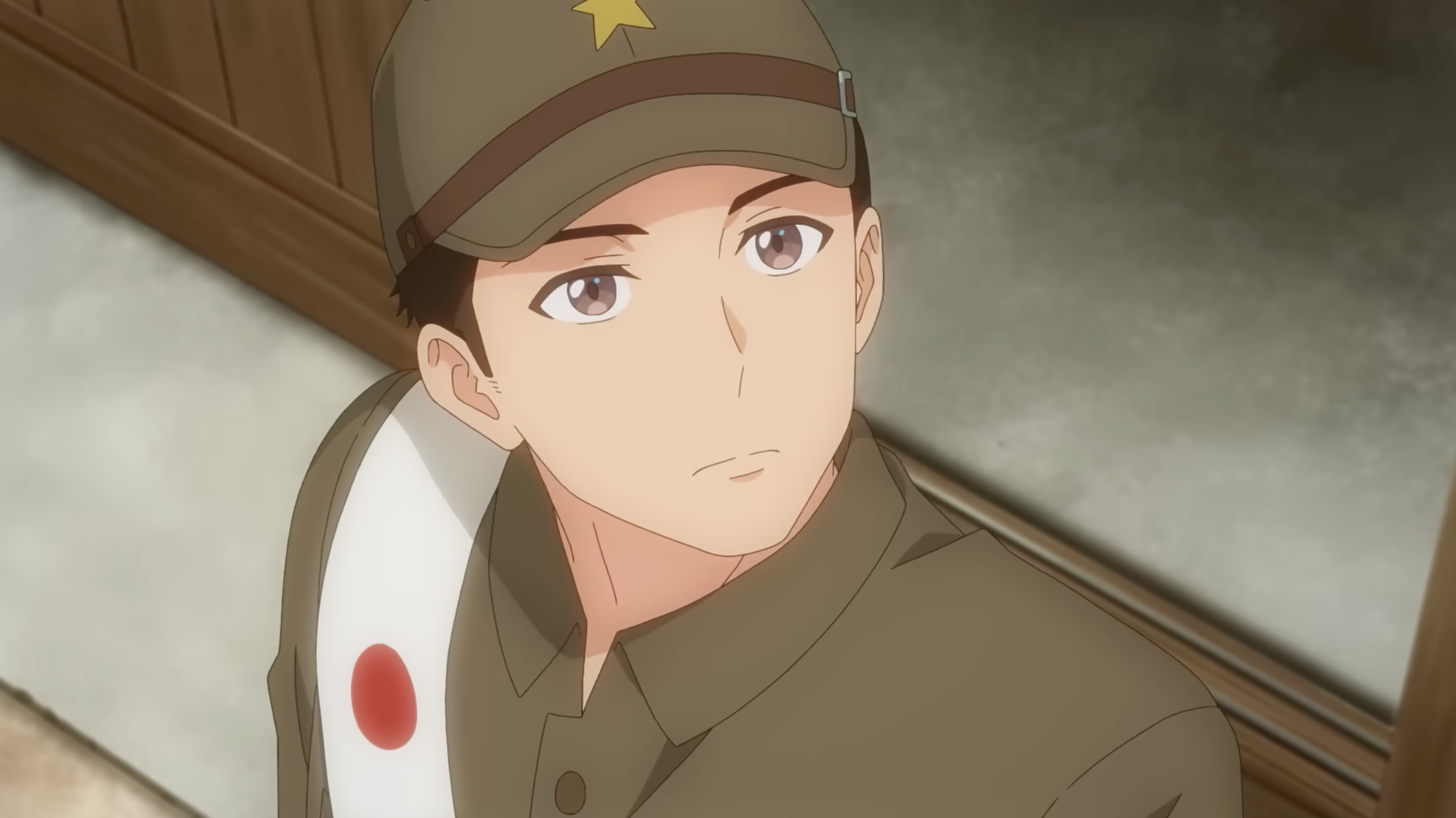
There is no attempt, however, to integrate this wartime aspect of the story into the broader narrative of these two characters, not that there’s much to latch on to with these characters in the first place. After their initial conversation confirming their unlikely connection of artist and fan, the two barely speak again in a way that would deepen their relationship. Any interaction they do have is purely to advance the narrative, with this story progression supposed to take the place of any emotional connection being built. In one scene, the unmotivated-to-draw Makoto is talking with Aki after school, going on a walk through the grounds of an old shrine. It’s unclear if it’s days or weeks or even months since they first met. The conversation leads into a request to draw art for a school festival for a cafe, which is then inspired by this.
The shrine also proves to be inspiration for a separate piece of art additionally, but there’s once again little communication between them despite the only visit to this location and its significance to this story is the pair visiting it together.
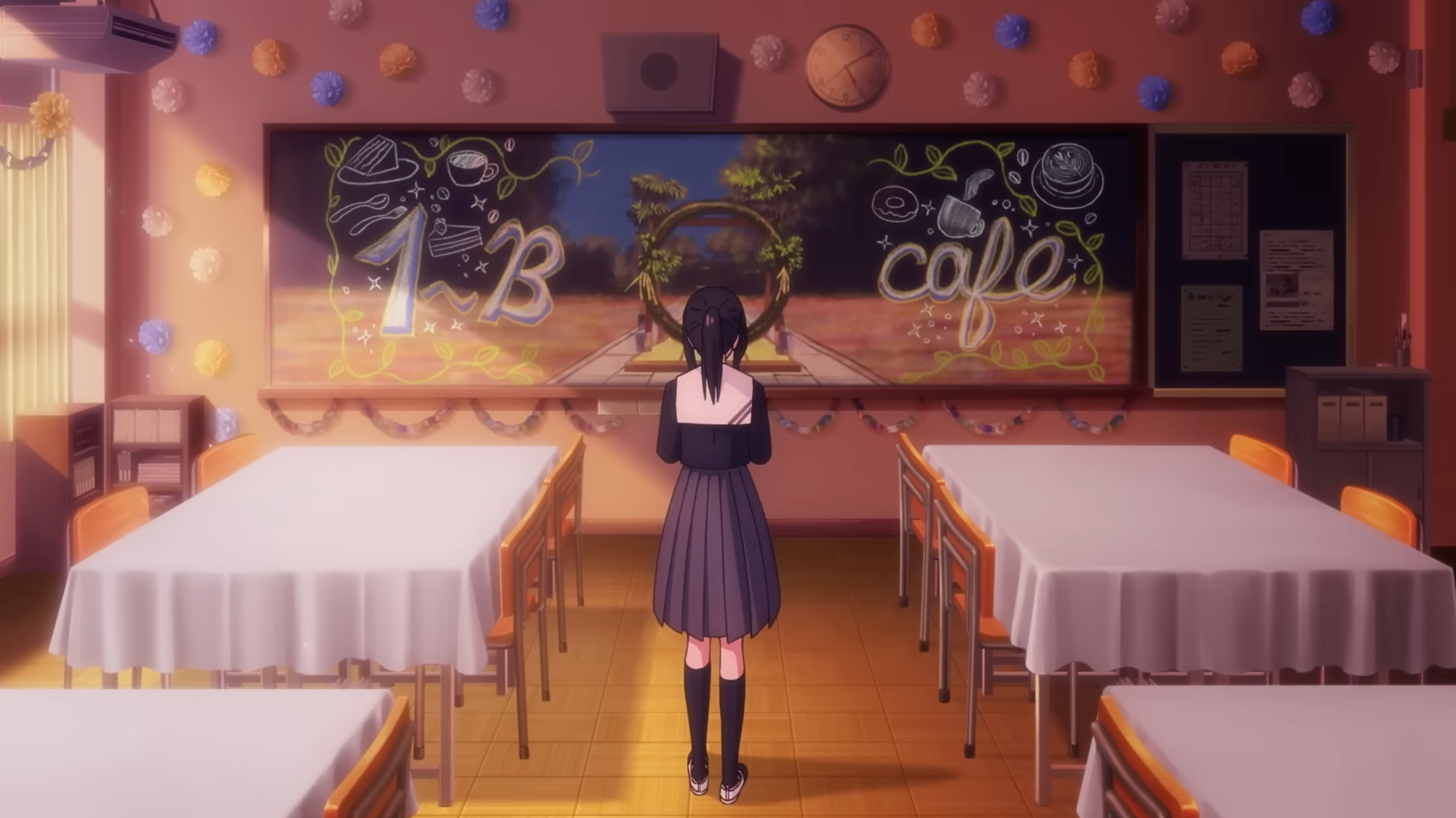
Building a connection over all these different spaces and over time is implied within the film, but never visible. We see the winter and spring school uniforms replaced for summer ones with barely any communication between them, and seem to go through a number of months of them growing close without ever getting to know either of these characters. After their first conversation, they won’t properly communicate until it is suddenly announced that she will move to Nagaoka, which is also the moment the drawing returns.
There is a fascinating crumb of an idea being toyed with in this shift in direction. After witnessing war in the opening stages, the fireworks show set to take place in Nagaoka is an antidote: explosions meant not for destruction but celebration and community and joy. A shift in humanity and connection from distrust to love represented through the decision to move on from war and into love would work wonders in this story, if we could find ways to tie it into their romance. Even this is too much to ask.
We follow Aki to Nagaoka, and then she basically never appears in the story again. She disappears after a dream sequence, and in the process Haru is transported into modern-day Nagaoka and remains present for the remainder of the runtime. Despite being a vessel to help understand their connection and to link the fireworks more directly as an antidote to the past, her character ends up more developed than Aki herself, as she enjoys more screen-time, has more conversations and chemistry with Makoto, and generally has more influence on the story as an old fireworks recipe she possesses firing twin flames that represent the connected hearts of two becomes a driving force of the latter half.
Even at this point, however, the story plays like a train of cliches rather than a narrative for which we can connect with on any deeper level. Rather than trying to bridge these timeframes, we have montages of the time-traveling girl getting used to her new world. From the opening minutes all to the end, we get glimpses of the payoff from a narrative beat without the buildup to deliver on it. When we eventually try to get that firework of love made, a true representation of how, after generations since the destructive explosion, the same tools can bring such joy, even this feels like we get the payoff without ever having the challenge of seeing it made.
I think to A New Dawn, which understood the art and memory imbued in a firework, and how that film meticulously used visuals and story to imbue what it meant before we finally saw it go off. None of that matters here. Perhaps the hope is that releasing it in summer, when everyone is taking their dates to see fireworks, that it becomes implied. But implication and a reflection in our own lives doesn’t mean seeing it on screen without meaning will register. I visited two fireworks festivals in recent weeks with friends and people I care for, and it doesn’t make it resonate for me.
It feels lazy, or worst, vapid and exploitative, hoping to get a response without putting in the effort to earn it. That spreads to animation, to voice acting, a film that in most departments feels thrown together on the idea of a story rather than a concept of one. There’s meaning to the ideas underneath here. It just never tries even once to actualize them.