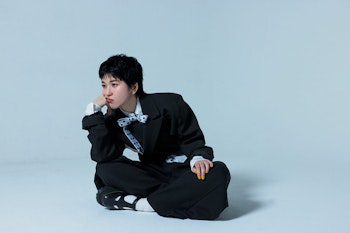
The past plays a central role in dance-pop unit Haretokidoki’s music. Yet the duo of producer Yu Fujishima (also known as brinq) and vocalist Misatsun balance one another out when it comes to how reverent for yesteryear they are.
“To be honest, I’ve gradually lost interest in a lot of current music,” Fujishima tells scrmbl over a video call in late November, eliciting a shocked “waaaaaaaa” from Misatsun. He admits he leans towards older video games and anime in his free time, albeit in a way to imagine a different future.
Misatsun, meanwhile, has become appreciative of the new, embracing the latest releases and finding their connections to the past. “I’m kind of searching from the future back into the past, while he’s searching from the past toward the future. We’re doing opposite things that meet in the middle,” she says.
It’s this dynamic that has made Haretokidoki’s recontextualization of older sounds stand out in an age of easy nostalgia plays. Formed in 2018, the pair’s early releases explored the crystalline sound of ‘80s synth-pop, emerging out of the then-booming internet styles of vaporwave and future funk. Yet rather than replicate what came before them, the project aimed to mix older sonic ideas with contemporary touches, resulting in songs shaped by a bygone time but retaining an edge for “now.”
Fujishima says it is critical for the project to always be moving ahead, and latest album Endless Destiny finds Haretokidoki expanding its inspirations. Released at the end of October, the duo’s third album draws heavily from ‘90s J-pop and Eurobeat — to the point of bringing in vocalist motsu on driving cut “PRECIOUS NIGHT” to add some Velfarre vibes to the cut. Yet despite turning to the Heisei era, the album finds them still weaving in modern pop touches while packaging it all in a sci-fi storyline involving space and time travel.
scrmbl chatted with Haretokidoki about Endless Destiny, ‘90s J-pop, XG and much more. It has been edited for length and clarity.
scrmbl: I believe this is one of the first interviews you’ve done for an English-language publication. Could you tell us how Haretokidoki came together, what it was like when you first met, and your first impressions of each other?
FUJISHIMA: To put it simply, I was scrolling through a friend’s posts on Instagram and happened to see Misatsun in one of them. I sent her a DM, and that was the start.
MISATSUN: I was already making music, and we were connected through mutual friends in the music scene. So it started as a kind of “music friends of friends” connection.
FUJISHIMA: [laughs] At the time we first met, MISATSUN was still in high school. She was 17 years old, and I was in my mid-30s. If someone you only know over the internet says, “Let’s meet up,” it sounds pretty suspicious, right? [both laugh] So when we met for the first time, it wasn’t just the two of us. Her mother came along as well. Her mom apparently thought I was pretty suspicious. [laughs] Looking back, I totally get why she’d feel that way. I’m not sure how much I should be saying this, though. I’d be happy if Misatsun could wrap this up more nicely. [laughs]
MISATSUN: If I had to sum it up, when we met face to face, we realized that our musical tastes overlapped a lot. Even though there’s a big age gap between us, we didn’t really feel it once we started talking. We bonded quickly and were able to share our vision of what we wanted to do. Thanks to that, it was easy to imagine taking this project beyond just a hobby and really debuting and working with music as our job. And on top of that, the songs he made were just really good.

You’ve been working as Haretokidoki for seven years now. How have things changed over that time, whether in your relationship with one another or the sound of the project overall?
FUJISHIMA: At the very beginning, our sound leaned pretty heavily toward an ‘80s vibe. Vaporwave and similar styles were popular at the time, and I was very conscious of internet culture. Our first song “Kiss Me” was actually written about only by you, and I was really happy about that. It’s a nostalgic memory now. It made me feel like there really are people out there in the world who can speak up on our behalf. Even in the Japanese music scene around us, there weren’t many people who could clearly articulate what we were doing.
From the beginning, my “scheme” was to start with ‘80s influences, then gradually move through different eras of music. So we’d get into the 90s, and now we’re exploring 2000s trance and Eurobeat. I wanted the sound to keep shifting over time. At first I had a strong awareness of internet culture, but lately I’ve started to feel like it’s okay to be more selfish with what we do.
The kind of music we’re making now… it feels like there really aren’t many people doing exactly this. With dance music, you’ll usually have a handful of artists in a similar lane, and that group forms a kind of movement. But with what we’re doing, I suddenly realized there aren’t many people in this era working quite like us.
In terms of sound quality, I’ve started bringing the kind of gear used in proper recording and mixing studios into my home setup. I’m trying to make music that can stand up to the songs created in studios used by the artists I admired growing up.
MISATSUN: For me, doing music beyond a “hobby” was a completely new experience. I spent a lot of these seven years answering questions like, “How do I express myself?” and “What is it that I really want to do?” There were times I wasn’t sure if I was expressing myself well. But whether it was over the ‘80s-inspired or the 2000s-style sound we’re doing now, we’ve always been upfront with each other about what we like. “This part of this song is so good,” and figuring out how to update and reinterpret that essence in our own way. So I always want to write songs that are honest about what I love.
In the past, when he brought me a song, I would just think, “Wow, he made something great again,” and didn’t really voice my own ideas. Recently though, especially with the newest releases, I listen and say things like, “I want to do something nostalgic, but I also want to add this new kind of sensibility,” or, “Right now I’m into this kind of thing and want to try it someday.” We share those updates way more often than before. He picks up what I say and weaves it into the tracks, and that makes the whole process much more fun for me.

That’s a perfect lead-in to talk about the new album, Endless Destiny. Could you walk me through how this album came together?
FUJISHIMA: It ended up taking about three years to get Endless Destiny out. We did release some of the songs that ended up on the album as singles during that time, and in addition to that we did a remix album and put out a couple cover songs, 1986 Omega Tribe’s “Kimi Wa 1000%” and Scha Dara Parr’s “Konnya Wa Boogie-Back.” But we decided to leave those off the album. Both are very popular songs within Japanese culture and are pretty well known overseas, too, but when we thought about this album as an album, we wanted its world to come first. If we were on a regular label, that probably wouldn’t fly. [laughs] They’d want us to include the hits. But once we lined the songs up, it felt right to prioritize the album’s world over putting in the “sure things.”
As for deciding to make an album, we started really moving in 2025, right?
MISATSUN: Yeah, I think so. We’d continued to put out singles and always said, “someday we’ll turn this into an album,” but we only really got things rolling at the start of this year.
FUJISHIMA: Right. There’s also something about 2025 as a number. I just really like how it looks. The year that had the biggest impact on me musically was 1995. Now it’s 30 years later. I liked the idea that someone like me, who was so influenced by the music of ’95, could make something in 2025 that mixes that feeling with something modern too. So from around spring, I started making rough ideas for album tracks.
What kind of year was 1995 for you musically? What artists, songs or genres from that time really shaped you?
FUJISHIMA: Around 1995 was when I bought my first CD. I really loved Gundam, and there was a series called Gundam Wing. Its opening theme was by an artist called Two-Mix, and that song hit me so hard that I could have watched the anime just to hear the song every week. Compared to what I thought of as “anime songs” up to then, it felt like real “artist music,” and that was really sensational for me. It was in 1995 I had that kind of experience with music and realized, “Oh, I really love music.”
What other artists or producers from the 1990s influenced you?
FUJISHIMA: I’ve been influenced heavily by Takashi Kimura, Tetsuya Komuro, Phoenix and Sakura among others, but rather than tracing their path, I really try to mix things up and hit on something only I can feel. I want to take the essence and blend it up with it together.
MISATSUN: It really depends on the song I'm making at the time. As a singer, I definitely have moments where I think, “I really like the essence of this artist, so I want to incorporate it.” That happens quite a bit. For something like Endless Destiny, I wanted to do something like Hello! Project or Utada Hikaru, so I tried singing it in my own way while incorporating their vibes, and maybe even mimicking the feel of the lyrics a bit? As for what I want to do going forward, my voice is quite... how should I put it? It's delicate, yet incredibly powerful. But I'd love to try singing powerful songs someday, like R&B or soul or something with a bit of that ‘90s Latin flavor mixed in.
Listening to Endless Destiny, I hear a lot of what I’d call 80s-inspired songs – sparkly synth-pop sounds – but also a strong Eurobeat presence and elements that remind me of 90s J-pop and 90s music in general. For both of you, what new challenges did you face on this album, especially when working with those influences?
FUJISHIMA: One big challenge was that, in Japan around 1995 another huge music trend was visual-kei. If we talk about the big names, there’s LUNA SEA, maybe GLAY in kind of a different way, and also Dir en grey, PENICILLIN, so many groups. Meanwhile, on the production side, there was Tetsuya Komuro and Daisuke Asakura, for example. Blending rock and dance music is actually pretty difficult. If you get it wrong, listeners who liked you before can end up thinking, “hmm, this isn’t it.” I’ve experienced that myself as a listener. I loved a dance-music creator, and then their next album suddenly leaned too far into rock. As a fan of their earlier stuff, I went, “ehh…” We really didn’t want that kind of reaction. So I tried to find a good balance point where visual-kei rock and dance music could coexist.
MISATSUN: For me, I really wanted people to listen to the album from track one all the way to the end. With streaming, it’s easy to just loop your favorite song over and over. But for us, the world of the album is very important. This is our third full-length album, and we’ve always cared about people listening to the whole work. On this one, the interludes between songs proved especially important. I speak a lot more on them than before, and they’re written to emphasize the story. I wrote a script and created the “hidden” setting behind the album, and I worked hard to make sure everything connects and all the songs fit together. That was the part I put the most energy into during production, so I’d be really happy if people pay attention to those interlude sections, too.
Could you give me the elevator pitch of what Endless Destiny's story is about?
MISATSUN: This is our third album, and the trio form a continuous story. The first album is Moonlight Nebula, and the second is Lost Memory. Endless Destiny continues from those. I wrote the script and built the setting with that in mind. In the story, the two of us are always traveling through space on a spaceship, gathering “lost sound sources” scattered across the universe. Music that’s been forgotten. That’s the main axis of the narrative. This time, we added a time-travel element. The story is about something that happens on a planet we go to investigate. It’s very similar to Earth but just a little bit different. We look back nostalgically on our time on Earth while experiencing the music that’s been forgotten there and wondering what will happen to the world from here. There are bright, nostalgic, and powerful parts, but I also wanted to express unsettling feelings – like the fear and uncertainty of space – through the interludes.
What is it about space and sci-fi that appeals to you so much?
MISATSUN: When we first started this project, one of the very first things we talked about was the name “Haretokidoki,” which translates as “sunny with occasional…” In Japanese, that phrase can be followed by rain, clouds, whatever. It implies that the weather could change into anything. We liked that it felt very free, like we could express anything we wanted under that name. We wanted the unit itself to be something that can expand infinitely and keep challenging new things.
That sense of “any direction is possible” overlaps a lot with the image of space for us. So we link the changing weather to the passage of time in our songs, and to our desire to constantly take on new challenges. From a conceptual point of view, that’s why space feels so attractive to us.
Endless Destiny includes quite a few guest collaborators. When you work with guests, either on this album or in general, how does your creative process change, if at all?
FUJISHIMA: It changes quite a bit. When I worked with DE DE MOUSE, for example, I wrote the melody and a rough version of the track, and then he handled the main arrangement. He also wrote the lyrics. Usually, Misatsun handles the lyrics, but I’m also fine with others handling them if they want to. If someone says, “I really want to write them,” I’m like, “Please, go ahead!”
MISATSUN: On that track, DE DE MOUSE wrote the lyrics for the first verse, and I wrote the lyrics for the second verse as a continuation. I’d never really co-written lyrics like that before, so I wasn’t sure what the best way to move forward was, and that part was a bit of a struggle. But it turned into a very fresh and fun way to work.
FUJISHIMA: When it’s just the two of us, we do everything between us, but I try not to get too hung up on process. Going forward, I’d like to hand off more of the arrangement side to other people and not be afraid to let others in.
MISATSUN: New things can be born from that.
FUJISHIMA: I like those kinds of chemical reactions – that’s part of why we ask people to do remixes, too. I like changing the way we make songs from track to track, so it might be that on the next releases we do a lot more singles emerging from different creative processes.
Now that Endless Destiny has been out for a little over a month, what’s the biggest artistic lesson each of you has taken from it?
FUJISHIMA: For me, it’s that I always push myself to the limit before a deadline. [laughs] That’s nothing new, but it hit me again this time. When I decide, “we’re releasing an album,” I want to do my best right up to the finish line. So I invested in gear that I felt was important for improving the mix and mastering quality, and I worked hard on that side of things.
But now that I listen back, there are still parts where I think, “I could have done this a little differently,” to be honest. If I get the chance, I’d actually like to remaster it someday. That said, when I look at the whole tracklist and think, “OK, this is the world of this album,” I feel like we really did manage to build that world. It took about three years, but I can feel how much I’ve grown, and how much Misatsun has grown as well.
MISATSUN: For me, in terms of new songs, we have “Endless Destiny,” “Hyper Break,” “Tropical Plan” with Yukkyun and the R&B track “Step in the rain,” among others. During production, I had more freedom than usual. There were more moments where I was asked, “what do you want to do?” and I expressed my desires more clearly. On “Tropical Plan,” for example, I was almost half-producing it. I decided on most of the structure, and even though Yukkyun also writes lyrics, I ended up writing most of them myself.
So while the base of the album is very much “Fujishima’s favorite things,” it’s also our album to date where I could most strongly express my own personality and tastes. When I listen back, I feel like our individual loves and preferences are packed into it more densely than ever, and I’m really happy about that.
Away from the album, something I think scrmbl readers will be very interested in is your connection to rhythm games, including beatmania. How did you first get involved with it, and how do you approach making songs for a game like that?
FUJISHIMA: It started through the creator kors k. We’d see each other a lot at events, and we became friends. I’d also appeared at some beatmania-related events in the past. Not under my own name, but I’d joined as an arranger. The game has always been part of my roots. Back in the ‘90s, before all the keys were even added, I was already playing it. Through those games, I learned about genres such as trance, reggae, dub, house and so much more. That was huge for me!
About five years ago, before the COVID-19 pandemic, kors k asked me, “do you want to make a track for Dance Dance Revolution?” So I made a song for DDR and thought, “OK, maybe beatmania will come next,” but the beatmania offer didn’t come right away. I kept waiting for it. [laughs] Then one day, the offer finally came from kors k. The first track I made was “Secret Rouge.” That song appears in beatmania and also in pop’n music. I’ve always loved that kind of slightly bittersweet Eurobeat, so for my first contribution I poured twenty years of feelings into it. “I’m going to throw everything I’ve got into this track.” Because songs like that are rare in the current scene, the reaction was really strong. It turned out there were a lot of players who felt the same way I did.
Haretokidoki’s music is deeply inspired by the past but you always weave that together with contemporary sounds and trends. On a personal level, what is your relationship to the past? Are you nostalgic by nature, or not really?
FUJISHIMA:For me…to be honest, I’ve gradually lost interest in a lot of current music.
MISATSUN: [shocked] Waaaaaaaaa!
FUJISHIMA: I was still following new Japanese releases up until about 2016 when bands like Suchmos were coming out. I’d listen to them and apply aspects of their arrangements to my own songs.
But beyond music…in terms of whether I’m nostalgic, I still mostly play older games. Open-world games nowadays are so long they feel like they could eat up my entire life, so I prefer old-school RPGs on the PlayStation and things like that. That scale feels just right. It’s not that “old equals bad” at all. It's more that, revisiting these games as an adult, I discover so many new things. That’s what’s fun for me now.
With current anime and games, sometimes I feel like everything is too easy to understand. I personally like works that make you think a bit, that leave some room for interpretation. That’s why I love the “mystery” in a lot of ‘90s anime. Neon Genesis Evangelion, for example. So yeah, I guess I’m the type who really respects the past.
At the same time, I feel like doing a “revival” well takes a lot of taste. So many anime and games are being remade now, but the approach to remakes often leans toward making everything match current visuals. Personally, I think there are lots of aspects that should just stay as they were. I suspect there are plenty of young people now who actually prefer older art styles rather than modern ones. So yes, I’m nostalgic, but I also feel something futuristic in the past. So instead of just “the past,” it feels more like a “nostalgic future.” That’s become one of my themes lately.
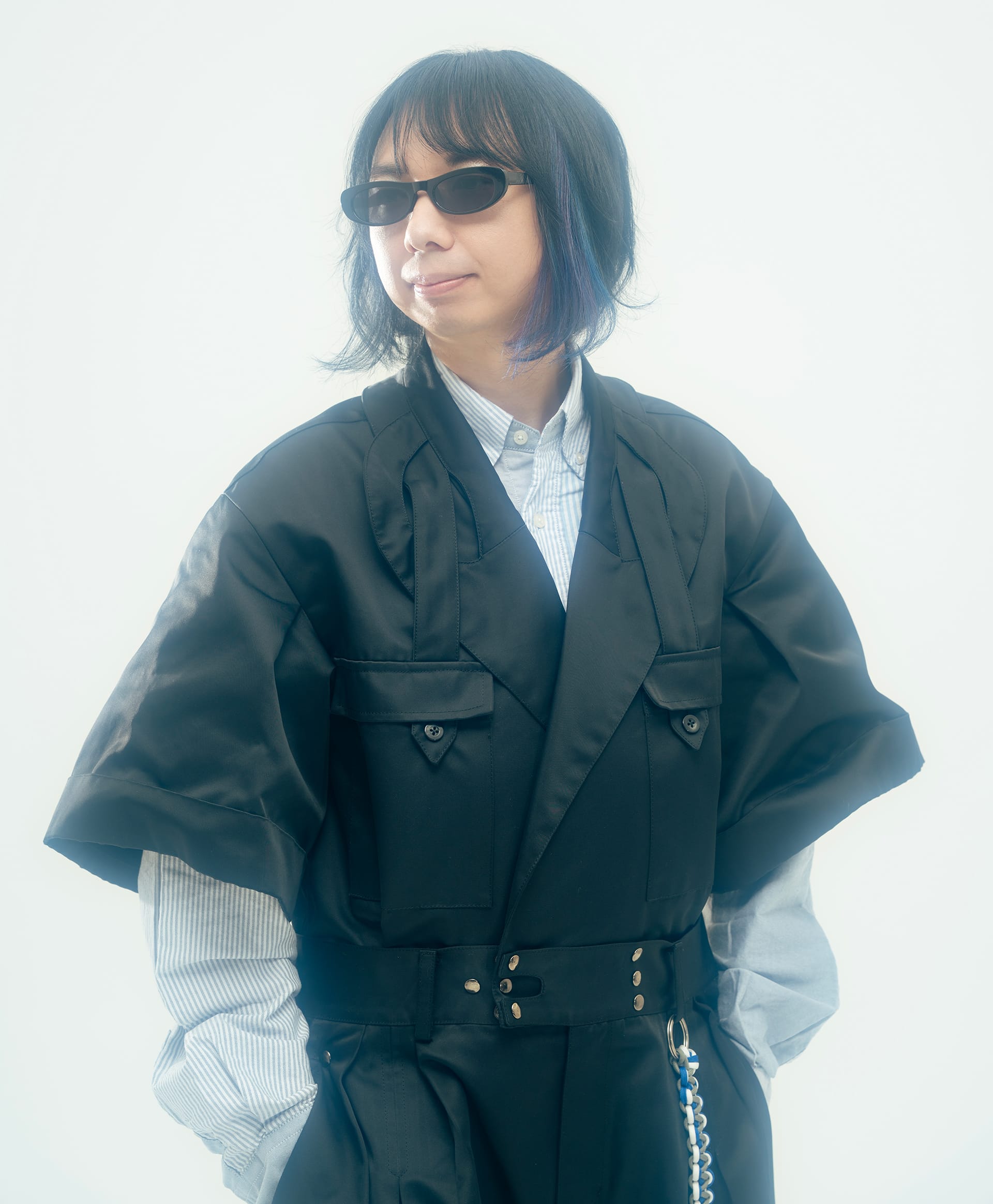
MISATSUN: As for me, I’m kind of the opposite. I’ve realized I really like new things. When we first started Haretokidoki, I’d collect tons of ‘80s idol CDs because of the whole future funk and vaporwave movement, and I’d go around visiting retro buildings, drawn to that culture. But now I love listening through the newest releases one after another and widening my musical range through that. Personality-wise I get bored easily and always want to see and enjoy something new. That’s true for clothes and stage outfits too. I just keep buying new things. So in that sense, we balance each other out.
FUJISHIMA: She dragged me out to an XG show, and as an artist I really loved it. [laughs] If she hadn’t made me go, I probably would never have understood how good they are. XG has a strong respect for older sounds and their fashion is incredible. It’s an amazing project. Among recent acts, they’ve influenced me the most. I’m grateful to Misatsun for that.
MISATSUN: I tend to discover the “past essence” in new releases, such as with XG. They build their sound with a real love for ‘90s R&B, for example. So I’m kind of searching from the future back into the past, while he’s searching from the past toward the future. We’re doing opposite things that meet in the middle.
I didn’t expect to talk so much about XG tonight, that’s a fun twist. For my last question, feel free to interpret it however you like: recently, what are you most proud of about yourselves?
FUJISHIMA: Even with all that anxiety I have, I still managed to finish the album. So honestly, I’m just really glad I’ve made it this far in life. [laughs] It sounds dramatic, but that’s how I feel. January and beyond are going to be tough too, but I’m doing my best to keep going and to be glad I’m still here.
MISATSUN: For me, Haretokidoki was the first thing I started entirely because I wanted to – something where I decided everything myself, did it the way I wanted, delivered results and shared it with people. Looking back over these seven years, I feel like I’ve made so many choices on my own. Releasing this album really drove that home.
I’m the type who doesn’t agonize much. I make decisions quickly, but when I look at where I’ve ended up, I feel like all the choices I’ve made have led somewhere really good and helped build up my confidence. Of course, I’m very grateful to my partner in this as well.
So every day I live with this feeling of, “Thank you, past me, for making the choices that let Haretokidoki continue and allowed us to keep delivering music to people.”