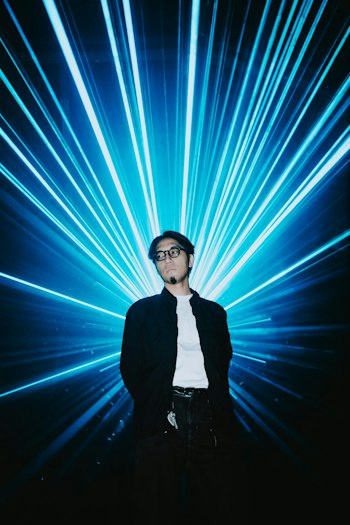
Duran is used to playing live. Since the mid Aughts, he’s been playing in rock outfits such as Rootless and a flood of circle, sharpening his guitar chops at gigs across Japan. He’s also become an in-demand player for countless names, including Koshi Inaba, Shikao Suga, Fujii Kaze, and Vaundy.
Still, even with all that experience, deciding to record his latest album under the name DURAN (joined by others to form a band) completely live in one take with no edits afterward seems daunting. Yet for Duran, it was an essential move.
“Live recording brings out more of the human feel,” he tells scrmbl. “These days, you can do anything with technology, you know. And I think that kind of music is great too. But the music I grew up listening to was full of things that could only be born from people playing together in the same room. Those little miracles, impulses, moments you can’t plan.”
For latest album Vornak, released in late November 2025, Duran along with drummer Shiho and bassist MASAE set up shop in his mom’s bar Maman in Yamanashi Prefecture. There they recorded a rollicking set of garage rock cuts straight to tape, capturing a raw sound adding extra energy to his original songs and a cover of Kanye West’s “Black Skinhead.”
Once a solo project, Vornak signaled the transformation of Duran into a band project, and one tapping in to the live energy so central to rock. scrmbl caught up with Duran to talk about the album, playing live and much more. It has been edited for length and clarity.
scrmbl: What was your first experience encountering live music? What about it left a mark on you?
DURAN: The first live show I ever saw was probably my dad’s band. He was playing bass and singing, and it was a trio with keyboards and drums. I was really young, so I don’t remember it clearly, but still…
The show that really shocked me was my tutor’s band. I was in my first year of junior high, and my tutor was a college student. He had a band, and I went to see them at a live house. It was my first time ever going to a live venue, and honestly, everything about it blew my mind.
When was the first time you ever played in front of other people? How was that experience?
The first time I played in front of people myself was probably at a Battle of the Bands in the Philippines. I think we played covers of ’90s bands. I was around 14. I dyed my hair bright red [laughs]. I had just moved from Japan to the Philippines. I didn’t know the language and didn’t really have friends yet, but after that show, the way people looked at me completely changed. That was the moment I realized how powerful music really is.

What made you want to present DURAN the project as a band for Vornak? Why not approach it solo as you've done in the past?
I’ve been in a lot of bands over the years, and in 2018 I started working as a solo artist. Since then, I’ve been playing with the same members: Shiho on drums and MASAE on bass. I’d already played in a band with Shiho before that, and for all of us, it’s always felt like a band, not just a solo project. So for us, nothing has really changed. But Atsuo from Boris once told me that it might be better to present DURAN more clearly to the outside as a band. I guess because my support work tends to stand out, I wanted my activities as DURAN to be seen as something separate from that — its own artist project.
So why record the album itself live?
Live recording brings out more of the human feel. These days, you can do anything with technology, you know. And I think that kind of music is great too. But the music I grew up listening to was full of things that could only be born from people playing together in the same room. Those little miracles, impulses, moments you can’t plan. That’s what I want to capture.
What is your relationship to modern recording technology? What do you think is lost when artists have so much space to adjust and fix sound after recording?
There’s music that can only exist through technology, and I think that’s totally valid in its own way. It’s just that the kind of music I want to make can’t be created like that. What gets lost through technology, I think, is the performer’s soul, identity and individuality. If everything can be fixed or shaped afterward, then it doesn’t really matter who played it anymore. It’s the same with social media. Everything is processed and polished. You start getting brainwashed into thinking everything has to be perfect. A lot of music today feels like that too. Originally, recording wasn’t about perfection. It was about capturing something that could only exist in that moment — the story. That’s why old records are so amazing. Even if the playing is a little rough, that’s not the point. You can hear the musicians’ breathing, their background, even the atmosphere of that time.

What are your memories of the actual recording of Vornak?
The recording was amazing. We brought microphones, recording gear and instruments into the live bar my mom runs. I only came in with a few rough guitar riffs and ideas, and then we just jammed freely and recorded everything as it happened. We were completely going for it, so honestly, all I remember is how much fun it was the whole time.
While recorded live, I wanted to get a sense of how you approached the songwriting before. What was on your mind while working on the music and lyrics for Vornak?
We didn’t make demos or anything like that. I just brought in a few rough ideas, and we started jamming together and recorded everything straight off the floor while the momentum was there. Rock music doesn’t really benefit from over-arranging or overthinking things anyway. You’ve got to protect that initial impulse. A lot of the lyrics came to me right there on the spot too. We were writing the music and the lyrics while recording, and everything came together insanely fast. I guess I had a lot built up inside hahaha. For some songs, I wrote the lyrics by stepping into the shoes of characters from movies I love. “Goose Egg” was inspired by Eraserhead, and “Chevy Malibu 1984” was inspired by Repo Man.
Why did you decide to cover Kanye West's "Black Skinhead?" I'm curious if you were worried anyone would take it the wrong way, or be put off given how Kanye has become pretty controversial over the last year.
I wasn’t really worried about that. An artist’s work isn’t guilty because of who they are as a person. I’ve always loved Yeezus. I listened to it a lot, and it genuinely shocked me when it came out. Whatever is going on in someone’s private life is their own business. To stop engaging with an artist’s work, or to dismiss it entirely because of that, honestly feels stranger to me. In Japan especially, I see this kind of reaction a lot — like movies becoming untouchable just because an actor had an affair. I don’t really understand that. Someone’s private life has nothing to do with the power of the work itself.
As for “Black Skinhead,” I did hesitate at first because I’m not Black, and I was conscious of that. But what really drew me to the song was its force. That feeling of trying to smash through the environment you’re trapped in, the walls that surround you. That energy spoke to me very deeply. I’d been thinking for a long time that I wanted to take it on someday, and this time I decided to go for it.
What's the biggest lesson you've learned from creating this album?
Satisfaction is the end.
Since the year is coming to a close...outside of the album, what were some of your favorite memories of 2025? Why was that?
Hmm… yeah, I’d say live shows. In 2025 I got to play so many different stages. From big international festivals to tiny bars. Every single one of them was amazing.
Last, what are your New Year's resolutions for 2026?
It’s not really commercial music like mine, but I think there are definitely people who’ll connect with it. So I just want to aim for that and hit them right where it counts. Things are slowly getting better environment-wise too. The tour is still going, and we’ve already got tours lined up in the Philippines and Thailand as well. I want to keep sharpening my “craft” as a rock musician even more.