The World Cup may have ended in disappointment for Japan, but this past weekend saw the opening matches of the new J-League season, relaunched as a summer-starting football league aligned to the rest of the world. Thanks to that, soccer fever is still in the air, and even the movies are getting in on the act, as a live-action adaptation of the Blue Lock franchise hits Japanese theaters.
What’s made the series such a fascination ever since its initial debut in the pages of Weekly Shonen Magazine in 2018 is just how much of a departure it is thematically from most other sports stories. Especially for sports like soccer, but also for volleyball (Haikyuu), basketball (Slam Dunk), or even other soccer franchise (Giant Killing, Captain Tsubasa), the emphasis is on the team. It’s a sport where you can’t find victory solo, it’s 11 v 11 where every player has their own role to play in order to secure victory. And to work together requires training and camaraderie beyond the match itself, giving plenty of space for character relationships to form and for a series to center on personal growth through the metaphor of competition.
That’s where Blue Lock begins to differ, but is also a major factor in its success even beyond fans of the sport or typical sports readers. Japanese soccer is in crisis, as there’s no belief or push to create the team who can find victory on the world stage. That’s when the proposal is put forward: the team is merely too nice. Respect and a lack of aggression and greed, a lack of ego, is to blame for the absence of a world-class striker who could elevate the team to the next level, and bridge the gap between victory and defeat. Thus, what Japan needs to build is not teamwork, but greed. Ego.
The Blue Lock initiative is born of precisely this idea, bringing together the best strikers from across the country to compete to become the best. They can immediately go into national team considerations, the others will probably never play for the national team in their life. High risk, high reward. Everything is designed to rank strikers against one another.
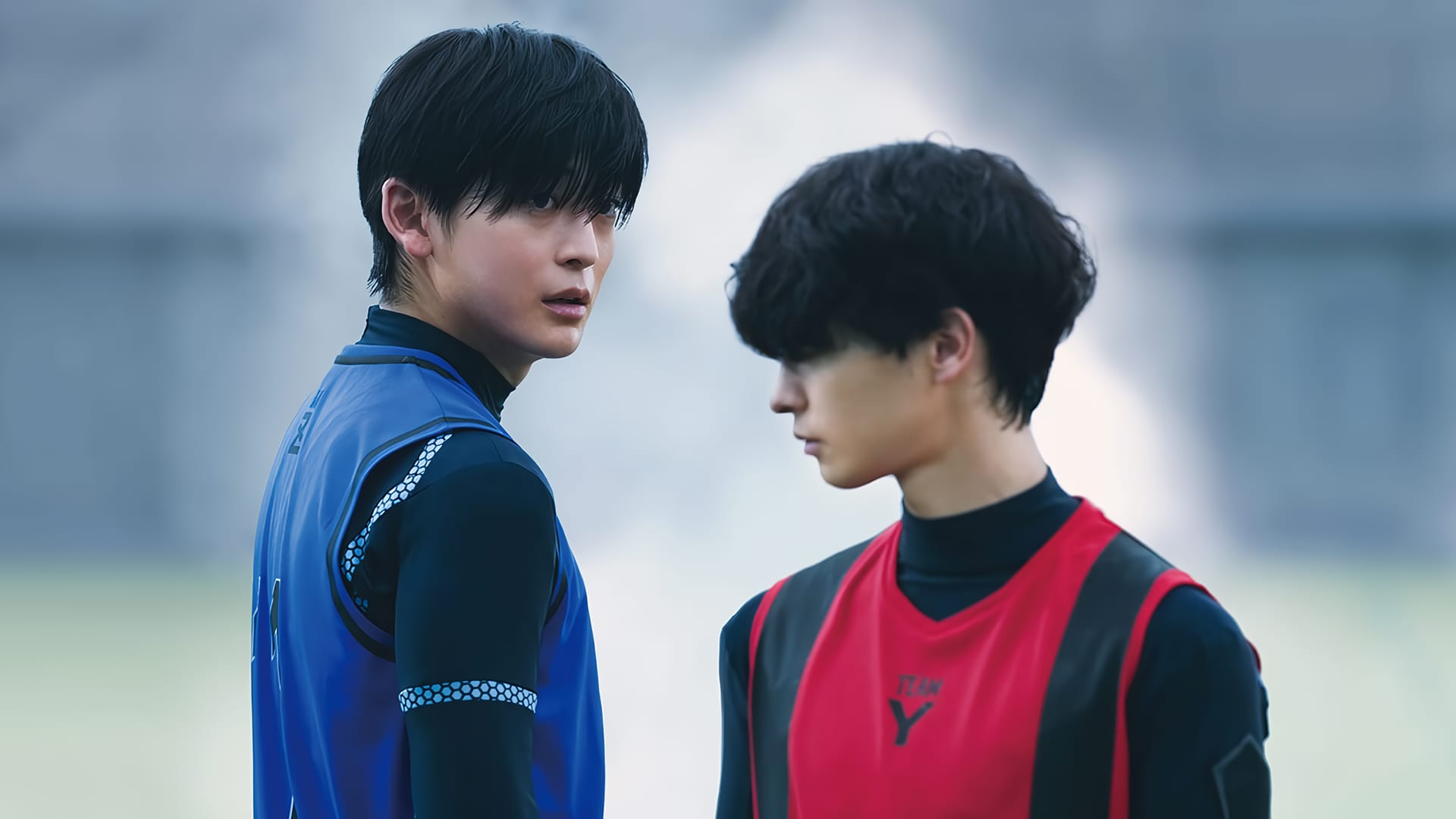
Yoichi Isagi (portrayed in live action by Fumiya Takahashi) is chosen personally by Jinpachi Ego (Masataka Kubota) despite his team not qualifying for nationals alongside 300 strikers for the competition, with each group being placed into rooms of 12 for the first test: last person to touch the ball in 3 minutes immediately goes home. After that, the eleven strikers form a team, all wanting to score and prove themselves above the others but forced to still work together to not get knocked out in a group-stage tournament of near-ranked teams. This is the start of their Blue Lock journey, where the skills and personalities of each player, and what makes them unique above the rest, is tested.
It’s a fascinating concept, challenging but not outright denying the concept of teamwork and greatness that instantly sets it apart from any competition. Like any sports manga, however, adaptation is always challenging. In animation, the fluidity of sports can be difficult to recreate, something the anime gets around by focusing on monologue and correctly portraying key scenes. It’s arguably harder to bring it to life in live-action. There’s a visual language fans who have watched sports on TV are used to that simply doesn’t work for a film, while the emotional connection between fan and team is tested more when real people, not characters, are on screen. Sport is built on narratives, rivalries, teams, sometimes over years. How does a movie do that in just two hours?
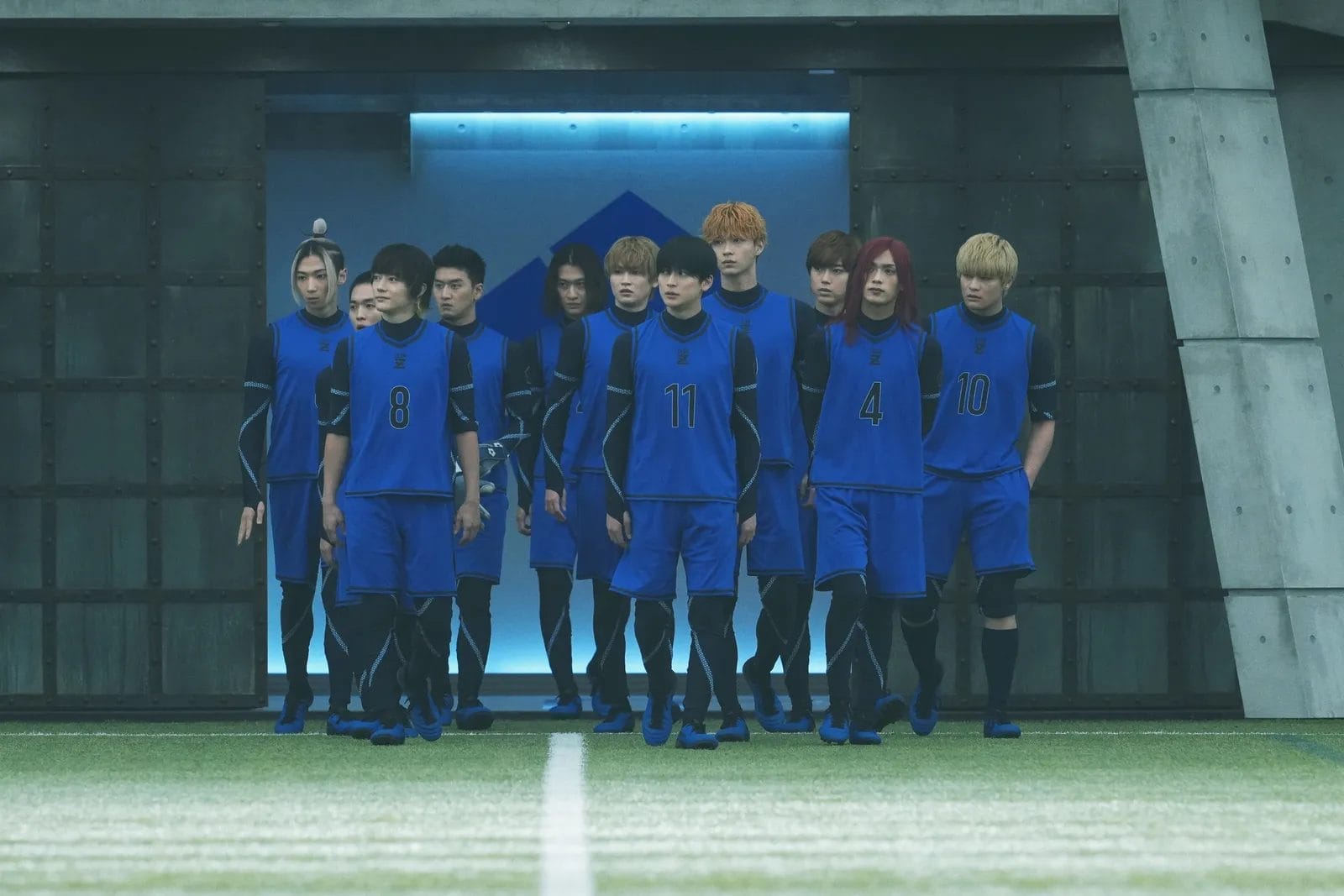
Despite these obstacles, it has to be said that the right blend of over-the-top fantasy to remove the series from a sports mindset, while still ultimately capturing the pace and energy of real football, helps Blue Lock to soar. Opening on a intra-school match where the decision to pass to a teammate at a key moment, technically the best play when that player had an easier opportunity for a goal, rather than shooting themselves, only for that player to miss and cost them the game, immediately sets the core philosophy in a way anyone can understand. A non-sportsperson recognizes defeat, while a soccer person recognizes the unique frustration of such a cruelly-missed opportunity. Crucially, it bridges the gap on prior connection to the player and team through the emotional relatability and the boots-on-the-ground camera angles that suck you into the match by being so close to it.
By the time we enter the Blue Lock training camp, we already care for the stakes of a new striker, and have even bought into the idea of era as a sporting necessity for victory. Rather than entirely turn to nihilism, however, the rest of the film, centered just on the team Z participants Isagi has been placed within, tries to see if some sort of balance can be found between ego and team that elevates beyond. The rules of the system demand ego - your rewards for meals and facilities are based on you yourself scoring, removed from team performance. Yet the best chance for you, and your teammates, to score can only come from finding a balance.
This tug, this push and pull, is the heart of what makes the film tick. Takahashi as Isagi has just enough hunger and naïveté to be someone to root for and believable, while for all they lack screentime, Kubota’s performance is perhaps most indicative and the best in the film. Mostly he appears simply to react to the matches, but finds a teasing joy at the transformation his hand-picked striker from the 300 has found this unique intersection in his stated request (ego) and something that elevates that to the next level. All he gives is a smirk or a sly comment, an emotion hidden under layers of outward demands and coldness, but it’s all you need, like you’re seeking his approval for supporting Isagi as much as the player himself.
The tactics and energy of matches are punched up by a heavy rock soundtrack and repeated motifs from insert songs by J-pop star Ado, whose new song “Monstro” and World Cup support tune for Adidas, “Kira,” are used numerous times throughout the film at key goalside moments and matches to give an extra oomph to every kick. Rarely does an adaptation like this match its soundtrack and overall soundscape as well, but it’s necessary to bridge the impossible gap of caring for a team of match that doesn’t exist.
Far from just an adaptation for fans, Blue Lock creates an all-round great sports movie, a challenge few can accomplish. Where it falls short is lacking a true conclusion due to the nature of the source material, merely concluding the groups before setting the stage for what will inevitably be a sequel. This film does what matters the most, though, and made me a fan of the team if follows. I’m ready for the next match, and ready to support Team Z as far as they can take it.